US strikes Iran again as conflict widens across Middle East
Published in News & Features
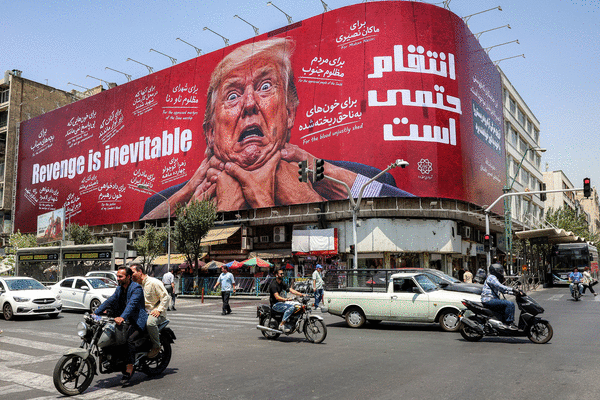
The U.S. and Iran exchanged airstrikes as fighting in the five-month war flared up once again, with hostilities now spreading across the Middle East.
Washington hit dozens of Iranian military targets in an early Thursday operation aimed at degrading Tehran’s ability to threaten U.S. troops, its Arab allies and commercial shipping in the region, U.S. Central Command said in a post on X.
Iran’s Islamic Revolutionary Guard Corps targeted air bases in Jordan and Kuwait, according to statements on Telegram, saying the former was a response to U.S. strikes on residential areas of the Islamic Republic. The Kuwait Army said Iran targeted a building in the north of the country, killing one worker and causing “significant” material damage.
Two liquefied natural gas vessels at an Egyptian port on the Mediterranean Sea were struck in a drone attack on Wednesday, according to the North African nation’s Cabinet, causing fires but no injuries. No party has yet claimed responsibility.
The tanker strikes were the first in Egyptian waters since the U.S.-Israeli war on Iran began just over five months ago. For much of the conflict, Iran’s retaliation has centered on Arab states in the Persian Gulf and Jordan.
Saudi Arabia and Iraq have now been drawn further into the fray, with Riyadh this week joining the U.S. in attacking Iran-backed militias in Iraq in response to attacks on Saudi oil facilities.
Houthi militants in Yemen, who are also sponsored by Tehran, have attacked Saudi vessels in the Red Sea after announcing a blockade targeting the kingdom.
The U.S. and Iran had paused an exchange of strikes at the end of last week to give diplomacy a chance to end the war. That lull ended Tuesday night when Tehran carried out what U.S. President Donald Trump called a surprise attack, firing multiple ballistic missiles at an American military base in Jordan. The assault sent oil prices soaring.
“We’re going to be hitting them very hard because it’s our turn to hit them,” Trump told reporters at the White House on Wednesday, two days after playing down the prospect of a renewed escalation. “They know what’s coming.”
There was no indication the latest U.S. attacks had targeted civilian infrastructure that would signal a major expansion of the military campaign. Trump has regularly threatened to strike Iranian bridges and power plants to force the Islamic Republic into a new peace agreement.
Oil prices steadied on Thursday, with benchmark Brent crude trading at about $90 a barrel after surging 8% in the previous session.
Energy prices have been advancing since the latest round of hostilities got underway this week, just days after a pause in about two weeks of tit-for-tat strikes. That came after the collapse of a ceasefire and an end of formal talks aimed at building on an interim peace agreement signed in June, which is now effectively obsolete.
Negotiations between the U.S. and Iran are “ongoing” to restore stability, particularly in the Strait of Hormuz, Pakistan’s Foreign Ministry spokesperson Tahir Andrabi said in Islamabad, without giving details.
Trump has repeatedly said the U.S. and Iran were close to reaching a deal, even as Tehran denied it was engaged in active talks with Washington. Major differences remain, with Iran refusing to meet U.S. demands to ensure commercial shipping through the strategic Strait of Hormuz remains uninterrupted.
A prolonged conflict poses political risks for the U.S. president, whose Republican Party faces an uphill fight to retain control of Congress in the November midterm elections. Those will largely hinge on the economy, with voters giving Trump poor marks on his handling of the issue.
The war has brought a sharp increase in U.S. gasoline prices as shipping through Hormuz came to a standstill, reducing supplies of oil and LNG. The strait remains largely closed with few ships passing through.
The protracted nature of the war and shuttering of Hormuz is also weighing on Saudi Arabia, which saw its economy contract the most since the Covid-19 pandemic in the second quarter. The slump was driven by an 24.7% decline in the oil sector, versus 2.9% growth in the first quarter.
Qatar, meanwhile, has sent its first LNG shipment through the strait since one of its tankers was attacked in the waterway about three weeks ago. The move indicates that QatarEnergy may be resuming shipments through the strait after pausing them when the Al Rekayyat gas carrier was struck July 7.
Pakistan negotiated with Iran to secure safe passage for the Al Areesh, which had been idling in the Persian Gulf since picking up a shipment from the Ras Laffan export facility in early July, according to people with knowledge of the matter. The South Asian nation has been seeking to use its diplomatic ties to ease a deepening energy crunch.
The U.S. continues to enforce a blockade against Iran, which is primarily aimed at preventing the Islamic Republic from exporting oil and products.
—With assistance from Mirette Magdy, Salma El Wardany, Patrick Sykes, Jen Judson, Moira Warburton and Carla Canivete.
©2026 Bloomberg L.P. Visit bloomberg.com. Distributed by Tribune Content Agency, LLC.






Comments