What makes muscles contract? A physiologist explains how muscles move
Published in News & Features


Curious Kids is a series for children of all ages. If you have a question you’d like an expert to answer, send it to CuriousKidsUS@theconversation.com.
What makes the cells of the muscles contract? – Samarth, age 13, India
Muscles are amazing. They’re what let you strum a guitar, kick a soccer ball and high-five your friends. When you decide to move, your brain tells your muscles what to do, and they spring into action. But what is actually happening inside your muscles to make that happen?
To answer that question, you first need to understand how your muscles are put together.
Every muscle in your body is an organ, and just like every other organ, muscles are made of cells. Muscle cells, called muscle fibers, are shaped a little differently than most other cells. Muscle fibers are long and ropelike. They can stretch and shorten, kind of like a bungee cord.
Each muscle contains a bunch of these fibers all lined up together, side by side, like a bag of dry spaghetti noodles. Some muscles are made of hundreds of thousands of fibers.
The muscles that you use to move your body are called skeletal muscles because they move your bones. Each muscle is attached to bones by tendons. When a muscle shortens, it tugs on the tendon, which pulls on the bone, allowing you to move.
Your cells are filled with molecular machines made out of proteins. They help your cells do their jobs.
Actin and myosin are two proteins that are super important for muscle fibers. Actin is like a microscopic rope, and myosin is like a microscopic hand. When millions of tiny myosin hands grab onto actin ropes and pull at the same time, the muscle fiber gets shorter. Scientists say the muscle is contracting.
Notice that the tiny hands can only pull on the ropes. They never push. That is why muscles can only pull.
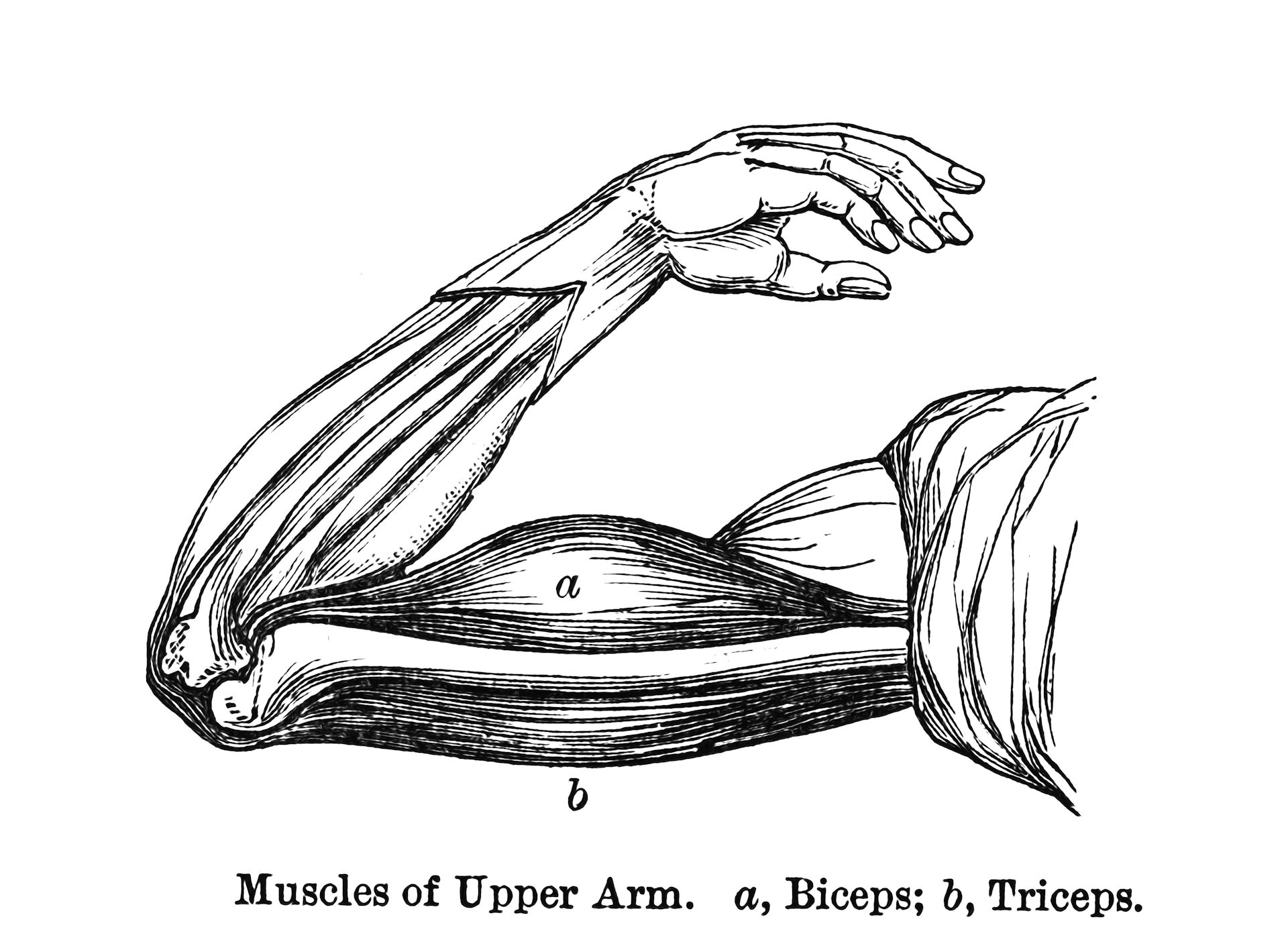
See for yourself. Go ahead and bend your elbow. That muscle on the inside of your upper arm is called your biceps. When it gets shorter, it pulls to bend your arm. Now straighten your arm out. That muscle on the back of your arm is called your triceps, and it is pulling to straighten your arm. No pushing necessary.
That’s how muscles create movement, but those tiny myosin hands aren’t pulling all the time. What tells them when to pull? The answer is your brain.
Your brain and muscles communicate using electricity. When you decide to move, your brain generates an electrical signal it sends to your muscles. To reach your muscles, the signal travels down your spinal cord, then along nerves that connect to your muscle fibers.
These signals travel at speeds of over 200 miles per hour. They reach the muscles so quickly that movement feels almost immediate. Luckily, for common movements like walking or writing, the brain sends these signals automatically so you don’t need to think about them.
When an electrical signal reaches the muscle fibers, it tells tiny sacs full of calcium to open. When calcium is stuck in these sacs, the myosin hands cannot get ahold of the actin ropes. But when the calcium is released, it acts like a key and unblocks the actin ropes so the myosin hands can grab on.
Scientists call this calcium storage system the sarcoplasmic reticulum.
Once calcium lets the myosin hands grab the actin ropes, they still need energy to pull. That energy comes from a special cellular fuel called ATP. ATP is the main source of energy for all of the cells in your body. Your body uses the food you eat to make ATP, and ATP helps power your proteins so that cells can do their jobs.
So, what makes muscles contract? It takes an entire team of electricity, calcium, ATP and proteins all working together.
First, your brain sends an electrical signal to your muscle fibers. This causes calcium to be released in those fibers. Calcium lets myosin proteins grab onto actin proteins. ATP provides the energy for myosin to pull. When millions of tiny pulls happen at the same time, your muscle shortens and creates movement.
Next time you wave to a friend or scroll to another Curious Kids article, you’ll know that thousands of muscle fibers and millions of microscopic proteins are working together to make it happen.
Hello, curious kids! Do you have a question you’d like an expert to answer? Ask an adult to send your question to CuriousKidsUS@theconversation.com. Please tell us your name, age and the city where you live.
And since curiosity has no age limit – adults, let us know what you’re wondering, too. We won’t be able to answer every question, but we will do our best.
This article is republished from The Conversation, a nonprofit, independent news organization bringing you facts and trustworthy analysis to help you make sense of our complex world. It was written by: Kiki Crawford, USC Dornsife College of Letters, Arts and Sciences
Read more:
50‑year‑old muscles just can’t grow big like they used to – the biology of how muscles change with age
What are muscle knots? An exercise physiologist explains what those tight little lumps are and how to get rid of them
What causes muscle cramps during exercise? Athletes and coaches may want to look at the playing surface
Kiki Crawford does not work for, consult, own shares in or receive funding from any company or organization that would benefit from this article, and has disclosed no relevant affiliations beyond their academic appointment.






Comments