Trump threatens more attacks on Iran after Houthis join war
Published in News & Features
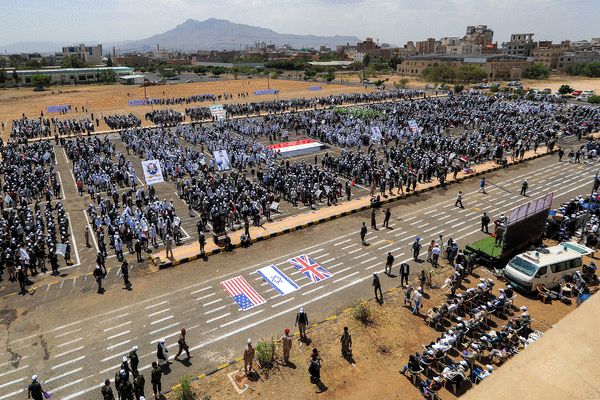
WASHINGTON — President Donald Trump threatened to step up strikes on Iran and said he’ll hold the country responsible for any further attacks by the Yemen-based Houthis on Red Sea ships, as the widening Middle East war puts new strain on global energy supplies.
Trump told Axios in an interview that he’s considering a “massive attack” and is “close to making a decision” on it, the news agency reported. The president also posted that the U.S. will inflict “major military punishment” on both Iran and the Houthis in the event of more strikes on shipping from Yemen.
The group earlier claimed it hit two Saudi Arabian oil tankers, opening a new front in the conflict that’s rattled commodity and bond markets. Brent crude climbed above $100 a barrel on Thursday for the first time in almost two months.
The war that began when the U.S. and Israel attacked Iran in February is in a new phase of escalation after the effective collapse of a truce signed last month. While hostilities remain less intense than they were at the conflict’s height, they’re ratcheting back up after 12 straight days of tit-for-tat strikes as both sides vow to match any move by the other.
Iran warned it will retaliate against infrastructure in the region, including energy facilities, if Trump follows through on his threat earlier this week to destroy one bridge or power plant each time Tehran shoots at vessels in the Strait of Hormuz.
Traffic through the crucial waterway, which before the war carried about one-fifth of global energy supplies, has slowed to a trickle. Now Houthi involvement in the conflict threatens to close another maritime chokepoint. Some vessels are already avoiding the Bab el-Mandeb strait at the mouth of the Red Sea.
“Tehran and the Houthis are showing they still have room to climb on the escalation ladder,” Dina Esfandiary and Becca Wasser wrote for Bloomberg Economics. “But as escalation creep settles in, finding an off-ramp becomes harder.”
Both sides have been dismissive of a near-term return to the negotiating table, even as the risks to energy markets and the world economy mount.
“As long as the United States fails to understand that the only way forward is to respect the Iranian people and Iran’s national interests, there is no prospect of progress on this front,” Iranian Foreign Minister Abbas Araghchi told state TV.
Trump last month cited the risk of a global economic crash as a key reason why he agreed to a truce. But he said on Thursday that Iran is “not ready yet” for a deal and signaled U.S. attacks will continue. “They need more of the same,” he said.
The recent escalation has seen the U.S. bombing Iran for 12 consecutive days, saying it’s targeting missile and air-defense facilities. Iranian state TV reported an attack last night on the passenger terminal at the Shalamcheh border crossing with Iraq, killing two people. Iran has fired at U.S. bases and military sites in Kuwait and Jordan.
The U.S. president faces some political pressure ahead of midterm elections in November when his Republicans face a struggle to retain control of Congress. Polls show the war isn’t popular and the fallout weighs on voters, especially gasoline prices that have climbed back above $4 a gallon this week. The House of Representatives on Thursday passed its second resolution calling on Trump to stop the war, albeit the measure is largely symbolic.
Attacks from Yemen threaten to push energy prices higher still because the Red Sea has emerged as a vital workaround for crude exports, particularly from Saudi Arabia, with Hormuz largely shut. The group has sent emails to shipowners warning them not to go to the kingdom’s ports.
The Houthis are part of the so-called Axis of Resistance, a loose alliance of militias funded and trained by Iran but operating with a degree of autonomy. They control much of the country’s populated areas including the capital Sanaa and the Red Sea port of Hodeida. The Saudis fought for several years to oust the group, and the kingdom was blamed by the Houthis for an attack on Sanaa’s airport last week that helped trigger the latest clashes.
The Yemeni group has used its strategic location to disrupt Red Sea shipping before, carrying out drone and missile attacks starting in 2023 in response to Israel’s assault against Hamas in Gaza. Trump ordered a bombing campaign against the Houthis last year aimed at restoring maritime traffic, then called it off after two months when a partial truce was agreed.
_____
With assistance from Iain Marlow, Jeff Mason and Meghashyam Mali.
_____
©2026 Bloomberg L.P. Visit bloomberg.com. Distributed by Tribune Content Agency, LLC.





Comments