More intense fires, unpredictable wind patterns likely to keep putting Illinois in the path of wildfire smoke
Published in News & Features
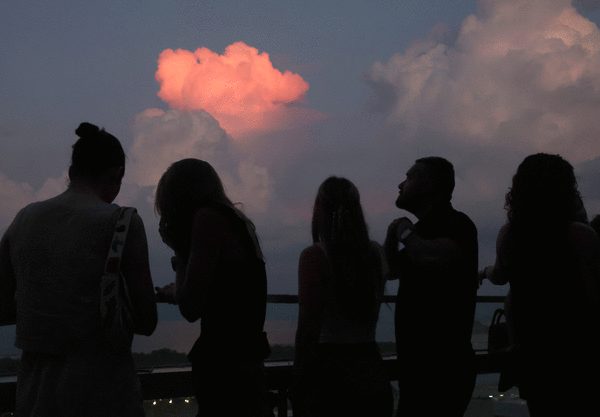
CHICAGO — As more than 900 wildfires continue to burn across Canada, predicting when air quality conditions will fully return to normal in Illinois and the rest of the Midwest can be tricky.
“Some of these fires in the boreal forest, they don’t end until the rain hits,” said Craig Clements, director of the Wildfire Interdisciplinary Research Center out of San Jose, California.
Clements said that could be October or November, or as early as next week.
More than 7 million acres in Canada have burned since the start of the year, according to the Canadian Interagency Forest Fire Centre, an organization owned by wildfire management agencies. The group’s website says more than 40 started Sunday alone, and many in western Ontario are classified as “out of control.”
These fires and at least 19 in Minnesota have sent large concentrations of the pollutant PM2.5 to Illinois. Cook County quadrupled its previous PM2.5 record on Thursday.
An air quality alert ended Monday, but smoke is expected to remain in the area Tuesday, according to AirNow, a website that combines data from county, state and federal air quality agencies nationwide.
The smoke could return later this summer, and air quality issues resulting from wildfires may become more common in the future, experts say.
Boreal forests appear throughout the northern hemisphere, mainly in Russia, Canada and the U.S., according to the United Nations. Canada’s boreal forest is 667 million acres, about 30% the United States’ total land area, according to the Canadian government.
These forests are mostly uninhabited. According to research organization Canada Wildfire, most wildfires occur from two sources. First is human activity, such as campfires, power line failures and discarded cigarettes. And secondly, lightning strikes start just under half of wildfires while contributing to more than 80% of the land burnt in Canada.
But wildfire smoke doesn’t just come from up north.
“In August, the Midwest could be inundated with more smoke even if these fires get under control in Canada, from Idaho or Washington,” Clements said. “It just depends on the weather patterns.”
Delaware State Climatologist Kevin Brinson said the more intense the fire, the easier smoke can be lifted high into the atmosphere and moved around by winds. At that point, it’s up to weather patterns to determine where the smoke goes.
Brinson said smoke from Canadian wildfires often makes its way to areas with stagnant winds, such as the Midwest.
“That smoke can kind of just work its way down to the surface,” he said.
The weather patterns bringing smoke from Canada to the Midwest are pretty typical for this time of year, Brinson said. Before Thursday, the record for PM2.5 levels in Cook County was set in 2023 during Canada’s record-breaking wildfire season. That year, 37 million acres burned across Canada. So far this year, 7.4 million acres have been consumed.
“What is maybe a little unusual and kind of unfortunate is that we’ve got these extremely intense fires occurring, you know, sort of all at once,” Brinson said. “So you get a very high concentration of that smoke.”
Pollutant levels in Chicago skyrocketed during the initial wave Thursday, dropped off Friday and then increased Saturday night as smog drifted back in from Michigan and Wisconsin.
Brinson likened the traveling smog to a campfire. Right next to the fire, it could be hard to breathe. But as the smoke drifts up, particles spread out and become less concentrated. A similar process happens as winds disperse wildfire smoke.
Brinson said how long that takes depends on weather patterns. If a cold front comes in, air quality could improve in hours, he said.
As climate change intensifies, concerns grow about air quality events becoming more and more frequent.
Jonathan Overpeck, dean of the School for Environment and Sustainability at the University of Michigan, said this time of year always sees fires; it’s just getting much more severe due to man-made climate change.
“What climate change is doing is it’s changing the nature of the fire season,” Overpeck said.
He said when it gets hotter, the atmosphere can hold more moisture. This dries out plants and makes them more prone to combustion. That’s especially the case for the large trees found in Canada’s forests.
When those trees combust, they release carbon dioxide into the atmosphere, both increasing air pollution and further intensifying climate change.
Wildfire smoke contains PM2.5. These fine particles harm human health and are sometimes deadly. Initially, fine particulate matter may cause a burning sensation in the eyes and nose. But because of its small size, it can settle deep in the lungs and cross into the bloodstream.
All of the PM2.5 from forest fires adds onto air pollution naturally occurring due to hotter conditions, Overpeck said. Heat increases the presence of ground-level ozone, another pollutant.
“We’re getting pollution levels that are as bad as back in the ‘50s and ‘60s,” Overpeck said, referring to before the U.S. imposed regulations on factory and car emissions.
Last week, air quality in the Chicago area was so bad, the Illinois Environmental Protection Agency warned that being outside was dangerous for everyone. By Monday, PM2.5 levels in parts of northern Illinois had dropped from last week’s “hazardous” to “unhealthy for sensitive groups,” according to AirNow.
Sensitive groups include people with heart or lung disease, older adults, teens and children. These groups should avoid long or intense outdoor activities.
Many Illinois residents have questioned if heavy summer air pollution is becoming the new norm. Overpeck said these conditions will become more frequent. And, he said, if the climate isn’t stabilized, large fires will start breaking out in the Midwest, probably within the next decade.
“We think of wildfires as something out west or up north in Canada, but as it gets warmer and warmer, we’re gonna start to see more wildfires, bigger wildfires — the same thing will be happening here in the Midwest,” Overpeck said.
____
©2026 Chicago Tribune. Visit at chicagotribune.com. Distributed by Tribune Content Agency, LLC.





Comments