Blanche faces questions about Trump's IRS settlement, Epstein files, Jan. 6 pardons
Published in News & Features
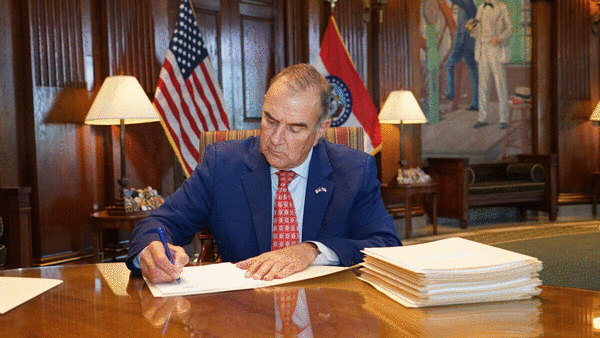
Acting Attorney General Todd Blanche faced tough questions from both Republicans and Democrats on the Senate Judiciary Committee on Wednesday as he seeks to make his role permanent.
Blanche was pressed about a settlement agreement between the president and the Internal Revenue Service, the Justice Department's release of the Epstein files, the president's blanket pardon of violent protesters who breached the U.S. Capitol on Jan. 6, 2021, and actions taken by the department against Trump's opponents.
Sen. John Cornyn, R-Texas, asked Blanche about the current status of the agreement with the IRS that created a $1.8-billion "anti-weaponization" fund that could benefit Trump's allies and granted Trump, two of his sons and his business immunity from tax audits.
"There's so much that's unusual about this," said Cornyn, whose support is crucial for Blanche's nomination to move forward in the Republican-controlled committee.
Blanche said that the $1.8-billion fund is "dead," but conceded that the agreement was still technically alive.
"I'm concerned it's not dead yet," Sen. Chris Coons, D-Del., said later in the hearing.
Blanche demurred when asked by Coons whether he had advised Trump that the settlement was a bad idea.
"I will not talk about communications I had with the president," Blanche said.
In a scathing ruling this week, the federal judge presiding over the IRS case wrote that the lawsuit was improper and recommended sanctions against two Justice Department attorneys who worked on the case, though not Blanche himself.
Cornyn told reporters during a break in the hearing that he is still "weighing" his decision about whether to support Blanche.
With the death of Sen. Lindsey Graham, D-S.C., last weekend, Republicans hold only a one-seat majority on the committee, though a replacement for Graham on the panel could be appointed before the expected vote on Blanche's nomination in two weeks.
Sen. Thom Tillis, R-N.C., who has also previously expressed some ambivalence about supporting Blanche's nomination, struck a more positive tone in his questioning.
While he criticized the IRS settlement agreement and Trump's pardons of some of the Jan. 6 protesters, he also made a point of praising Blanche's performance at the hearing.
"You've done a great job today," he said.
Blanche was confirmed as deputy attorney general in March 2025 and became acting attorney general after his predecessor, Attorney General Pam Bondi, was fired by Trump in April of this year.
Blanche could continue to serve as an acting attorney general even if he is not confirmed, but the administration would not be able to nominate a replacement for Blanche's previous role of deputy attorney general.
Blanche, 51, spent 12 years working for the U.S. attorney's office for the Southern District of New York, working largely on drug and violent crime cases, and rose to the level of co-chief of the district's White Plains division.
He left the office in 2014 for private practice and joined the prominent law firm Cadwalader, Wickersham & Taft in 2017 as a partner. He left the firm in 2023 and went independent after other partners expressed concern when he took Trump on as a client.
Trump touted Blanche's record ahead of the hearing.
"Todd Blanche is doing a PHENOMENAL job as Acting Attorney General of the United States," the president wrote on Truth Social. "He is a great lawyer, always very fair, and every Republican Senator should vote to CONFIRM Todd Blanche, ASAP!"
In his opening remarks Wednesday, Blanche made the case for his nomination by emphasizing the near record-low murder rate and actions taken by the administration to take on drug cartels and protect the country's borders.
"We are keeping America safe," Blanche said.
Blanche defended the Justice Department's release of millions of pages of files from its investigations into deceased sex abuser Jeffrey Epstein in which the names and personal details of numerous victims were inadvertently made public.
"Whenever we learned that any victim's name had been improperly redacted, we immediately took them down," Blanche said.
He also defended criticism that the Justice Department hasn't brought new charges against any of Epstein's alleged co-conspirators.
"If we learn today, if we learn next week, if we learn next month that there's an individual we can prosecute out of the Epstein files, you better believe we will," Blanche said.
But he declined to commit to meeting with 10 Epstein victims who were present at the hearing when pressed by Sen. Dick Durbin, D-Ill., the top Democrat on the committee.
Blanche said he could not meet with them directly if they were represented by counsel, but that a staffer present who was with him could.
"I think you ought to be in the room, because you ought to hear this," Durbin said.
Blanche also declined to say whether he agreed with Trump's decision to pardon more than 1,500 people charged in connection with the Jan. 6 storming of the Capitol, saying numerous times that Trump had the right to pardon anyone.
Blanche, who served as a defense attorney for Trump before entering office, faced numerous questions about his independence from Trump.
One question seemingly designed to establish Blanche's independence from the president might have inadvertently had the opposite effect.
Sen. John Kennedy, R-La., asked Blanche whether he was friends with Trump.
"I'm his lawyer," Blanched replied, before correcting himself. "Was his lawyer."
_____
©2026 Los Angeles Times. Visit latimes.com. Distributed by Tribune Content Agency, LLC.




Comments