District attorneys, lawmakers celebrate California's changes to mental health diversion law
Published in News & Features
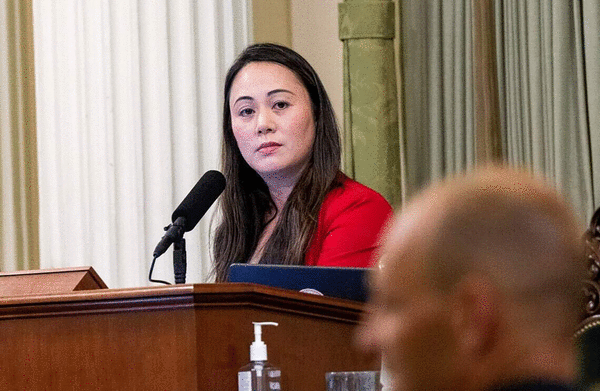
SACRAMENTO, Calif. — Lawmakers, district attorneys and community members celebrated the signing of Assembly Bill 46 in a Tuesday press conference.
Gov. Gavin Newsom signed AB 46 into law on June 29. The newly signed law, authored by Assemblymember Stephanie Nguyen, D-Elk Grove, expands courts’ ability to deny mental health diversion to defendants in criminal cases.
“Public safety and access to treatment are not competing priorities,” Nguyen said. “We can and should do both. I believe AB 46 reflects that principle, and I am so proud of where we landed.”
Until the legislation takes effect on Jan. 1, mental health diversion protocols will continue as outlined in California law. Under the code, defendants in criminal court may seek diversion if they have been diagnosed with a mental disorder that played “a significant factor in the commission of the charged offense.”
If a mental health expert says the mental illness that caused the defendant to commit the crime would respond to treatment and the defendant will not “pose an unreasonable risk of danger to public safety,” they will be granted diversion under the current law. Defendants charged with certain crimes, such as murder, are not eligible for diversion.
AB 46 restores the judicial power to determine if the defendant seeking diversion poses a “substantial and undue risk to the physical safety of another person.” The bill also requires that a mental health expert state whether diversion is clinically appropriate to address the defendant’s symptoms.
The measure says defendants must also have been diagnosed with a mental illness within the last five years, a clause that Sacramento County District Attorney Thien Ho said aims to prevent defendants from “manipulating the system.”
“As originally written, the law stripped judges of sound discretion, created dangerous loopholes in accountability, invited manipulation by those seeking to game the system and release violent offenders back into our community and neighborhoods with little supervision and, too often, little treatment,” Ho said.
Ho and Yolo County District Attorney Melinda Aiello both said current law does not adequately protect victims of violent crimes, as it requires prosecutors to prove that a defendant will commit a “super strike” — such as a murder, rape or child molestation — to deny diversion.
“Victims deserve to have their voices heard, and our communities deserve a system that is both compassionate and effective,” Aiello said.
Nguyen introduced the legislation in December 2024 and garnered bipartisan support in the legislature. AB 46 passed 56-7 on the Assembly floor in May 2025, and the Senate floor by a 34-6 vote in May 2026.
“This was not a one-sided thing,” said Marin County District Attorney Lori Frugoli. “This was both parties getting together to unify to do the right thing for victims and for public safety.”
Frugoli, a former police officer for downtown Santa Rosa, said she saw firsthand a “lack of education” in law enforcement and the Legislature about addressing mental illness. AB 46, according to Frugoli, is a step in the right direction.
“This is a big moment for district attorneys, for prosecutors, for the community and for the victims of crimes who we cannot overlook,” Frugoli said.
____
©2026 The Sacramento Bee. Visit at sacbee.com. Distributed by Tribune Content Agency, LLC.






Comments