Iran rallies millions for funeral of slain leader Khamenei
Published in News & Features
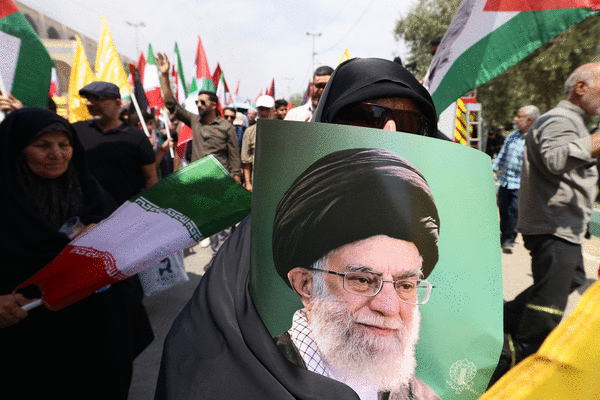
Iran began a mass funeral for late Supreme Leader Ayatollah Ali Khamenei on Saturday, in a weeklong ceremony that’s expected to draw millions of mourners and serve as a show of strength for the Islamic Republic.
The body of Khamenei — who was killed in a U.S. and Israeli attack on the first day of the war in late February — will lie in state at Tehran’s Imam Khomeini Mosalla mosque complex for public visits over the weekend, according to the state-run Islamic Republic News Agency.
That will be followed by processions in the capital Tehran, the seminary city of Qom, and Najaf and Karbala in neighboring Iraq – holy cities in Shia Islam that are home to major shrines. Khamenei will be buried in his home city of Mashhad on July 9.
Tehran municipality said more than 2.2 million people had attended as of 3 p.m. local time on Saturday, according to the semi-official Tasnim news agency, with as many as 20 million expected in total.
Khamenei’s son, Mojtaba, was named as his successor, but was injured in the attack that killed his father and is yet to be seen in public. It’s unclear whether he will make an appearance at the funeral.
Large crowds gathered early in the morning in Tehran. Live coverage broadcast by Iranian state television showed the coffins of Khamenei and four family members resting inside glass boxes on a raised platform, each draped in the national flag. Khamenei’s coffin stood elevated above the others, topped with his signature black turban. Among them sat a noticeably smaller coffin belonging to his grandchild, who was killed in the U.S.-Israeli strikes.
By noon local time, footage showed mourners chanting for revenge and pledging allegiance to Mojtaba Khamenei. In remarks carried by Iranian media on Saturday, Hadi Khamenei, the former supreme leader’s brother, said Iran should seek revenge parallel to holding talks with the U.S. about a permanent end to the war.
Acknowledging the complexity of the situation, he added, “This was an entirely unprecedented event globally, and it remains unclear how we should deal with the perpetrators.”
Foreign delegates from countries including China, Russia, India, Pakistan, Turkey and Iraq, as well as from Middle East militias allied to Iran, joined a smaller ceremony on Friday.
Of the Gulf Arab countries, many of which were attacked by Iran during the initial phase of the conflict, Qatar, Oman and Saudi Arabia sent representatives.
Iran has shut down large parts of the capital to accommodate the proceedings, declaring a three-day public holiday and tightening airspace security for the event.
Temperatures in Tehran rose as high as 36C (96.8F) on Saturday, with authorities deploying a misting system in the mosque supplied by fire engines to keep mourners cool, the semi-official Iranian Students’ News Agency reported.
The funeral was initially planned for March, amid the height of the fighting with the U.S. and Israel, but was postponed due to expectations of large crowds. Some attacks have continued despite a preliminary deal to end the war last month.
The revised schedule for Khamenei’s funeral comes after a provisional peace deal with the U.S. signed last month and coincides with the Islamic holy month of Muharram, in which Iran’s Shia-majority population commemorate the death of the grandson of the Prophet Muhammad.
A senior member of the clergy, Khamenei emerged from the religious, anti-imperialist movement that took control of the country’s 1979 revolution. An unsmiling figure, Khamenei never left Iran after taking office and used his authority to suppress protests.
He defined Iran’s position in the Middle East as a staunch enemy of Israel and an uncompromising obstacle to U.S. attempts to influence and shape the region.
The 1989 funeral of Iran’s previous supreme leader, Ayatollah Ruhollah Khomeini, set the world record for the biggest percentage of a country’s population to attend a funeral. Over 10 million people joined, according to official figures, with eight people killed in a stampede.
Crowd safety is a concern again on Saturday. During the 2020 funeral for Qassem Soleimani — the general killed in a U.S. drone strike — a massive stampede broke out during his burial procession in his hometown of Kerman, leaving 61 dead and 200 injured.
_____
(With assistance from Eltaf Najafizada, Veena Ali-Khan and Bertha Wang.)
_____
©2026 Bloomberg L.P. Visit bloomberg.com. Distributed by Tribune Content Agency, LLC.




Comments