Altadena residents unify to pass legislation protecting their community from dense developments
Published in News & Features
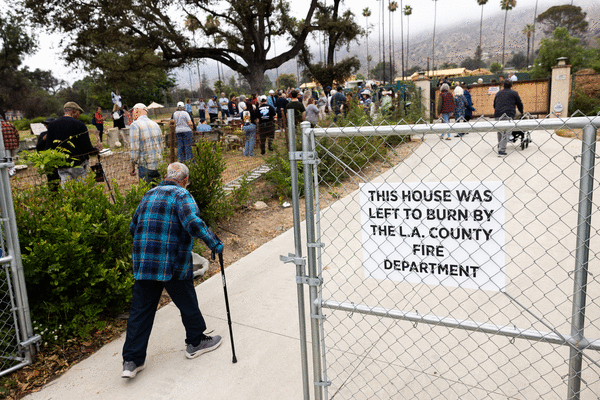
LOS ANGELES — In mid-June, it became apparent that Altadena was having a moment unlike any other in the 18 months since the Eaton fire burned much of the community to the ground. More than 450 people flooded a June 16 Town Council meeting, focused on what some say is a fight to preserve the neighborhood's identity.
In a community where residents are preoccupied with their own difficult recovery journeys, the unity was noteworthy.
"This is the first time pre- or post-fire that we have been able to unite and find enough common ground to stand together," said Shawna Dawson Beer, leader of Beautiful Altadena, a community advocacy group formed a little more than a decade ago.
Over the last several weeks, residents have rallied behind Senate Bill 1090, which would pause multi-unit building projects in the L.A. County neighborhood. Following the devastating January 2025 firestorms, plans have been submitted or work has begun on at least 13 single-family lots that would create subdivisions for multi-family housing, according to Altadena Recovery Watch, a local group of fire survivors.
The bill creates a carve-out from laws that expedite transitioning single-family lots into multi-family housing in California to help alleviate the state's housing crisis.
"We heard over and over again from community members, those who lost their homes or who were affected in some way by the fire, to make sure that the community stayed the community that was there before the fires," said state Assemblymember John Harabedian, D-Pasadena, in an interview with The Times.
Harabedian and state Sen. Sasha Renée Pérez, D-Alhambra, co-authored the bill, also known as the Keep Altadena Land in Altadena Hands Act, which grants an exception to SB 9 and SB 1123, which created pathways to develop on single-family lots.
"The people of Altadena are demanding protection from speculators who are buying land from distressed fire survivors and trying to exploit the intent of existing laws," Pérez said in a statement announcing the legislation.
Momentum around the bill began to build more than two weeks ago, on June 14, when the Altadena Town Council announced it would be meeting two days later "with an agenda that keeps the community's two preoccupations — utility costs and the rules governing rebuilding — front and center."
Emergency Town Council meetings were held June 24 and again on Monday on Zoom, each meeting building on the momentum from the last, with hundreds in attendance.
Before Monday's Zoom, a crowd of community members gathered for a news conference in West Altadena.
"I stand here with just part of an unprecedented alliance that will keep focus on this bill moving forward and will continue to do so with every challenge and obstacle," said Altadena Town Council Chair Nic Arnzen at the press event. "Because there is nothing we can't overcome if we stick together."
"I think that more communities should do this kind of grassroots organizing because it's the only way to educate our leaders and our decision-makers about what's going on on the ground," said Noel Minor, a former land-use attorney who is part of community group Altadena Recovery Watch, in an interview with The Times. "I don't know that I have ever seen so much of the community come to a singular event ever."
Altadena residents have flooded the inboxes and voicemails of state and local lawmakers, hoping the bill passes its first hurdle Wednesday when it's up for a vote by two committees. L.A. County Supervisor Kathryn Barger will be joined by several Altadena residents in Sacramento to speak in favor of the bill.
Altadena residents Gary and Mary Lyzenga spoke about the emotion behind the widespread efforts in the community to pass the bill.
"It's heartbreaking to see multi-generational families, diverse communities being gutted," Gary Lyzenga said of the new development. "Altadena has not been without apartment buildings, condos," he added, but he said residents worried about high-density development on narrow streets that lack sidewalks and parking.
"It's not that we don't think that there needs to be development," he told The Times, "but it shouldn't be of this predatory nature where developers are swooping in."
Some residents are pushing for the law to extend the development carve-out beyond 2029, saying more time may be needed for recovery as residents deal with insurance payouts and litigation with Southern California Edison, among other issues.
"It should never be easier for speculative developers to buy up land and build for-profit housing that is not affordable than it is for fire survivors to come home," said Dawson Beer.
If the bill passes, it would then move on to the Assembly floor when legislators are back from recess in August. Wednesday's committee hearings are scheduled to begin at 9:30 a.m and 1:30 p.m.
©2026 Los Angeles Times. Visit at latimes.com. Distributed by Tribune Content Agency, LLC.






Comments