Man believed to be Michigan's last Montford Point Marine laid to rest in Detroit
Published in News & Features


DETROIT — A man believed to be Michigan’s last original Montford Point Marine, Robert Armond Hassler, was buried Saturday at Elmwood Cemetery.
Hassler served in World War II as one of the first Black men to enter the United States Marine Corps.
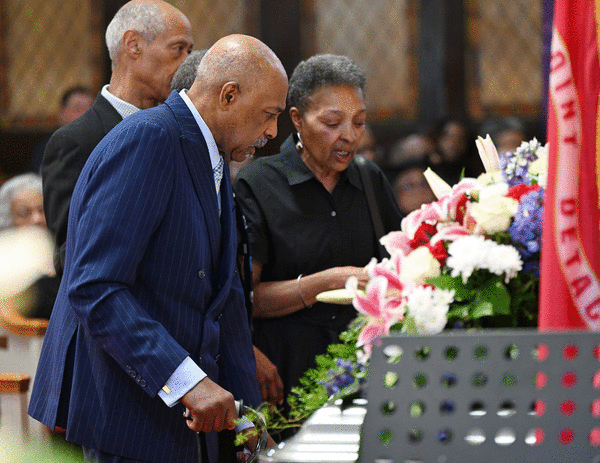
Hassler died June 16 at age 101. He's survived by three children: Kevin, Ina and Lisa, six grandchildren, three great-grandchildren and his brother, Mickey Hassler. Friends and family gathered Saturday for his funeral service at the People's Community Church on Woodward Avenue in Detroit.
They remembered him as someone with a big heart and a zest for life — and a talent for making excellent coffee.
Hassler stayed deeply involved with the church, and was known for making coffee every Sunday to go with breakfast before the worship service, prepared by various clubs and organizations.
Vera Toples, a member of the Board of Stewards at People's Community Church who called Hassler "Dad," said everyone looked forward to his coffee each week. Toples promised her one day he would tell her his secret to making it so well.
"Guess what? Today, he still hasn't told me," Toples said, and laughter erupted throughout the church. Toples claimed she's figured out the secret to the coffee on her own.
Hassler enlisted in the Marines in 1943, training at Montford Point in North Carolina, a segregated base. Hassler fought in the Pacific and served until 1947. Hassler then studied finance at Morehouse College in Atlanta. He and his wife, Ollie, married in 1961 and eventually relocated to Detroit.
But unable to find work as an accountant in Detroit because of racial barriers, he drove a taxi and worked for the C.W. Morris Funeral Home. He later worked for 30 years as a journeyman at the Chrysler Sterling Stamping Plant. Hassler retired in 1993.
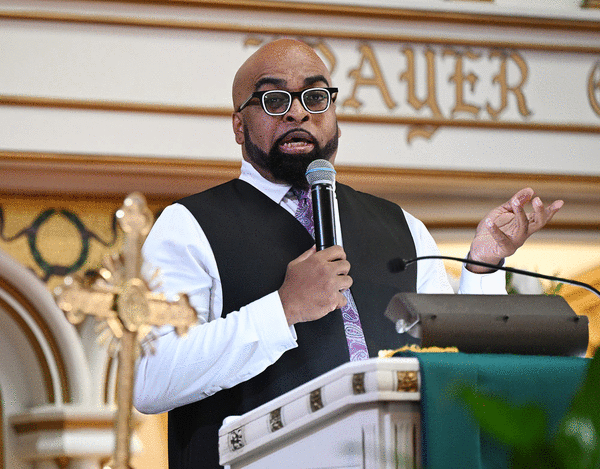
The Rev. Rashard Hollman, who delivered a lively eulogy for Hassler on Saturday, compared his life to Forrest Gump's: Almost too extraordinary to believe at times, and yielding endless stories to tell.
"I thought Forrest Gump met some people. Oh no. Robert Hassler had him beat," Hollman said.
Hollman said Hassler had a knack for connecting with people and always being nice to them — he counted Hank Aaron and the brother of the Rev. Martin Luther King Jr. among those he met — even white people who may not have respected him. Hassler recognized you never knew how people you met could affect your life later on, Hollman said.
"Just by being who he was, down through the years, those connections became a blessing to him."
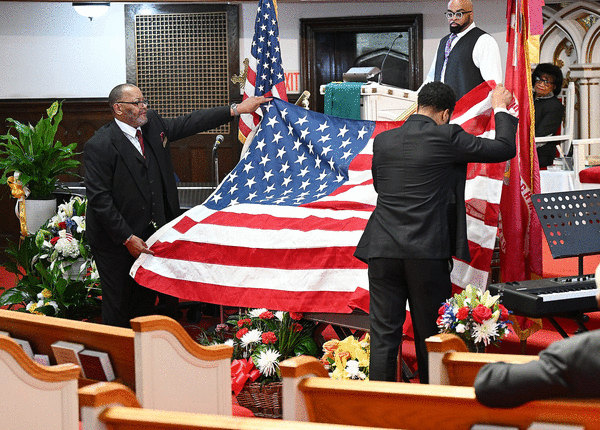
An American flag, folded into a triangle shape as a ritualistic practice that resembles the tri-corner hats worn by Revolutionary War soldiers, accompanied Hassler's casket during the funeral. It was unfolded and draped over the casket for Hassler's transport to his burial. A white drape with the Marine Corps insignia that lay on his casket was presented to Hassler's family. Bouquets of flowers in pink, white, red, yellow and orange surrounded him.
The first Black Marines were prohibited from training at the branch’s San Diego and South Carolina bases. The year before Hassler joined, the first recruits built their own base at Montford, constructing their quarters and running water lines through undeveloped land they shared with copperhead snakes and other reptiles.
In 2012, the Montford Point Marines were awarded the Congressional Gold Medal.
"When they finally gave the Black Marines the recognition, he said that he was really glad about that because they never, ever, mentioned them," Hassler's children told The News.
Ramon Rogers, a retired Marine Corps master sergeant, first met Hassler in 2012.
“By the time he arrived, they at least had removed the direct white trainers. They now had some Blacks that would train the individual recruits that came in,” Rogers said. “They were still at a place that ‘You get out of here, and we still don't want you.’”
He attended Hassler's funeral with several other members of the Marine Corps League, a Veterans Service Organization. The members, wearing red hats and jackets, saluted Hassler's casket as it was brought out of the church after the service.
Black Marines weren’t allowed to train at the main Marine bases until 1949, years after Hassler served his country in the Pacific.
The Montford Pointers weren’t allowed to fight the same way as white members of the Marine Corps. They were meant to retrieve bodies, cook and complete other non-combat jobs. But Hassler and other Montford Point Marines defied this expectation and fought with distinction in brutal island battles across the Pacific.
"Their courage under fire and fidelity to fellow Marines, regardless of skin color, began to erode the cruel and false generational stereotype within the Corps that blacks could not, and would not, fight in the face of danger," a Veterans of Foreign Wars release said in 2011, urging the U.S. Senate to recognize the Montford Point Marines for their service. "This led Gen. Alexander Vandegrift, then Commandant of the Marine Corps, who had observed the courage of black Marines in hand-to-hand combat on Saipan, to say 'The experiment with the Negro Marines is over. They are Marines … period!'"
Rogers estimated fewer than 20 Montfort Point Marines remain.
“We’re in a unique, challenging spot. And by Mr. Hassler’s departure of life, it changed the dynamics right here in southeastern Michigan, or Michigan, as a whole, because it wasn't time past,” Rogers said. “As I spoke to individuals about the Montford Point Marines, I could bring an original Montford Pointer.”
After he served in the Marines, Hassler studied finance at Morehouse College in Atlanta, returning to the state where he was born. He later met his wife, Ollie, in Milwaukee through his friendship with her family. The couple married in 1961 and eventually relocated to Detroit where they raised their family with three children.
“Mr. Hassler thought this would be a good place to kind of hang his hat, build a life, and make things work for him,” Rogers said. “And apparently, it did work well.”
Rogers presented a distinguished service medal to Hassler in February at the Montford Point Marines Annual Black History Month Banquet.
"I'm not saying I didn't have to do anything in the Marine Corps to get to the place of retiring as a master sergeant, but if they would've quit, if they would have failed, if they would have just played it simple and said 'I've had enough, and we're not going to deal with it,' there would not have been a Ramon Rogers, that in turn retired from Marine Corps. From a comfortable position, I have to say thank you to those for what they did," Rogers said.
©2026 The Detroit News. Visit detroitnews.com. Distributed by Tribune Content Agency, LLC.





Comments