Supreme Court greenlights Trump termination of TPS for 350,000 Haitians, Syrians
Published in News & Features
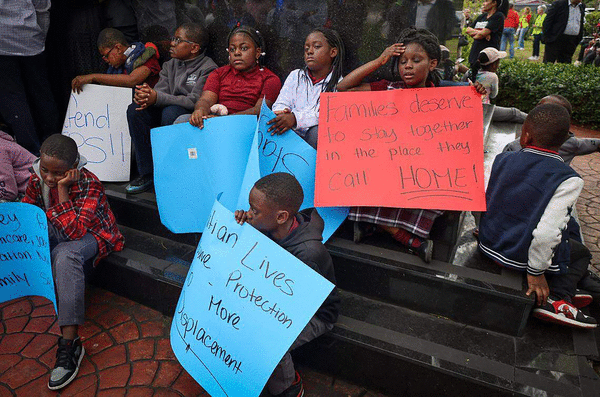
The nation’s highest court paved the way for President Donald Trump to deport hundreds of thousands of immigrants from Haiti and Syria fleeing instability and violence in their home countries in a case about their deportation protections under temporary protected status.
In a 6-3 decision, the justices said the federal law is clear in that it prohibits judge’s to review executive branch decisions about TPS if they aren’t related to constitutional .claims. It also said that the arguments that the Trump administration was terminating it because of race, violating equal protection claims, “is unlikely to succeed.” TPS shields people from designated countries in turmoil from deportation.
“Respondents and the courts below offer no sound theories to overcome the plain meaning of the judicial-review bar. Respondents’ argument that the [TPS law applies only to substantive claims, not those based on alleged procedural errors, finds no support in the statutory language,” reads the majority opinion, authored by Justice Samuel Alito.
“Reversed and remanded,” wrote Alito, meaning that federal judges’ rulings upholding the protections was reversed and that the case was sent back to the lower courts.
The Supreme Court’s decision deals a major blow to beneficiaries of temporary protected status and comes despite revelations that the Department of Homeland Security did not consult with the State Department, as federal law requires, before moving to end Haiti’s protection.
It’s also a major victory for the Trump administration, whose mass-deportation agenda has relied on stripping hundreds of thousands of immigrants with legal status of their work permits and deportation protections. It could pave the way for the Trump administration to end TPS without judicial review for a slew of other countries as well.
It also has significant consequences for Florida, where a third of all Haitian TPS holders, reside. While a federal judge in Washington, D.C., had kept their protections, the Supreme Court ruling now opens the door for the Trump administration to end their deportation protections. The administration has rounded up hundreds of former TPS holders from Venezuela, which already lost TPS protections in another Supreme Court emergency ruling while lower court litigation is pending.
The State Department is involved in the deployment of the international Gang Suppression Force to Haiti. The effort is funded by assessed contributions to the United Nations and voluntary donations That alone is an acknowledgment by the Trump situation of the instability in Haiti and is among the reasons that federal lawmakers have said should be considered in designating a country for TPS, advocates have argued.
In a statement to the Miami Herald, James Percival, the Department of Homeland Security’s General Counsel celebrated the decision, saying that “The T in TPS stands for TEMPORARY, yet many of these designations became de facto amnesty. This is a win for the rule of law and common sense.”
He called it the administration’s “second Supreme Court win of the day,” referring to another ruling that came out Wednesday about asylum. The ruling, also written by Justice Alito, held that federal law “neither entitles an alien standing in Mexico to apply for asylum nor requires an immigration officers to inspect him.” Immigration and advocates say the ruling effectively allows the Trump administration to turn away immigrants seeking asylum at ports of entry and will radically reshape access to asylum.
The TPS Supreme Court ruling stems from emergency requests that the Trump administration made to the Supreme Court asking for the justices to end the protections for Haiti after three lower courts ruled in favor of TPS holders from the Caribbean country. That includes Judge Ana Reyes, who is on the district court in Washington, D.C., and said the comments from then-Secretary of Homeland Security Kristi Noem about Haitians showed prejudice.
In its emergency request, the Department of Justice argued that the courts were overreaching their authority and that the plaintiff claims about improper procedures to end TPS were meritless because the courts don’t have the right to review TPS terminations.
The Supreme Court consolidated that emergency request with another for ending protections for Syria, which has about 4,000 TPS holders living in the United States. It heard arguments in April.
The Trump administration first ended TPS for Haiti in February 2025, around the same time it also did for Venezuela. The Department of Homeland Security, then under Noem, argued that conditions in Haiti were safe enough for its nationals living in the United States to return despite ongoing extreme violence, widespread hunger and political instability. At the same time, the Department of State has said American travelers should not go to Haiti.
The United Nations estimates that up to 90% of Port-au-Prince is controlled by gangs and that gang violence has killed over 2,300 people in Haiti since the beginning of this year. Haiti first received TPS in 2010 during the Obama administration after an earthquake that the Haitian government estimates killed over 300,000 people.
The Supreme Court allowed the Trump administration to end protections for Venezuela in October. It gave no reasoning. A lower federal court in California had determined that those terminations were illegal. An appeals court in January upheld the lower court’s ruling, but the Supreme Court stay is still in effect.
©2026 Miami Herald. Visit at miamiherald.com. Distributed by Tribune Content Agency, LLC.






Comments