After ballot errors, Maryland voters weigh trust in election process
Published in News & Features
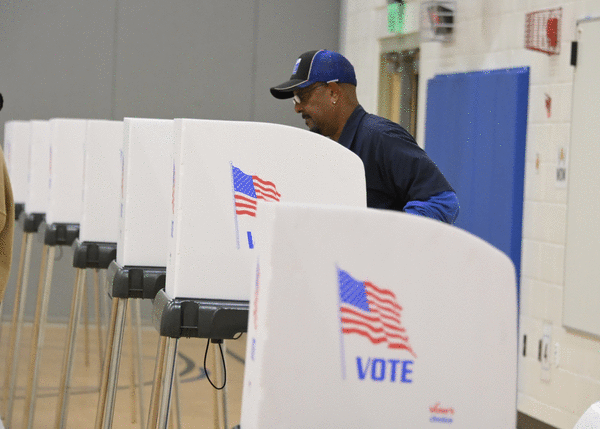
BALTIMORE — After erroneous ballots were mailed to Maryland residents earlier this year, Tuesday’s primary election was not just a referendum on candidates, but on how to vote as well.
At Bel Air High School, Michael Peters said people should vote in person, and mail-in ballots should only be sent to those who are unable to come to the polls because they are ill or away on vacation or military service.
“That’s a lot of votes that sit somewhere that can be susceptible to fraud, to changing, to losing some, mishandling … manipulating,” said Peters, who was canvassing for a Harford candidate.
But one regular user of mail-in ballots, during his years of military service, came to a different conclusion.
“If they can get my ballot from across the world, I trust that,” said Jacob Smith, who on Tuesday was serving, as he has since 2009, as a chief elections judge at South County Senior Center in Edgewater. “There’s no problem with mail-in ballots.”
Maryland was thrust into an election controversy after hundreds of thousands of voters were sent ballots with candidates for the wrong parties. The printing company under contract to the state then sent correct, replacement ballots, but concerns rose about possible confusion over which ballots would be filled out and counted.
The Maryland State Board of Elections instructed voters to fill out and return the replacement ballots, and said any original ballots would be quarantined and counted if no other ballot was sent in. Voters who opted to vote in person despite having requested mail-in ballots were supposed to receive provisional ballots.
“All our processes are in place,” Jared DeMarinis, the state elections administrator, said during a poll visit at the Arbutus Fire Department. “Marylanders can definitely trust the results as they come out.”
DeMarinis said Tuesday morning that the board had received back 200,000 print-at-home and replacement mail-in ballots. The office also received original mail-in ballots, but he did not specify how many. The board contacted those voters and encouraged them to fill out the replacement ballots, he said.
Joanne Antoine, executive director of the watchdog group, Common Cause Maryland, said she heard few concerns about voting while monitoring a national election protection hotline, 866-OUR-VOTE, run by the Lawyers’ Committee for Civil Rights Under Law. Most of the Maryland concerns dealt with issues like signage or the lack of a wheelchair ramp at one polling place.
“It’s not as big an issue as we thought it might be,” Antoine said.
Still, some voters said they only felt they could be sure by heading to their polling place on Tuesday.
Brian Polk, 39, voting with his mother-in-law Debbie Plummer, 76, at Liberty High School in Carroll County, called it a “civic duty” to vote — and in person.
“I’ve never been a big proponent of the mail-in ballots,” Polk said. “I’d rather do it in person, so that way I know what’s tried-and-true written down on the paper.”
“I don’t trust mail-in ballots at all,” Plummer said. “It’s too easy to make them disappear, and no one would ever be the wiser.”
Jay Martin, a Towson resident in his 60s, said he went to his polling place at Towson University hoping for a change in state leadership — and to feel more secure by voting in person. He said he thinks mail-in ballots are susceptible to errors and fraud.
“I know we don’t have much of a chance in Maryland,” he said, noting he is a registered Republican, “but still it’s important to vote regardless.”
For Ruie Lavoie, Baltimore County election director, the rain might have been more of a factor than election integrity concerns. She said there weren’t more pollwatchers than in past elections.
She said she encouraged anyone with a replacement mail-in ballot to return it to a dropbox or make sure it was postmarked Tuesday. She said Baltimore Countians have returned about half of the mail-in ballots they requested so far.
“I don’t think there’s more people going to vote in-person because of the mail-in ballot error,” she said, expecting many of the mail-ins to come in Tuesday from drop box pick-ups and through the mail.
Several longtime political volunteers in Prince George’s County said confusion surrounding the county’s recent ballot mailing problems remained a topic of conversation among voters.
Pat Fletcher, who said she has worked elections at the precinct since 1977, said there were delays in the delivery of voter guides this cycle. Romeo Spaulding, a canvasser and longtime political activist sitting beside her outside William Paca Elementary School, said he is still waiting on his.
“It’s the only different thing this year,” Fletcher said. “I’ve never seen that happen before.”
Still, neither Fletcher nor Spaulding reported widespread problems with voters casting ballots in person Tuesday. Fletcher said she had heard from some voters who experienced issues receiving replacement mail-in ballots, but she said those voters were still able to vote at polling locations.
At Old Mill Middle School South in Anne Arundel County, Jadiel Colon-Perez of Millersville was among a steady stream of voters. He was there because of his concerns over immigration enforcement and reproductive rights, rather than election integrity.
“I think [they] have been massively overstated,” he said. “People are trying to undermine the results of the election when they don’t like the results. It’s not as big of an issue as they make it seem.”
Leslie Aguila, 43, said she’s “hopeful things are going to be better this time around,” in light of increased scrutiny on the Maryland Board of Elections, which has made repeated ballot errors in this year’s primary elections and previous years.
Aguila, a registered Democrat in Baltimore County, said she faced no complications casting her ballot at Arbutus Fire Department, a polling center in Halethorpe, Maryland. But she noted that while the state elections board should arm voters with information ahead of elections, voters should also research the races that affect them and understand their options.
“Everybody needs to do their own individual research before going in, and not just voting for whoever,” she said. “It’s important to do the research and vote for whatever you stand for. That’s what I felt like I did today.”
Pamela Galligan-Stirle, an election judge at South River High School in Edgewater, said she believes there is great strength and integrity in voting and that it would be very difficult to commit election fraud.
Having been a poll worker since 2008, her main goal is ensuring “everybody has a free, easy and unpressured voting experience.”
Jennifer Rice of Linthicum is a 3rd-year poll worker. The former Republican said she started serving her community because of the accusations of voting fraud.
“I’ve been assured the process is safe,” she said, after educating herself on the polling process.
Rice gestured to the observer section, which sat empty all day. She felt it was hypocritical that people would not come to watch how the voting process was conducted.
“Get your butts here,” she said, “and be part of the solution, not the problem.”
________
(Sun reporters Racquel Bazos, Tanisha Bhat, Tinashe Chingarande, Mennatalla Ibrahim, Luke Kaiser, Lorraine Mirabella, Sofia Montoya-Deck and Sanya Wason contributed to this article.)
________
©2026 The Baltimore Sun. Visit at baltimoresun.com. Distributed by Tribune Content Agency, LLC.





Comments