LA faces state of emergency as Boyle Heights fire continues spewing smoke across region
Published in News & Features
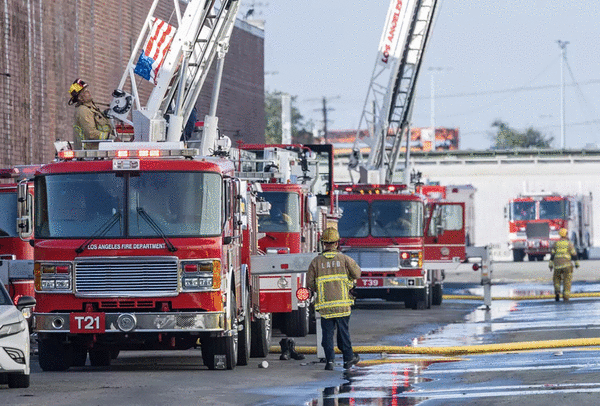
LOS ANGELES — L.A. city officials said Saturday they expected to declare a state of emergency as firefighters continue to battle a stubborn warehouse fire in Boyle Heights that has sent plumes of irritating smoke across the region.
Los Angeles Fire Department Chief Jamie Moore described the blaze that broke out Wednesday as a “very unique fire, a very unique challenge for the Los Angeles Fire Department, for the city of Los Angeles, but also for the County of Los Angeles,” at a morning press conference.
The 500,000-square-foot commercial building at 1400 S. Los Palos St. stores 85 million pounds of frozen food “like a giant cooler,” he said. The corrugated steel walls are filled with very dense foam that is burning slowly and emitting gases despite ongoing water drops from helicopters.
The building is also topped with solar panels that have caught fire.
Moore cautioned people with lung issues or smoke sensitivity to avoid outdoor activities, but said crews have mitigated hazardous materials at the site, and are also concerned about biohazards potentially posed by spoiled food.
A shelter-in-place order for residents was lifted on Friday, but many across the region on social media reported thick smoke smells, haze and poor air quality in the San Gabriel Valley, Northeast Los Angeles, Glendale, Burbank, downtown Los Angeles and many other areas.
Some said the smoke was as bad, if not worse, as during the Eaton fire that burned in Altadena in January 2025.
The American Red Cross has opened two smoke respite shelters at City Terrace Park at 1126 N. Hazard Ave. and Pecan Recreation Center at 145 S. Pecan St.
Mayor Karen Bass, who joined Moore and other local officials at the City Terrace Park press conference, said a state of emergency declaration is pending and that she has reached out to Gov. Gavin Newsom for additional support.
“Our chief concern is for your safety and for your health,” Bass said. “No smoke is good, but especially the smoke that could be toxic because of the chemicals that were needed to keep the food frozen in the facility.”
L.A. County health officer Muntu Davis said the main public health concern was smoke and fine particles that can cause irritation of the ear, nose, throat and lungs, as well as exacerbate heart and lung conditions.
“People really just need to pay attention to how they feel, especially if they have underlying health conditions, and watching children as well,” she said.
Sensitive individuals were encouraged to wear well-fitting N95 and P100 masks, and to register for emergency notifications at alertla.org.
Will Barrett, assistant vice president for nationwide clean air policy with the American Lung Association, told The Times that it can be hard to pinpoint exactly what is in the smoke while crews are still working to contain the evolving health risk, but that the most important thing is to avoid exposure.
“Much like recent industrial and wildfire incidents, the makeup of the smoke can include toxic chemicals, fine particles and other serious risks to lung health depending on fire conditions and what is burned,” he said.
On its own, particle pollution can increase the risk of asthma attacks, heart attacks and other medical emergencies, and other chemicals in the air can cause both near- and long-term harms, he said.
Another concern is the possibility that there were lithium-ion batteries within the structure. Batteries are often used to store energy produced by solar panels, although officials could not immediately confirm whether that was the case in Boyle Heights. However, they said the building does house about 60 forklifts that run on lithium-ion batteries, although those are “currently unburned.”
Low-level toxic fumes measured on Thursday included hydrogen fluoride, a byproduct produced by burning lithium-ion batteries, LAFD spokesperson Lyndsey Lantz told The Times.
“It is likely that there were some involved at some point,” she said. “We just don’t have confirmation of where they were or what part of the building they were responsible for.”
The threat posed by the batteries was at least mitigated when 56 of the forklifts were moved or isolated from the flames in a dangerous operation, LAFD Battalion Chief Nicholas Ferrari said.
“It’s an extreme firefighter risk to go down an aisle that’s 600 feet long, one way in, one way out, product 54 feet high, with the potential to fall,” he said. “It would trap firefighters and kill them.”
The warehouse is owned by Lineage Logistics. The company could not be reached for comment Saturday, but released a statement to CBS saying it believed the fire was started by contractors testing the solar array on the facility’s roof.
“Lineage’s top priority is the health and safety of the community, and we are continuing to work closely with the Los Angeles Fire Department and other agencies to provide any assistance we can,” the statement said.
It noted the facility is not used for the storage of hazardous materials.
The multiday effort has been full of challenges for firefighters with fiery flare-ups.
The fire initially grew into a huge inferno, creating a pillar of thick, black smoke that could be seen for miles. It then reached an ammonia line, triggering several small explosions and a dramatic image of flames shooting through the building‘s roof as crews evacuated the area to avoid the fumes.
That caused officials to order a shelter-in-place order that was lifted — only to be reinstated on Thursday after a different section of the building caught fire. That prompted a new shelter-in-place order that was lifted Friday just before 11:30 a.m.
The smoke from the fire also triggered a special particle pollution advisory from the South Coast Air Quality Management District. It was set to remain in effect until 12:30 p.m. Saturday.
The building is so big, and the flames are in such hard-to-reach areas, that firefighters have needed to get creative with their approach, using water-dropping helicopters and other heavy equipment.
Ferrari said the fire is complex because the building is a freezer constructed with insulated materials. Within the first hours, fire crews removed the ammonia found in the building’s refrigeration system.
Chief Deputy Jon O’Brien with the Los Angeles County Fire Department said Saturday that deep pockets of smoldering fire remain buried under structural debris and solar panels.
“Our city firefighting brothers and sisters are executing a meticulous, deeply challenging operation to bring the fire under control,” he said.
Last month, Southland residents experienced an industrial incident involving an overheated storage tank of methyl methacrylate at the GKN Aerospace facility in Garden Grove, triggering fears of an explosion or toxic release.
The event led to the evacuation of about 50,000 people.
The near-disaster was a reminder of Southern California’s long history of industrial development, and how close many such facilities are to homes and communities throughout the region.
Assemblymember Jessica Caloza, D-Los Angeles, who represents East L.A., pointed out during the press conference that East L.A. also experienced an oil spill last month.
It occurred when a crew laying fiber optic cable ruptured a pipeline carrying crude oil from Kern County to the Port of Los Angeles, causing a hazardous material incident, The Times reported.
“Communities like East L.A., like Boyle Heights, immigrant Latino communities — hardworking everyday working-class people — bear the brunt of air pollution, of environmental hazards, of all these things that for some reason keep happening in the same neighborhoods,” she said.
———
(Times staff writer Richard Winton contributed to this report.)
©2026 Los Angeles Times. Visit at latimes.com. Distributed by Tribune Content Agency, LLC.




Comments