Fencing to prevent encampments has Minneapolis neighbors worried about road safety
Published in News & Features
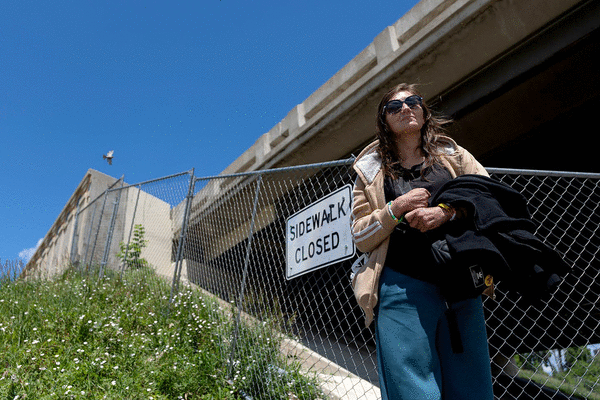
MINNEAPOLIS — Fences installed to prevent homeless encampments along a busy Minneapolis highway underpass have reignited frustrations from some residents who say the barriers are blocking pedestrian access ― sparking debate over whether the move to improve public safety is actually a hindrance to livability.
This spring, the Minnesota Department of Transportation (MnDOT) erected fences along Cedar Avenue where it crosses under the Hiawatha Avenue highway in order to clear out a large homeless encampment.
Officials say it was necessary due to safety risks and open-air drug markets which have been in the area of several fatal shootings in Minneapolis — including a pair of mass shootings within 12 hours of each other at a different encampment.
But people who frequent the area say the fencing has only created its own traffic risks by preventing pedestrians on Cedar from crossing to the other side of Hiawatha without walking through a lane of traffic.
The bottleneck caused by the fencing was on full display during a recent June downpour in Minneapolis. About two dozen people huddled beneath the Hiawatha Avenue overpass and onto a concrete median to get out of the rain. Some pitched tents, while others huddled to stay dry.
When the crowd spilled out into the lane of traffic on Cedar Avenue, workers put up orange cones to temporarily close the lane and keep anyone from getting hit. On the other side of the street, the fences blocked off the sidewalks where the tent encampment once stood.
Kayla Monroe, 30, who is unhoused and stayed at the encampment until it was swept out, said she is against the fencing and wants the various local agencies to stop restricting where people camp. She thinks the median is next.
“I’m guessing pretty soon they’re going to fence that up, too,” she said.
On one of the MnDOT signs for the fence closure, someone wrote with marker “Leave us alone.” Another segment was cut open by someone who previously broke through the fencing.
Joseph Coleman, 56, who has been unhoused for four years and uses a wheelchair, was holding a cardboard sign asking for assistance on Tuesday afternoon. He was upset as he watched an MnDOT worker tell people across the street to move their belongings.
“They’ve got this fence up blocking off a sidewalk that could be readily used to keep people from getting hit in the middle of the street, and I’ve seen people almost got hit several times,” Coleman said.
Local and state agencies say that while fencing isn’t a solution to homelessness, it’s required in some cases in order to break up and close off large encampment sites, some of which have been the site of not just shootings, but also human trafficking and open drug use and sales.
The camp residents and many others, however, say it’s moving issues associated with encampments down the road without improvement for communities or addressing the deeper struggles of homelessness.
Until June, pedestrians and cyclists could still safely cross Hiawatha Avenue by going over the bicycle bridge at the nearby intersection of 24th Street. But that, too, was fenced off roughly two weeks ago in response to people camping along the bridge.
Lillian, a 38-year-old Loring Park neighborhood resident who declined to give her last name, was bicycling east on 24th Street. She had to look at her phone and find a different path across Hiawatha Avenue after learning that the bike bridge was closed on her trip to a bookstore. The map application on her phone assumed she still would be able to access the bicycle bridge.
Lillian said she opposes fencing and thinks it would have been preferable to allow people to camp under the bridge and solely focus on getting them into housing.
“This traffic makes you feel more unsafe than a few unhoused people sitting on the side of a sidewalk ever would,” she said. “It’s all-around worse.”
MnDOT spokesperson Devin Henry said that highway rights-of-way and roadways “are not safe places for human beings to live and be,” and that for safety reasons some areas have been fenced in Minneapolis.
“As always when responding to the complex and urgent needs of people experiencing homelessness, MnDOT closely coordinates with local service providers and state and county partners to provide information, support and alternatives,” Henry said.
MnDOT declined a request for an interview with officials or to answer other questions sent by the Minnesota Star Tribune for this story regarding the broader conversation of fencing and homelessness.
Robert Lilligren, president and CEO of the Native American Community Development Institute (NACDI) and member of the Metropolitan Council, said he’s fed up by the mixture of chain link and metal bar fencing in this neighborhood which has a high Native population.
Lilligren said he’s been in discussions with multiple agencies about how he’d like to improve the area by turning it into an American Indian “cultural corridor” that attracts tourism and showcases Native art and restaurants. With the fencing on Cedar, along with other underpasses that have been closed, the fences are only making his vision harder to achieve, he said.
“It makes it feel like we’re living in a prison camp, which with the history of American Indians in this country, that’s not an unfamiliar feeling, especially in this area,” Lilligren said.
Unlike some other areas of Minneapolis that are solely city-owned, the jurisdiction of the sidewalks and land along this stretch of Hiawatha is much more complicated, with a convergence of city, Hennepin County, Metro Transit and MnDOT facilities in the area.
Minneapolis city spokesman Brian Feintech said the agencies are “all working together to try and preserve access while addressing safety concerns.”
“Steps needed to be taken to address crime and open air drug use,” he said. “The fences are temporary measures to allow time for all jurisdictions to identify better long-term solutions including crime prevention through environmental design directly beneath the bridges.”
The city has fenced other areas in response to public safety issues, such as outside of Minneapolis Central Library downtown. City staff from several departments meet twice a month with members of the Native American community to discuss “unsheltered homelessness, addiction and ways to collaborate toward a brighter future for this community,” Feintech added.
People who live and work in the area said that they see both sides, with fencing being necessary in some cases but also causing problems by pushing people into surrounding neighborhoods.
Debbie Lund, executive director of Baby’s Space child care center, which is a couple of blocks from the highway underpass, said the problems with people smoking drugs and blocking the sidewalk where parents drop off their kids tend to become worse whenever the underpass encampments are closed down or fenced.
Sometimes day care center employees have called 911 over gunfire, and livability concerns have gotten worse with needles strewn along the sidewalk and people defecating on the sidewalk and playground.
The day care is planning to build a new playground, along with a “bullet-resistant” fence to wall it off from the street to ensure safety, Lund said.
While fencing off encampments may affect neighbors, Lund said she understands the reasons for it.
“I get why we have this stuff going up, because it’s unsafe if they enter the underpass and people waver in and out of the road,” she said. “I oftentimes worry about that and how I would never want to hit anyone with my car.”
Minneapolis City Council Member Jason Chavez, who oversees Ward 9 which includes the Hiawatha Avenue corridor, said that while there is nuance and difficulty around addressing homelessness, he disagrees with the fencing strategy and said it has led to headaches for constituents trying to get around.
“Fencing that closes pedestrian paths blocks safe passage for people who bike, roll and walk, and scatters our unhoused neighbors, breaking up their support networks and making it harder for outreach workers to reach them,” Chavez said. “Displacement without a plan just moves harm around.”
©2026 The Minnesota Star Tribune. Visit at startribune.com. Distributed by Tribune Content Agency, LLC.





Comments