Cause of death revealed for Central Park carriage horse that reignited controversy
Published in News & Features
NEW YORK — The carriage horse that died suddenly in New York City’s Central Park last week expired after eating a “substantial” quantity of a poisonous plant, according to a necropsy report released Tuesday by the Transport Workers Union — a finding the union says undercuts claims the horse was worked to death as the union pointed the finger instead at the group that runs the park.
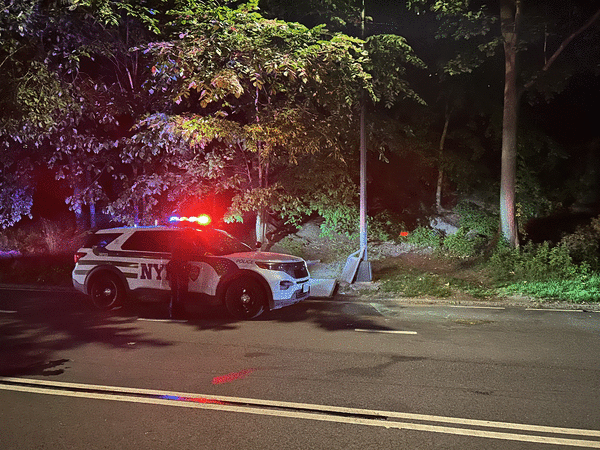
The horse, named Deniz, collapsed and died at W. 72nd St. and West Drive around 8 p.m. last Tuesday — setting off renewed debate about the ethics, and future, of the carriage horse industry in New York City. The necropsy, conducted by equine doctors with the Cornell University College of Veterinary Medicine, found “abundant plant needles” consistent with Japanese yew in the horse’s teeth, stomach and intestine, according to the report.
In a statement Tuesday, the union cast blame on the Central Park Conservancy — the nonprofit that manages the park, which joined calls last year to ban horse carriages — noting that Deniz’s owner saw the horse eat an unknown plant along the carriage drive near E. 90th St.
“Deniz’s tragic death was not caused by neglect or abuse or the fact he was a carriage horse — as some animal rights activists and elected officials claimed,” TWU’s administrative vice president Alexander Kemp said. “Poor Deniz died because the people running the Park Conservancy never warned anyone that there were deadly yew plants in the park. This is negligence at the highest level of the Conservancy.”
But the Central Park Conservancy said the circumstances of the horse’s death, in fact, point to negligence on the part of the TWU since “NYC Parks rules plainly forbid horses from eating vegetation anywhere across our 843 acres.”
“TWU has now demonstrated how their own negligence has resulted in this unfortunate incident,” the conservancy said in a statement.
“The same rule requires carriage drivers and operators to attend to their horses at all times in order to keep them safe and healthy. Perhaps if they had, Deniz would not have suffered as he did, and died.”
A dense shrub with green needles and distinctive red berries, Japanese yew is commonly used as an ornamental plant in landscaping. But the U.S. Department of Agriculture warns it is “one of the most toxic of all poisonous plants,” often responsible for deaths in livestock and even humans.
“Though the exact amount of ingested [yew] could not be quantified since the plant material was mixed with other ingesta, a substantial amount of the plant material was present in the stomach and the intestine,” the doctors wrote. “It was subjectively interpreted as enough to be lethal.”
“Very little material is needed to cause severe illness or death,” according to a plant guide published by the USDA. “It takes only 0.04 to 0.1% of an animal’s body weight in fresh plant material to be lethal in horses or cows.” Chemicals in the yew disrupt function of the heart, leading to death by cardiac arrest.
It was not immediately clear how the horse was able to ingest the toxic plant.
Deniz’s death comes amid a years-long debate about the future of carriage horses in New York City.
A coalition of animal rights activists has repeatedly argued that the very nature of the work — in which horses pull carriages with sightseeing passengers around Central Park — is inhumane. Mayor Zohran Mamdani has said he supports a ban.
But the TWU — which in addition to 38,000 subway and bus workers represents some 200 carriage horse owners and drivers — maintains that the work is fundamentally safe and the horses are well cared for.
The City Council is expected to soon step into the fray, with two competing visions of the industry’s future up for consideration.
One bill — a reintroduction of an effort known as “Ryder’s Law,” named after a carriage horse that died in 2022 — would sunset the industry, banning future licenses and effectively ending the sightseeing practice in the park.
Another bill, which has TWU’s backing, would require the long-dormant Rental Horse Advisory Board to conduct a study on the best practices for equine health, allowing the industry to continue with additional regulation.
Both bills are waiting to be heard before the Council’s Committee on Health.
---------
©2026 New York Daily News. Visit at nydailynews.com. Distributed by Tribune Content Agency, LLC.





Comments