Just what does Florida's homestead property tax amendment do? Your questions answered
Published in News & Features
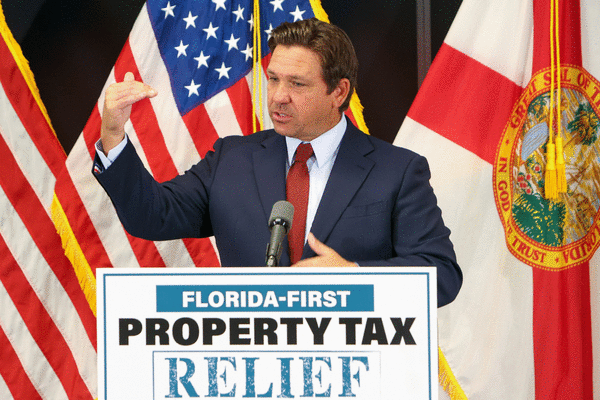
TALLAHASSEE, Fla. — Florida voters will decide on Nov. 3 whether to approve a constitutional amendment pushed by Gov. Ron DeSantis that creates property tax relief for homeowners while upending the way local governments pay for services.
The controversial measure, which would require 60% of voters to approve it, creates a lot of questions about how homeowners, cities and counties, and public employees would be affected. Here are some answers.
Q: Does the amendment completely eliminate property taxes for homeowners’ primary residences?
A: No. Contrary to what DeSantis initially said, it does not get rid of so-called “homestead” property taxes entirely — and the legislature limited the governor’s proposed cuts even further. In final form it eliminates non-school taxes only up to $250,000 of assessed value in the second year. And you will still pay school taxes after the first $25,000 of your home’s assessed value.
It also ties to inflation any increases to the $250,000 homestead exemption starting in 2029.
Q: How many properties in Florida are homesteaded?
A: Approximately 47% of the 11 million total parcels in the state are homesteaded.
Q: How many properties actually would have their property taxes eliminated?
A: None — or only the small number of homesteads worth less than $25,000, the level at which you would also avoid school taxes. But the ballot measure could eliminate non-school property taxes for about 28% of homeowners, those whose homes are valued at $250,000 or below, according to September 2025 data from the state Office of Economic and Demographic Research.
Q: When do the exemptions take effect?
A: If approved, cities and counties would exempt all homesteaded properties up to $150,000 of their assessed value on Jan. 1, 2027. That is $100,000 more than the current $50,000 homestead exemption. Analysts for the Florida House estimate that exemption would cost cities and counties $4.6 billion in non-school taxes the first year.
Come Jan. 1, 2028, the exemption on assessed value of homesteaded property would rise to $250,000, costing cities and counties $8.4 billion in the second year.
Q: How would this affect my local government?
A: That will vary depending on how much of a city or county budget comes from revenue from homesteaded property taxes. Orange County could lose $253 million or nearly 14% of its total county levy in 2028 once the full exemption takes effect, according to the Florida Association of Counties. Seminole County would lose $113 million or 24%, and Osceola County would lose $250 million or 15%.
Q: How would the exemption work?
A: On a typical Orange County home, with an assessed value of $330,000, the exemption in the first year would reduce the taxable value to $180,000 and $80,000 in the second year.
Q: Can cities and counties increase my assessed value to make up for the loss in tax revenue?
A: No. Homesteaded properties are protected by Save Our Homes, which prevents the assessed value from increasing by more than 3% a year or the percentage change in the Consumer Price Index, whichever is lower.
The actual cap has been lower than 3% in recent years because of dips in the CPI – 2.9% in 2025 and 2.7% this year, according to the Florida Department of Revenue.
Q: Can local governments raise fees and assessments that are not tied to property values?
A: Yes. In fact, cities and counties may raise fees and assessments for everything from fire protection to stormwater management to make up for the loss of revenue from homesteaded property taxes.
No estimates are available as to how much those fees could increase, but people could wind up paying more to reserve tennis courts or use a public pool, or see a reduction in library hours and even see branch libraries shut down due to lack of funding.
Q: Could local governments be dissolved?
A: Yes. Many of the state’s poorer cities and counties that already are living on the margin and depend on the state for assistance in providing basic services could go bankrupt or be merged with other local governments, officials warned.
Lawmakers accepted that as a possibility, and even removed from the amendment the promise of a state trust fund to offset the losses of fiscally constrained local governments, saying there was no guarantee this would happen.
Q: How does this affect newcomers to Florida?
A: The amendment would create a five-year homestead exemption on the first $50,000 of assessed value of homestead properties ($25,000 for school levies, $50,000 for non-school levies) for owners who are not permanent Florida residents as of December 31, 2026. The $50,000 exemption would be indexed to inflation after 2028.
New property owners after Jan. 1, 2027 would receive the same homestead exemption as permanent Florida residents only after five years.
Q: Are there tax exemptions for non-homesteaded properties: apartments, hotels, resorts, amusement parks, business offices and industrial complexes?
A: No. However, the cap on how much local governments can increase the assessed value on such non-homesteaded properties each year would be slashed from 10 percent to 5 percent.
The Florida Policy Institute estimates that cutting the cap in half will cost cities and counties $5 billion a year.
Q: Does the amendment limit how cities and counties can spend the remaining tax revenue?
A: Yes. If approved, cities and counties would be limited to seven “core services” spending areas:
—Public safety, including law enforcement, fire and emergency medical services
—Public schools and education
—Infrastructure, including roads and bridges, maintenance and storm water control
—Natural resources, including flood control
—Local bonds for uses consistent with the approved uses above, and to pay off debt service
—Retirement benefits of local government employees;
—Constitutional county offices including supervisor of elections, clerk of courts, tax collector and property appraiser “except those expenditures prohibited by general law.”
Q: Does it exclude any service areas?
A: It doesn’t exclude any specific services, but it doesn’t include things like mosquito control districts, fire districts, water management districts, Medicaid payments, and libraries. It also failed to include expenses cities and counties are supposed to pay for by state law: general government operations, maintenance, utilities, garbage collection, transportation, housing and urban development, veterans services, senior and community centers, hospitals, parks, and court services.
The Legislature voted down attempts to add additional “core” services, including children’s services and water management districts.
Q: Could some of my favorite local government services disappear?
A: Yes, if local governments are required to first pay for public safety, schools and retirement benefits for their employees, there will be less money left over for libraries, parks and other community benefits.
Q: Will it protect small businesses, as it says in the ballot language?
A: Nothing specifically points to protecting small businesses in the actual bill.
Q: Will it ensure fairness to all residents, as stated in the ballot language?
A: The provisions of the measure don’t extend to all Florida residents. There is no guarantee that renters will be protected from increased rent, for example.
_____
©2026 Orlando Sentinel. Visit at orlandosentinel.com. Distributed by Tribune Content Agency, LLC.





Comments