Expansion of Alaska program for developmentally delayed infants passes Legislature, awaits governor's decision
Published in News & Features


WASILLA, Alaska — Emma Pike just turned 1 and still hadn’t learned to walk, worrying her parents Greg and Tara Pike.
That’s when they were introduced to Alaska’s Infant Learning Program, which provides therapy and interventions for developmentally disabled infants and toddlers.
“She ended up crawling and walking in the same week once we got connected with a therapist,” Tara Pike said.
At 14 months old in 2013, Emma had some hearing tests already, but the Pikes’ ILP provider recommended more. Emma soon received ear tubes, and expanded her vocabulary from a few words to more than 100 in the first week.
The Pikes, who foster medically complex children, have fostered 16 total over the years, including six who have gone through ILP.
Tara Pike now offers training for new foster parents. She said ILP is “the best thing ever” and wrote her legislators in support of Senate Bill 178, which passed both the Alaska House and Senate with near-unanimous support and now awaits the governor’s signature to become law. The bill would increase funding and expand eligibility for the program, allowing providers to hire more staff and serve more children with developmental delays.
“ILP has changed the trajectory of our kids’ lives,” Pike said.
Legislators in Juneau have added ILP funding to the budget for the second year in a row. Last year, Gov. Mike Dunleavy vetoed the $5.7 million increase, citing unsustainable funding amid fiscal uncertainty. Advocates and providers are hopeful that Dunleavy won’t veto the funding again.
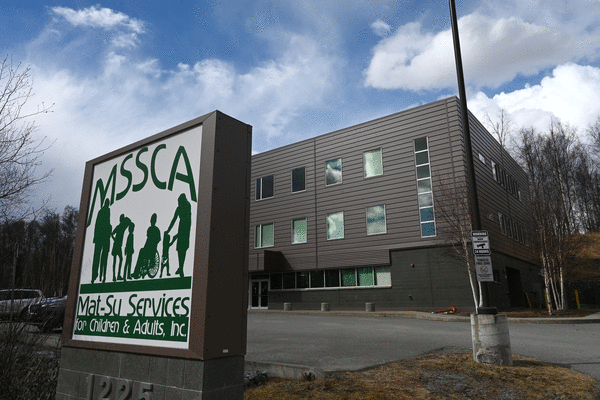
Stephanie Tucker is the infant, child and family supports director at Mat-Su Services for Children and Adults in Wasilla, the Pike family’s ILP provider. Tucker said they’re serving fewer children than in years past due to staff turnover and a combination of inflation and flat funding from the state since 2013. She believes if Dunleavy had understood more about the program last year, he would not have vetoed it.
“This needs to reach the governor’s ears,” Tucker said. “That is where we lost it last year.”
The state’s 15 ILP providers serve infants and toddlers with autism, speech delays and other cognitive issues from the time they are born until they turn 3 years old at no cost to the family, relying on federal and state funding. Providers typically visit families in their homes to observe the child’s behavior, connecting the parents with therapists or interventions that may improve their child’s delay.
To qualify, specialists, such as pediatricians, must determine a child is delayed at least 50% behind their peers. They use a screening tool called the “Ages and Stages” test to determine if the child’s reactions, expressions and brain development are in line with other children their age. But once they reach 3 years old, the standard to qualify for ILP is halved. Children who are 25% delayed or more qualify through the local school district, as defined by the Individuals with Disabilities Education Act. Alaska is one of three states with a 50% requirement to qualify for children from birth to age 3, and the only state that doesn’t include other criteria when considering which children are eligible.
Amy Simpson, executive director of the Program for Infants and Children in Anchorage, the state’s largest ILP provider, said about 1,600 Alaska children show delays somewhere between 25% and 49%, and would qualify for ILP at birth under the new standards.
“Anyone who has worked in early intervention for any length of time knows that what we’re doing is not early, it’s too late,” Simpson said. “A 50% delay is too late for many kids.”
Many children with cognitive delays will require special education services from their school district once they reach age 3. But 46% of children in the ILP show enough growth that they don’t need it. Providers say the state can save about $35 million annually by expanding access.
Simpson said the state‘s eligibility criteria for the program has not changed since she started 31 years ago, arguing on behalf of the new standards in SB 178.
“This is the right thing to do because these are little kids and they need help,” Simpson said. “But it’s also the fiscally responsible thing to do for the state.”
For some families, the success can be short-lived. Many children who qualify under the state’s 50% requirement quickly become ineligible after they receive ILP services and show signs of improvement.
Dr. Therese Tomasoski, a Wasilla pediatrician, said children with delays between 25% and 49% can become targets of abuse in the home if their parents don’t understand why they aren’t learning. She referred to these children as “in-betweeners” because they fall in between the state and school district threshold to qualify for ILP.
“We have a big group of kids that are those in-betweeners that don’t get extra help,” Tomasoski said. “By the time they get to where there’s more significant delays, we’re already behind.”
Most of a child’s brain development occurs before age 3, meaning their delays can be more difficult to make up after they age out of ILP.
Bonnie Whitefeather and her husband, Joseph, are also foster parents. They have 14 children, six who have gone through ILP. Their 6-year-old son Daryl graduated from the ILP program and is now testing at grade level for reading and math, but her younger son A.J. is one of the “in-betweeners.” He also graduated from ILP, but Whitefeather worries about his continued difficulty speaking.
“I’m terrified,” Whitefeather said. “I can see all of his successes, but at the same time, I can see that he still needs them.”
Whitefeather believes A.J. will still need special education when he reaches school age, but he doesn’t qualify for the program anymore. She said it was “heartbreaking” to know her child needed help she couldn’t provide.
“He would have qualified if it was the 25% mark,” Whitefeather said. “We’ve lost a lot of time that we could have been progressing.”
The bill includes nearly $6 million in funding for the program. About a half-million dollars would be distributed to providers to hire more staff, and about a half-million would pay for additional state employees to administer the program. The other $2.7 million in state funding would match federal dollars for therapies and interventions that don’t currently qualify for reimbursement. The bill would allow all intervention services under ILP to be reimbursed by Medicaid, as opposed to only occupational therapy, speech therapy and physical therapy that are currently covered.
Families who have seen their children improve under the program are eager to spread the word at daycares and playgrounds. During an interview at Mat-Su Services for Children and Adults in April, Pike said she had 37 appointments for her children to see doctors and therapists that week, and called it her “full-time job.” The Pikes were told their son Nick likely would never walk. Nick has palsy, apraxia and autism, and started the program at 2 weeks old.
“I was looking at my perfect 10-month-old baby going, ‘What is this going to look like? Is he going to walk?’” Pike said.
Nick was discharged from the program a year ago, and will walk into his kindergarten class when the new semester starts this fall.
“He has graduated out of special education,” Pike said. “Therapies change lives.”
_____
©2026 Anchorage Daily News. Visit at adn.com. Distributed by Tribune Content Agency, LLC.






Comments