Built for MAGA appeal, Alligator Alcatraz leaves Gov. Ron DeSantis with big political bill
Published in News & Features
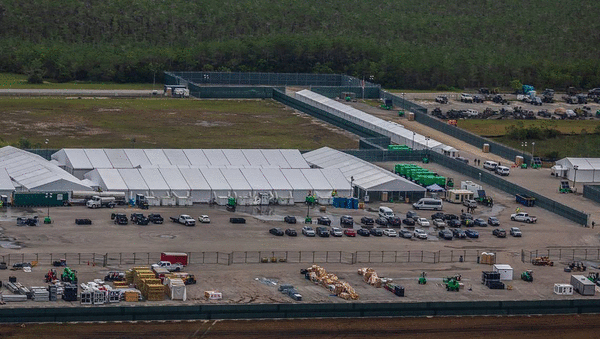
Gov. Ron DeSantis rolled out the state-run immigrant detention center dubbed “Alligator Alcatraz” last July with all the spectacle of a presidential campaign stop.
But less than a year after its launch, the controversial detention center is winding down operations. State officials have notified private contractors that the facility will soon close, bringing an abrupt end to what DeSantis once framed as the future of state-led immigration enforcement.
For DeSantis — now a term-limited governor searching for his next place in a calcified GOP still dominated by President Donald Trump — the closure carries political risk far beyond the Everglades.
Alligator Alcatraz was one of the clearest examples of DeSantis and his inner circle aligning themselves with the MAGA movement after the governor’s failed presidential bid: a flashy, hard-line project meant to show Trump allies that Florida could execute the aggressive immigration agenda conservatives had long demanded.
Now, as the project winds down amid mounting costs and criticism, Republicans are debating whether it should be remembered as a successful proof of concept or an expensive political stunt whose symbolism ultimately outweighed its results.
The reasons for the closure are as much financial as political. Federal officials have pointed to staggering operating costs — reportedly approaching a $1 million-per-day burn rate — as questions mounted over whether the state’s unprecedented experiment was sustainable. Florida has requested roughly $608 million in federal reimbursement, but Washington has yet to approve the payment despite repeated assurances from DeSantis that the state would be made whole.
The soon-to-be-shuttered facility poses a broader question for DeSantis as he enters the final stretch of his governorship: whether Alligator Alcatraz will ultimately be remembered as a bold conservative experiment — or as an extraordinarily expensive political symbol whose notoriety eclipsed its practical results.
The Republican governor pitched the pop-up facility — hastily constructed on an abandoned airstrip deep in the Everglades — as a national model for states eager to assist Trump’s mass deportation campaign.
Standing beside DeSantis during a walk-through tour of the compound, Trump praised the operation as “so professional, so well done,” while then-Homeland Security Secretary Kristi Noem hailed Florida as the tip of the spear for conservative immigration enforcement.
The facility’s headline-grabbing nickname, coined by Attorney General James Uthmeier, quickly became both a political slogan and a fundraising brand. DeSantis allies embraced the imagery of razor wire, swampland and alligators with unusual enthusiasm.
Uthmeier’s campaign website still sells baseball caps and bumper stickers emblazoned with the Alligator Alcatraz moniker, while conservative influencers continue to treat the compound as a symbol of Republican toughness on immigration.
DeSantis, for his part, has shown little sign of second-guessing the effort.
“Do you want some illegal alien from Guatemala who has molested kids to be released back into your community? Or do you want them sent back to their home country?” the governor said at a Wednesday press conference, arguing the detention center filled a temporary gap when federal authorities lacked sufficient detention capacity.
“Being able to fill that void — where, at the time, the federal government did not have the resources to do — no question that saved lives. No question it’s increased public safety. And no question it’s the right thing to do to defend the sovereignty of this country,” DeSantis said.
He also dismissed criticism of the facility’s enormous price tag, arguing taxpayers ultimately save money through aggressive immigration enforcement.
“You avoid all these different things you end up footing the bill for when you have an open border,” DeSantis said, citing healthcare, education and law-enforcement costs associated with undocumented immigration.
The governor’s allies have similarly framed the project as a success regardless of its short lifespan. They point to the roughly 22,000 deportations tied to the operation as evidence that Florida stepped into a vacuum while the federal government scrambled to expand detention infrastructure under Trump’s renewed crackdown.
But even within the MAGA movement, frustration is growing over the facility’s closure. Some Trump allies see the decision as politically baffling at a moment when Republicans continue campaigning on promises of mass deportation.
Far-right pundit Laura Loomer criticized the shutdown during a recent interview with State Rep. Meg Weinberger, a Palm Beach Gardens Republican aligned with Trump.
“It was touted as this revolutionary immigration facility,” Loomer said. “I think a lot of people are kind of confused as to why they put so much money into building Alligator Alcatraz and now all of the sudden — right before the midterm elections — they’re talking about shutting it down when this was a campaign promise.”
Weinberger echoed the confusion, saying she did not understand why Florida would scale back detention capacity as the Trump administration pushes for expanded deportation efforts nationwide.
“I can’t understand why we would do something like that when all we are trying to do is protect the citizens of our state,” Weinberger said. “The people who are voting us into office — when do we protect them?”
Other Republicans have framed the closure more pragmatically.
Rep. Juan Carlos Porras, a Miami Republican and occasional DeSantis critic, described the facility as a “successful” but temporary operation that helped relieve overcrowding pressures at South Florida detention centers such as Krome.
“It was always supposed to be a temporary facility,” Porras said. “I’ve had choice words for the governor over the years, but we’ll agree on 99% of policy issues, including immigration.”
Still, Porras questioned whether DeSantis will receive lasting political rewards for spearheading the effort.
“He can look back on it as something that supported the president and what the American people voted for,” Porras said. “But I don’t really know where DeSantis thinks he’s gonna go. I don’t think there’s any place for him in Washington.”
That uncertainty hangs over much of DeSantis’ final chapter in Tallahassee. Once viewed as the heir apparent to Trump and a dominant force within the Republican Party, DeSantis has spent the years since his failed 2024 presidential campaign recalibrating his political identity.
His relationship with Trump has improved markedly, but questions remain about what role, if any, the governor might play in the White House or in Republican politics after leaving office in 2027.
Alligator Alcatraz was in many ways emblematic of DeSantis’ political style: confrontational, media-savvy and designed to dominate conservative discourse. The facility generated wall-to-wall cable coverage, viral social media clips and outrage from liberal critics — often exactly the type of political dynamic the governor has thrived on throughout his rise to national prominence.
But the project also exposed the limitations of governance by spectacle.
It never quite lived up to DeSantis’ vision of a one-stop shop for deporting the “worst-of-the-worst” immigrants. Instead, the remote facility morphed into a grim waystation for immigrants with and without criminal records, some of whom spent weeks or months there or were ping-ponged between detention facilities.
And for all the headlines and merchandise, Florida taxpayers may ultimately be left carrying hundreds of millions of dollars in costs if federal reimbursement never arrives. The detention center’s rapid construction and equally rapid demise have also fueled criticism that the state prioritized political theater over long-term policy planning.
Scott Mechkowski, a visiting fellow with the hard-line immigration group Oversight Project, said the facility made sense politically and operationally during the early months of Trump’s deportation push, when conservative states were scrambling to expand detention infrastructure. But he suggested the momentum behind the project faded as illegal border crossings declined and the costs mounted.
“Trump lights a 10-ton megabomb and says ‘go.’ Florida is a whole different animal, and Alligator Alcatraz was perfect for it,” Mechkowski said. “It served a purpose. One billion dollars worth? I don’t know. Maybe people came to their senses and realized the costs outweighed the benefits.”
_____
©2026 Miami Herald. Visit miamiherald.com. Distributed by Tribune Content Agency, LLC.






Comments