Florida suspends sloth imports amid Sloth World debacle
Published in News & Features
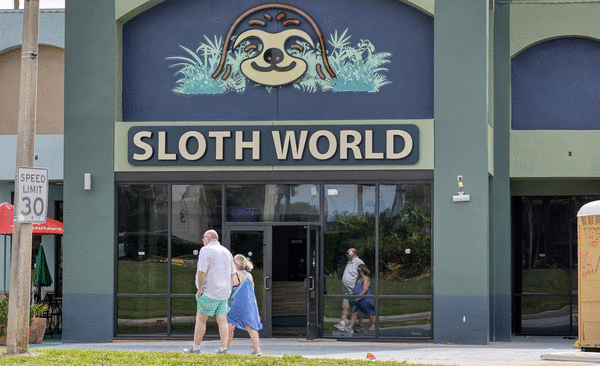
ORLANDO, Fla. — The Florida Fish & Wildlife Conservation Commission on Wednesday suspended most sloth imports to the state for 60 days, a victory for lawmakers and conservationists seeking to secure a permanent ban following the deaths of dozens of the animals acquired for a scrapped Orlando attraction.
“Florida making this decision will send a ripple effect across the country,” said state Rep. Anna Eskamani, D-Orlando, who had met with FWC officials to voice her concerns along with sloth experts based in Costa Rica.
The executive order, published hours after it was announced in a public meeting in Ft. Myers, still allows the entry of sloths scheduled to arrive in Florida before Wednesday if there is proper documentation, including a captive wildlife importation permit issued by FWC.
It’s not clear how the order will be enforced, and an FWC spokesperson did not respond to a message seeking comment.
In a video call with reporters, Eskamani said the suspension allows time to craft new rules excluding sloths from being allowed to be kept as pets or for exhibition. Such rules could have an impact as soon as this year while congressional lawmakers and the Florida Legislature pursue further reforms.
“We’re hopeful that the pause will also give us the opportunity to craft really intentional rulemaking changes,” said Eskamani, who further called for an end to the commercial ownership of sloths.
In Ft. Myers, FWC Executive Director Roger Young said discussions on rule changes “have already begun, and we look forward to beginning with staff and the industry moving forward.”
“To be clear, this very unfortunate situation resulted from one facility, Sloth World,” he said. “They are no longer licensed and it is not a widespread issue.”
Sloth World, once slated to open on International Drive, was abruptly canceled following news reports of 31 deaths of sloths in its care between December 2024 and February 2025, with three more having died after the animals were transferred to the Central Florida Zoo.
Twenty-one of those sloths, originally from the South American country of Guyana, died from a hypothermic “cold stun” reaction caused by faulty space heaters installed inside the warehouse where they were housed. Another 10 died of viral infections shortly after arriving to Central Florida from Peru, according to records first reported by Inside Climate News.
Necropsy reports reviewed by conservation groups put the total death tally at 55 sloths, with 21 additional deaths at the ill-fated attraction having occurred following the initial 31.
The revelations led to calls for a criminal investigation into Sloth World’s owners, prompting confirmation by Attorney General James Uthmeier on May 1 that one was underway. The Orange County Sheriff’s Office recently confirmed it is conducting the investigation.
Rebecca Cliffe of the Sloth Conservation Foundation and Sam Trull of the Sloth Institute, organizations based in Costa Rica, arrived in Central Florida last week to speak with state and local authorities and zoo officials about the matter, culminating in FWC ordering the temporary suspension.
“This is not only a huge step for Florida, it’s a huge step for all of the United States and it’s a huge step for sloths all over the world,” Trull said Wednesday.
A 2025 analysis of import data by The Sloth Institute found Florida is the primary gateway for these animals entering the U.S., with 98% of all imports going through the Port of Miami between 2011 and 2021. A vast majority of the sloths, 97%, come from Guyana.
Sloths primarily live in rainforests and are known as biological introverts for their highly specialized diets and survival mechanisms adapted over millions of years of evolution. Removing them from their environments and shipping them overseas can be a death sentence, experts say, with illnesses, often stress-induced, being difficult to detect before it’s too late.
Eskamani said it was “unbelievable” that so-called Class III permits, which allow for certain animals to be kept for personal or commercial use, were “appropriate for an animal as sensitive as sloths. … They’re also defined by their risk to the human, not the risk of the human to the animal.”
Eskamani also called for reforms to how FWC oversees facilities housing the animals, as the agency is not equipped to perform medical checks on the animals. In the case of Sloth World, FWC issued a verbal warning following a 2025 inspection for the size of the cages in which they were housed, which reports indicate were later rectified. However, its facilities never received required local use permits, Orange County has said.
As investigations into Sloth World continue, the pause on imports is welcomed by advocates as a first step. A federal import ban is the ultimate goal, said Cliffe of the Sloth Conservation Foundation, but FWC’s order in the meantime “fills us with so much hope to keep fighting.”
“Those sloths need justice,” she said, “and we’re not going to stop until we get it at the highest level.”
------------
©2026 Orlando Sentinel. Visit at orlandosentinel.com. Distributed by Tribune Content Agency, LLC.






Comments