Lawmakers query Iran war cost as Trump renews destruction threat
Published in News & Features
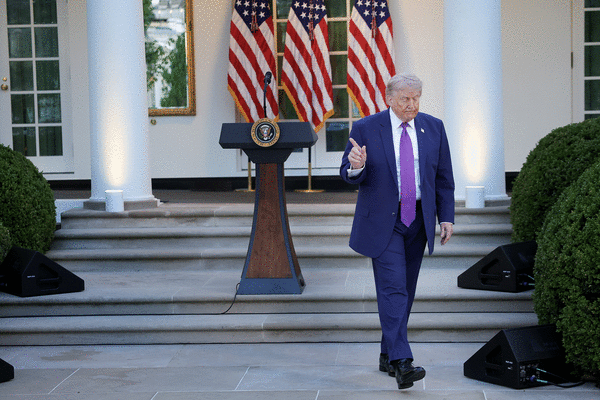
WASHINGTON — U.S. lawmakers pressed Pentagon chiefs for details on the mounting costs of America’s deadlocked war with Iran, amid signs the conflict is pushing up consumer prices at home too. President Donald Trump said the Islamic Republic will be “decimated” if a deal can’t be reached.
Defense Secretary Pete Hegseth declined to give a breakdown of costs as he faced questions about the conflict in Congress, as part of a hearing on the administration’s unprecedented $1.5 trillion defense spending request for next year. Jules Hurst, the Pentagon’s acting comptroller, said the war’s estimated price tag has risen closer to $29 billion, from a $25 billion estimate that had been questioned as unrealistically low.
Hegseth and General Dan Caine, the chairman of the Joint Chiefs, also declined to give details about U.S. assessments of the levels of Iran’s missile stocks. They were pressed on the topic by lawmakers, who cited a gap between administration claims to have destroyed most of the weapons earlier in the conflict, and recent reports suggesting larger numbers were intact.
Ten weeks into the war that began with U.S.-Israeli attacks, a ceasefire has held for about a month. But it’s under growing strain, Trump said Monday as he dismissed Iran’s latest offer as “garbage.”
Tehran has given no indication that it’s willing to back down from its key demands, which include the end of a U.S. naval blockade, sanctions relief and a degree of control over traffic through the Strait of Hormuz. The Trump administration says it wants a deal that would curtail Iran’s nuclear program and restore freedom of shipping.
Hormuz remains all but closed — depriving the world economy of vital supplies of energy as well as other goods like fertilizer, metals and chemicals — and oil extended gains Tuesday. The commodity squeeze is starting to bite in the U.S., where a new report showed the cost of living jumped 3.8% in the 12 months through April — the most since 2023 — amid rising gasoline and grocery prices.
Trump, who’s headed to Beijing this week for a summit with his counterpart Xi Jinping, told reporters on Tuesday that the two leaders will discuss the Iran war. But he said it won’t be a major topic there because the U.S. has Iran “very much under control.”
“We’re either going to make a deal or they’re going to be decimated one way or the other,” Trump said. He’s repeatedly threatened to resume the conflict with attacks on targets including civilian energy infrastructure. Iran says it would retaliate with strikes on other Gulf countries, likely deepening the global fuel crisis.
“The U.S. and Iran remain too far apart for a deal,” wrote Bloomberg Economics’ Dina Esfandiary and Becca Wasser. “If neither side is willing to make concessions, then a lasting peace deal will remain elusive, sporadic increases in intensity and protracted war the most likely scenario.”
China, where Trump is set to meet Xi on Thursday, buys the bulk of Iran’s crude and is in a unique position to exert some diplomatic sway. Trump, meanwhile, is under economic and political strain, as high fuel prices threaten to hit Republicans in the November midterm elections.
The president predicted Tuesday that inflationary impacts will be “short-term” and said oil prices will come down after the war. Trump indicated earlier this week he’ll seek a gasoline tax holiday to ease some of the burden on consumers.
Sporadic attacks on tankers have kept shipowners wary of attempting to exit the Persian Gulf via Hormuz. Qatar is asking ships at its main liquefied natural gas export facility to turn off their transponders, according to people familiar with the matter, with one calling it a safety measure. A cargo ship was targeted by a drone in Qatari waters last week.
The United Arab Emirates retaliated against Iranian attacks on its territory earlier in the war, according to people familiar with the matter, coordinating with Israel as the two countries deepen security ties. Saudi Arabia also conducted some retaliatory strikes in March, Reuters reported on Tuesday. Iran says Gulf Arab countries were complicit in the U.S.-Israeli attack because they allowed airspace and U.S. bases to be used.
The UAE, one of only a few Arab countries to formally recognize Israel, was targeted by Iran more than any other country in the region. On Tuesday, Washington’s Ambassador to Israel, Mike Huckabee, said Israel had sent Iron Dome missile defense batteries to the UAE during the war, along with personnel to operate them.
Here’s more related to the war:
—Iran won’t join another round of talks with the U.S. unless five confidence-building preconditions are met, including sanctions relief and release of frozen funds, the Fars news agency reported.
—The U.S. said it’s releasing additional barrels of oil from its strategic reserves to help tame surging prices.
—The main natural gas plant supplying fuel in the UAE will only return to full capacity next year. The Habshan facility is operating at about 60% capacity and aims to reach 80% by the end of this year, Adnoc Gas Plc said.
—An oil supertanker that exited the gulf on Sunday hauling a cargo of Iraqi crude appears to have stopped shy of the U.S. blockade line and turned back into the Gulf of Oman.
_____
(With assistance from Salma El Wardany, Roxana Tiron and Courtney McBride.)
_____
©2026 Bloomberg L.P. Visit bloomberg.com. Distributed by Tribune Content Agency, LLC.






Comments