Supreme Court moves Alabama closer to new congressional map
Published in News & Features
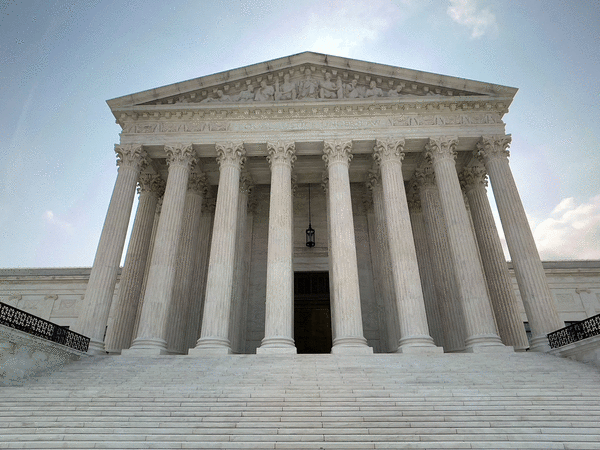
WASHINGTON — The Supreme Court on Monday set aside a lower court ruling that found Alabama’s congressional map illegally and unconstitutionally discriminated against Black voters, potentially paving the way for the state to adopt a map with one less district where Black voters have an opportunity to influence the result.
The unexplained, unsigned order Monday sent the case back to a lower court and instructed the judge to reconsider the result in light of last month’s Supreme Court decision about Section 2 of the Voting Rights Act. That decision invalidated a Louisiana congressional map with two Black opportunity districts.
Legislators on Friday passed a law to allow the state to delay the May 19 primary and use a congressional map it drew in 2023 for this year’s elections. The 2023 version has one Black opportunity district.
State leaders on the same day asked the justices to allow an emergency pause of the lower court order that blocked that 2023 version. That lower court later required the state to use a map that has two Black opportunity districts.
Instead, the Supreme Court set aside the lower court judgment entirely, as well as in two other cases that included Voting Rights Act challenges about Alabama’s congressional districts.
Justice Sonia Sotomayor, joined by Justices Elena Kagan and Ketanji Brown Jackson, dissented from the order and argued it would “unleash chaos” and “confuse voters” with a primary still scheduled for next week.
Vacating the district court’s injunction will “immediately replace the current map with Alabama’s 2023 Redistricting Plan until the District Court acts, even though voting has already begun,” Sotomayor wrote.
The dissent also points out that “the District Court remains free” to decide for itself whether the Supreme Court’s decision on Louisiana’s map affected the reasoning for blocking the state’s map, which included a finding that state officials had intentionally violated the 14th Amendment.
The dissent also argued that the majority should not have tossed aside the lower court ruling without any findings that the lower court was incorrect.
“In short, the record showed that Alabama made an intentional choice to perpetuate and entrench, rather than remedy and uproot, the racial discrimination that the District Court had previously found and that this Court had affirmed,” Sotomayor wrote.
Monday’s order came just after groups of voters and civil rights groups asked the justices not to allow Alabama to proceed. The three filings argued that the Supreme Court should not agree with the Alabama legislature’s last-minute effort to ram through a new map.
“The highest court of our nation should not grant its imprimatur to Appellants’ unlawful and unconstitutional conduct,” one response said.
The challengers argued that it’s possible to draw race-neutral maps where Black voters have a chance to influence the outcome. The brief said the legislature rejected multiple maps, from the map challengers and others, that would have satisfied the legislature’s stated redistricting goals.
A filing also argues that Alabama’s constitution prohibits changes to the election less than six months before election day, which makes the state’s statute too late.
Allowing the state to cancel its primary now would cause a “logistical nightmare” the filing said, citing the state’s own reasoning for keeping its 2021 plan on the books for the 2022 midterms.
“Entering a stay so that Appellants can at the last minute violate Alabama’s statutes and constitution by replacing a lawful plan with an unlawful one would create chaos and would reward Appellants for their repeated false statements to this Court,” the filing said.
The state Republican leaders, in their emergency application last week, argued that since last month’s decision invalidating a similar Louisiana map, the state should be allowed to use a new one passed by the legislature last week.
Alabama’s congressional map has been in litigation since shortly after the 2020 census results were released. The state originally passed a congressional map with one Black opportunity district, in roughly the center of the state.
Several groups of voters sued, arguing that the state legislature sought to dilute the power of the state’s Black population. The state has six congressional seats and a roughly a 30% Black voting population.
In 2023, the Supreme Court agreed, finding the state should have a map with two opportunity districts.
After that ruling, the state abandoned its original 2021 plan and passed a new map in 2023. That map too, was blocked by the courts and found to be discriminatory after a trial last year.
After last month’s Louisiana ruling, the state reinstated its 2023 plan and asked the justices to lift the lower court ruling preventing its implementation.
Monday’s order comes amid a last-second flurry of redistricting from Alabama, Louisiana and Tennessee seeking to divide currently Democrat-held congressional districts across the south.
_____
©2026 CQ-Roll Call, Inc., All Rights Reserved. Visit cqrollcall.com. Distributed by Tribune Content Agency, LLC.






Comments