Boston City Council budget chair pitches defunding Fire Department to restore mayor's $724,000 veterans cut
Published in News & Features
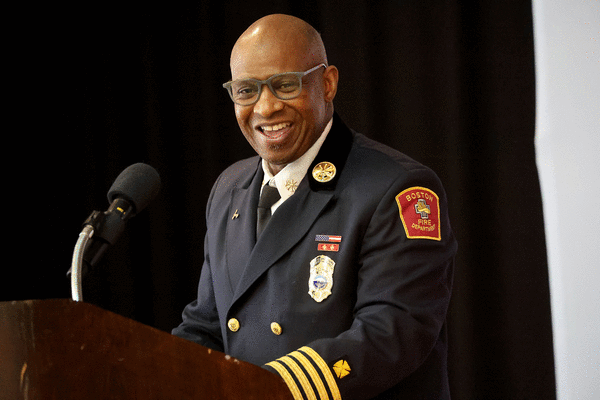
BOSTON — Boston City Councilor Ben Weber, who chairs the Council’s budget process, caused a stir by saying that he’s considering cutting from the Fire Department to restore the mayor’s proposed $724,000 cut to the veterans budget.
Weber’s suggestion, which he confirmed on Monday, was first revealed by Councilor Erin Murphy last week, when she said she had spoken with Weber about the matter after the Council voted, 11-0, to approve her resolution urging Mayor Michelle Wu to restore the proposed 14.6% cut to the veterans’ services office.
“I do not support restoring this funding by cutting another vital department,” Murphy said in a statement last Wednesday. “(Weber), the chair of Ways and Means, told me that he suggested the Fire Department could absorb the entire proposed cut to the Office of Veterans’ Services because many firefighters are veterans and, in his view, should be sympathetic to protecting veterans’ services.
“But why should firefighters be expected to carry the burden simply because many of them are veterans?” Murphy added. “Every member of this City Council and the mayor should be sympathetic to protecting veterans’ services. The obligation to support veterans, military families and surviving spouses belongs to the City of Boston, not to one department’s workforce.”
Murphy pressed the matter again on Monday at a City Council Ways and Means committee hearing on the Fire Department’s budget.
She said that rather than the Council’s budget amendment process, which gives the Council the ability to transfer funding between city departments but not reduce or increase the mayor’s proposed $4.9 billion budget, the city can dip into its $1.7 billion reserve fund to restore certain cuts.
Murphy didn’t specify what cuts could be covered by reserves, but she mentioned the possibility while speaking about the proposed $724,000 cut to veterans’ services and the loss of $1.4 million in grant funding for firefighter cancer screening that was raised as a major concern by fire officials at the budget hearing.
Weber dismissed the possibility of using reserves to cover the veterans cut, and confirmed that he is considering reducing Fire Department spending instead in a Monday statement to the Herald.
“I agree with my colleagues that we should work to restore funding for our vets,” Weber said. “Asking the mayor to simply increase the total budget or dip into reserves at a time when our residents are feeling the weight of rising property tax bills, however, is not fiscally responsible. Moreover, this approach could jeopardize our AAA bond rating and the city’s overall financial health.
“If we are serious about restoring this $724,000, we have to make difficult choices. I mentioned the Fire Department’s $336 million budget — the third largest in the city — because of the deep connection between our firefighters and our veteran community. If we can’t find a fraction of a percent within our largest departments to support our vets, then we aren’t having a serious conversation about priorities.
“I am committed to the amendment process and I am all ears for practical solutions. I invite Councilor Murphy and all my colleagues to join me at the table to identify specific, line-item offsets. Our veterans deserve a funded mandate, not an empty promise that leaves the bill for the next generation to pay,” Weber added.
Councilor Ed Flynn, a U.S. Navy veteran who served in Operation Enduring Freedom, has slammed the mayor’s proposed veterans budget cut as “unconscionable,” and said Monday that he would also “fight tooth and nail” against any cuts to the Fire Department budget.
Flynn told the Herald it would be “pretty outrageous” to cut a firefighter preventive cancer screening program, which fire officials said is at risk after the city’s grant application for roughly $1.4 million in funding was denied this year after approvals in past years.
Sam Dillon, president of the Boston firefighters union, Local 718, said Monday that while the union supports veterans, it does not support cutting from the Fire Department to subsidize another budget.
“Local 718 is a proud supporter of veterans and the veterans community,” Dillon told the Herald. “That being said, Local 718 does not, by any means, support any reduction to the Fire Department budget to subsidize any other initiative for the City of Boston, including veterans’ services.”
In response to suggestions that the Fire Department may support giving up some of its funding to the veterans department, given the connection between firefighters and military service, Dillon said it’s up to the city — not firefighters — to find ways to fund veterans’ services.
“Local 718 proudly counts many veterans among our ranks and amongst our membership,” Dillon said. “Nobody understands what veterans have to deal with more than fellow veterans. That being said, all the more reason that we’re taking the position — the City of Boston, it’s their responsibility to fund veterans’ services and public safety without taking one to subsidize the other.”
Dillon said the union has concerns about the potential loss in funding for health and wellness programs such as mental health and early detection cancer screenings, which he said are “essential to Boston firefighters.”
“We’re concerned that those benefits for our members may not be readily available to them, which is all the more reason why we can’t support or endorse any cuts at all to the Fire Department budget,” Dillon said.
He explained that health insurance companies may otherwise deny screening requests due to lack of symptoms.
“Being a firefighter is the symptom,” Dillon said. “It’s the most dangerous job in the city, and these early detection screenings are essential. When you look at what our people are exposed to on a daily basis, we have to have these screenings in place to catch cancer as early as we possibly can.”
Weber said he supports trying to find ways to make up for the loss of cancer detection grant money, “but again, the question is where the funding comes from.”
He said, “Delivering important services like cancer screening within the constraints of our budget will require compromise.”
_____
©2026 MediaNews Group, Inc. Visit at bostonherald.com. Distributed by Tribune Content Agency, LLC.






Comments