'What are they thinking?': Feminist leaders denounce Haitian ministry shakeup
Published in News & Features
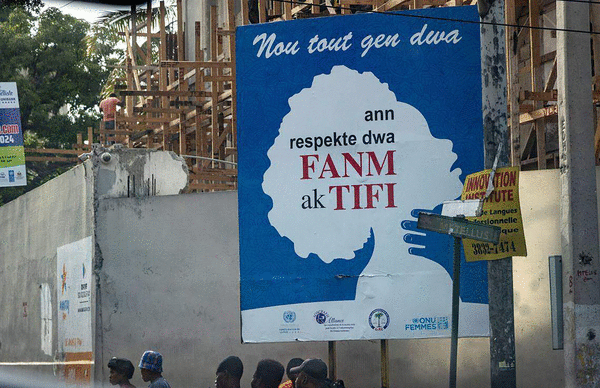
Feminist organizations in Haiti are condemning a decision by the government of Prime Minister Alix Didier Fils-Aimé to remove the female director general of the country’s only ministry dedicated to women’s rights and replace her with a man.
In a sharply worded statement, nearly three dozen women’s groups and individuals —including six former heads of the Ministry on the Status of Women and Women’s Rights — are denouncing the dismissal of Sandy François, a career public servant who spent more than 30 years working within the ministry. She will be replaced by Hermanex Gonzague Désir.
“We have too many women with the expertise, the competence, everything we need, to be in charge of this ministry,” said Pascale Solages, co-founder of the feminist organization Nègès Mawon.
The organization, which has been deeply involved in responding to the surging cases of rape and violence against women and girls by armed groups, said the issue is not only the removal of François, but what activists see as a broader pattern of excluding women from Haiti’s male-dominated political corridors.
Fils-Aimé, who was visiting the pope over the weekend, could not immediately be reached. He installed a new Cabinet earlier this year after emerging as the sole leader of Haiti’s transition government. While his office has promoted the Cabinet as bringing in newer and younger faces after he secured the backing of hundreds of political groups and civic organizations, critics have described his Cabinet as underwhelming and too closely aligned with some of the same political forces that have dominated Haiti’s politics for years.
“What are they thinking?” Solages said. The prime minister should not be replacing François “at this moment where we are talking about elections and where we are pushing for having more women in the electoral process, protecting women in the electoral process; at this moment where we need more women’s voices and women leadership to fight against the gender-based violence situation in the country.”
She added: “You think that the best choice is to replace this woman ... with a man in this position?”
Few women in government
François’ removal reduces the number of women serving as director generals in Fils-Aimé’s government to just three out of 18 ministries. That number, the letter points out, is well below the constitutional requirement that women occupy at least 30% of positions in public office.
Weakening women’s participation within the ministry during a period of political crisis and ahead of elections represents “a particularly serious violation of women’s rights,” the letter said.
It also is part of a broader pattern of exclusion in a deeply male-dominated Haiti. “This move by the Prime Minister is part of a long series of practices that marginalize the rights of women and girls, in contradiction of policies formulated for an effective and equitable transition,” the groups said in their letter.
Activists also argue that it also reinforces women’s underrepresentation at a moment when they are being disproportionately affected by the ongoing violence by armed groups.
In March, as the United Nations celebrated International Women’s Day, its political office in Haiti highlighted the worsening conditions facing women and children, and urged Haitian authorities to pay greater attention to safety and rights.
Women and children account for more than half of the nearly 1.5 million people who have been forced by the violence to flee their homes, the U.N. Integrated Office in Haiti said. The country recorded more than 8,000 incidents of gender-based violence in 2025, more than half involving sexual violence. Nearly two thirds were gang rapes and at least 566 cases of sexual violence against minors were recorded, including 160 cases of gang rape.
“At a time when security and the organization of free and inclusive elections have become major national priorities, women must play a central role in building a safer, fairer and more democratic society, ensuring their full participation at all levels of the decision-making process,” the U.N. said. “In a country where women continue to be underrepresented in public and decision-making spheres, it is more necessary than ever to pacify the political space, make it fair and accessible, and adopt inclusive policies and legal frameworks.”
Solages said the opposition to the appointment of Désir, who has worked in the ministry for more than two decades, was not personal. But the fight for female leadership and more women’s voices in Haiti’s affairs is part of a broader political struggle — one that led to the existence of the women’s ministry decades ago.
“It’s not our desire to give more men positions of leadership when you have so many women who can do that job,” she said.
_____
©2026 Miami Herald. Visit miamiherald.com. Distributed by Tribune Content Agency, LLC.




Comments