University of California, unions and state lawmakers back $23 billion bond to counter Trump's funding cuts
Published in News & Features
SACRAMENTO, Calif. — When President Donald Trump returned to the White House, he began canceling federal grants that helped fund research across University of California campuses. The university system estimates that over 1,600 grants awarded to the research powerhouse have been impacted by those cuts, resulting in a potential loss of over $1 billion in federal funding.
Now, the university, a union representing UC employees and a long, bipartisan list of state lawmakers hope that Californians can make up for the funding gap created by Trump’s cuts.
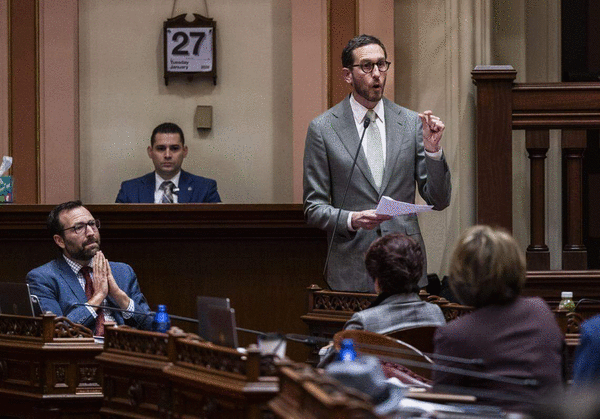
“Science is part of California’s DNA, and we know that the science that comes out of California changes the world,” Sen. Scott Wiener, D-San Francisco, told hundreds of people who attended a Monday rally in support of a proposed bond to backfill federal funding losses.
If lawmakers and Gov. Gavin Newsom approve the proposal, Senate Bill 895, a $23 billion bond to fund scientific research in California will appear on voters’ ballots in November. Wiener noted that roughly a third of California lawmakers have already signaled support for the proposal.
“This administration, this completely deranged regime … wants to stop research for ALS and Alzheimer’s and for cancer and for diabetes,” Wiener said. “We’re going to stop that wrecking ball.”
Depending on interest rates, the total cost of the bond to California taxpayers will be somewhere between $41 billion and $45 billion, according to a legislative analysis of the bill.
White House spokesperson Kush Desai said that the Trump administration canceled federal research grants for diversity, equity and inclusion efforts “and other left-wing ideological pet projects.”
“If California Democrats want to push more tax hikes on California residents to fund DEI and other pointless research, that’s on them,” Desai said in a statement.
UC President James Milliken said that because of actions taken by the Trump administration, “the University of California is facing the most significant disruption to our research enterprise in our history.”
He said that funding for research has received bipartisan support from federal lawmakers in the past, and those investments have helped make the UC system such a successful research institution. (Last year, five UC-affiliated researchers won Nobel Prizes, Milliken noted.)
“It’s inconceivable that we would voluntarily relinquish the leadership that has propelled our country, fueled our economy, made us healthier and made us safer,” the UC president said.
The proposal also has strong backing from UAW, a union that represents roughly 60,000 university employees. Supporters of the measure said Monday that federal funding cuts have already resulted in layoffs at University of California campuses. These funding losses not only impact the individuals who lose their jobs, but also threatens to delay future discoveries.
“I’ve met auto workers, factory workers across this country who rely on this research,” UAW President Shawn Fain said. “People whose families’ lives have been saved by cutting-edge cures and interventions that were only possible because of the work achieved on college campuses.”
UC Davis Vice Chancellor for Research Simon Atkinson said his university received funding from the U.S. Agency for International Development, which was one of the federal agencies most significantly impacted by cuts imposed by the Trump administration.
One specific example of research that is funded through USAID was studies into how to make crops more resilient in the face of climate change. That type of critical research will be more difficult to pursue if voters don’t approve this bond, Atkinson said in an interview.
Asked about California’s appetite for higher taxes to pay for this bond, Weiner said that voters in the past have been supportive of critical issues, such as housing, education and climate change.
“Our job will be to make the case to voters that this is not nice to have, but essential to the state,” Wiener said of he and his fellow lawmakers’ responsibility to garner support for the measure once it qualifies for the ballot.
A spokesperson for Wiener said his office arrived at the $23 billion figure based on estimates of how much research funding the Trump administration has attempted to cut from California research institutions.
The Senate Appropriations Committee will need to approve the measure next week before it is moved to the Assembly.
_____
(Reporter Kate Wolffe contributed to this story.)
_____
©2026 The Sacramento Bee. Visit sacbee.com. Distributed by Tribune Content Agency, LLC.






Comments