Bayer banks on US Supreme Court's help to rein In Roundup lawsuits
Published in News & Features
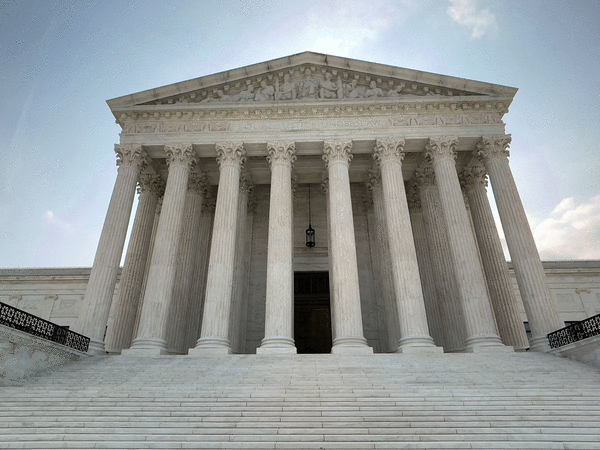
Bayer AG is counting on the U.S. Supreme Court to pare down lawsuits over its top-selling Roundup weedkiller and help corral the decade-long litigation that has cost the company more than $10 billion and cast a pall over its stock price.
Bayer’s attorneys during arguments Monday will urge the high court to overturn a $1.25 million Missouri jury verdict for a man who claims Roundup caused his non-Hodgkin lymphoma and should have had a cancer warning label. The company contends that since U.S. regulators didn’t require a cancer warning, federal law bars those types of suits.
Officials of the German pharmaceutical and crop-science giant are banking on a favorable ruling from the justices, saying on the company website that “could largely end the Roundup litigation.” Bayer, which has already spent billions of dollars defending and settling Roundup cases, recently reserved $11.25 billion (€9.6 billion) to deal with approximately 65,000 outstanding suits, according to the company’s latest securities filings.
Bloomberg Intelligence analyst Holly Froum estimated in a note that about $787 million in existing Roundup verdicts could be affected by the Supreme Court case. If the justices rule for Bayer, “it would eliminate plaintiffs’ strongest claim.” The court will rule by early July.
Bayer officials have steadfastly insisted the weedkiller is safe and doesn’t cause cancer. The U.S. Environmental Protection Agency has found that glyphosate, the active ingredient in Roundup, is “unlikely to be a human carcinogen” and has not required a cancer warning on its label. Still, the company removed the version based on glyphosate from the U.S. residential market in 2023. But the company has struggled to contain the litigation it inherited after buying Roundup manufacturer Monsanto for $63 billion in 2018. Out of 28 cases that have gone to trial since 2015, plaintiffs have won 11, according to Bayer’s 2025 annual report. Several have produced major damage awards.
“From an operational perspective, Bayer is now in a much stronger position than the share price would suggest,” said Markus Manns, portfolio manager at Frankfurt-based asset manager Union Investment, a Bayer investor. “Bayer is well on its way to reducing legal risks, but even lawyers find it difficult to assess the chances of success.’’
Bayer needs both a win at the Supreme Court and acceptance of a proposed $7.25 billion class-action settlement filed in state court in Missouri to take the legal risks off the table, Manns said. Bayer hopes to entice former Roundup users to review the compensation offer.
The litigation has cast such a cloud over Bayer’s stock, which is down about 60% since the Monsanto deal, that Chief Executive Officer Bill Anderson is weighing whether the company should even continue making glyphosate. Anderson also has vowed to get a handle on the litigation by the end of this year through a multipronged effort that also includes lobbying state and federal lawmakers.
At the Supreme Court, Bayer contends that federal law supersedes, or “preempts,” traditional state-law claims for failure to warn. The case centers on the Federal Insecticide, Fungicide, and Rodenticide Act, which sets out rules for pesticides including the requirement of an adequate label. FIFRA, as the law is known, also says that states can’t impose additional mandates.
Bayer says the latter provision means that once the Environmental Protection Agency approved Roundup’s mandatory label without requiring a cancer warning, the company can’t be sued for not having one.
President Donald Trump has embraced glyphosate, moving in February to ramp up domestic production. His administration has been backing Bayer, filing a brief in support and arguing alongside the company Monday.
“States may not impose different requirements based on their disagreement with EPA’s scientific judgment,” U.S. Solicitor General D. John Sauer said in court papers.
Various farm, business and nonprofit groups also have signed on to briefs filed at the Supreme Court in support of Bayer’s arguments that a uniform framework for pesticides is better than a patchwork of state laws with their own labeling rules. The U.S. Chamber of Commerce and other business groups say the medical-device, cosmetic and food industries are governed by similar laws and could be affected by the case.
“The security and affordability of the nation’s food supply depend on farmers’ and manufacturers’ ability to rely on the science-based judgments of federal regulators,” Bayer said in an emailed statement. “Clarification from the court is essential to restore uniformity, certainty, and the rule of law.”
Lawyers for the plaintiff, John Durnell, say EPA’s determinations don’t preclude state courts from making their own judgments about the need for a warning. The agency’s findings “are nothing more than EPA’s opinion on the matter,” Durnell argued.
Durnell’s supporters include consumer and food-safety advocates who say the EPA review process is inadequate because of loopholes, data gaps and corporate influence over the agency.
The Supreme Court ruled in 2005 that FIFRA allowed some types of state-law claims, including allegations of defective design, defective manufacture and negligent testing. But the court said failure-to-warn claims could go forward only if they would impose requirements “equivalent” to those under FIFRA and not if they would apply more stringent rules.
Justice Clarence Thomas, the court’s longest-serving member, worked as an in-house counsel for Monsanto for more than two years in the late 1970s, but is expected to hear the case along with his eight colleagues. He has not recused in previous cases involving the company.
Even if the Supreme Court rules in Bayer’s favor on the failure-to-warn issue, it won’t lead to massive numbers of cases being thrown out or voluntarily dismissed, said Carl Tobias, a University of Richmond law professor who teaches about product-liability cases.
“There will still be other claims left in cases, for negligence and defective design, that will be unaffected if failure-to-warn goes away,” Tobias said. “I don’t see any maneuver that can wipe all the cases out. That’s pretty much mission impossible.”
A representative for Bayer said that the company's settlement proposal includes cases that go beyond failure-to-warn claims and are based on other legal theories.
The nation’s highest court isn’t the only place Bayer is targeting Roundup suits. The company has in the last few years launched a lobbying effort among US states to revise their individual failure-to-warn laws to bar the claims from being weighed by juries.
So far, only Georgia, Kentucky and North Dakota have made such revisions. Bayer’s efforts failed to get Idaho, Iowa and Missouri legislators to make the changes.
Georgia legislators changed the state’s statutes last year after Bayer was hit with a $2.1 billion jury award on the basis that homeowner John Barnes was entitled to punitive damages for the company’s failure to warn about the product’s risks. The company later settled with Barnes.
“They’ve launched an extensive lobbying campaign at all levels of government,” said Angela Huffman, president of the Farm Action nonprofit, a farmer-led watchdog group over the US food supply. “They’ve had bills introduced in 15 states, but only three have signed on to their position.”
Bayer also set its sights on Congress, using its group Modern Ag Alliance to advocate for liability shields for manufacturers that make chemicals farmers use to take out weeds and bugs in their fields.
In addition to the Supreme Court case, the company is offering ex-Roundup users a chance to resolve claims via a $7.25 billion class-action settlement.
Payments to those who have already sued could reach $160,000 per person depending on the plaintiffs’ age and severity of illness, according to a website created by the settlement’s supporters. Those with less-aggressive forms of non-Hodgkin lymphoma could receive $40,000, the site shows. Its unclear what future claimants could expect in payments but the funds will be paid out over 21 years.
The specific terms of the new accord require nearly 100% of current and future Roundup plaintiffs to be part of the deal or it won’t be consummated. A St. Louis judge who must give final approval to the accord will hear objections July 9.
“The opt-outs need to be something approaching zero,” Anderson said in a March investor call. “If people opt out, then you don’t really have an agreement, and then we would have to move on to other potential solutions.”
The overall goal of the Roundup containment campaign may be to enhance Bayer’s leverage in settlement talks, said Elizabeth Burch, a University of Georgia law professor who specializes in product-liability law.
Although the failure-to-warn approach has been “the workhorse of nearly every successful Roundup verdict,” a Supreme Court win wouldn’t mean an “automatic dismissal” of all the cases, Burch said. Instead, it would put Bayer “in a much better bargaining position” to settle the cases at a lower cost.
©2026 Bloomberg L.P. Visit bloomberg.com. Distributed by Tribune Content Agency, LLC.






Comments