DeSantis signs bill on Earth Day reversing local climate change action
Published in News & Features
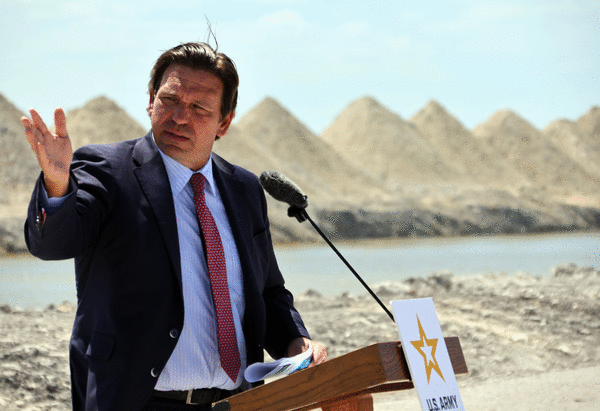
Florida Gov. Ron DeSantis signed a new law on Earth Day that blocks local governments from enacting policies to track how their emissions contribute to climate change.
“Floridians should not be forced to pay for radical climate agendas or identity politics with their hard-earned tax dollars,” DeSantis said.
Tracking “net-zero emissions” has been one way for local governments to measure whether the amount of pollution released into the atmosphere is balanced by the amount removed. That balance can be achieved through cleaner energy or efforts like planting trees that absorb carbon.
The new law prevents local governments from passing any “resolution, ordinance, rule, code or policy” that promotes net-zero goals. It also prohibits requiring assessments, fees or penalties tied to those goals. Currently, no local laws impose carbon taxes on polluting businesses.
It also blocks the use of taxpayer funds to support organizations that promote net-zero policies. Environmental groups opposed the bill, arguing that local governments should be able to take action on climate change.
Yoca Arditi-Rocha, the chief executive officer of the CLEO Institute, a climate advocacy non-profit, said the newly passed law “strips local governments from the ability to do common sense solutions.”
“It’s counterproductive in a state that’s at the frontlines of climate risk and is facing rising energy bills,” Rocha said.
The law doesn’t necessarily stop counties from transitioning to cleaner energy, especially when those efforts save money. For example, energy-efficiency programs or solar initiatives could still move forward if framed around cost savings rather than net-zero targets.
However, it could add red tape that slows progress. Miami-Dade County Department of Environmental Resources Management said in a statement last month that the measure would introduce “additional administrative requirements that could delay or discourage projects aimed at reducing greenhouse gas emissions, even when providing clear economic benefits.”
“I‘m concerned on what that means for our future in a state like Florida, where climate disasters happen regularly,” Mackenzie Marcelin, the climate justice director at the nonprofit Florida Rising.
The law takes effect in July.
_____
©2026 Miami Herald. Visit miamiherald.com. Distributed by Tribune Content Agency, LLC.





Comments