Survivors of Teotihuacán pyramid shooting recount daring escape
Published in News & Features
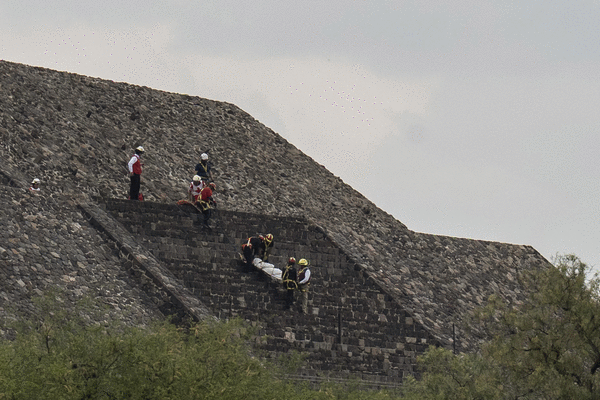
MEXICO CITY — Jalen Aybar and his girlfriend, Jaslim Landaverde, had just smiled for pictures atop the Pyramid of the Moon at the famed Mexican archaeological site of Teotihuacán on Monday when they heard the crackle of gunfire.
A woman lay sprawled on the ground nearby. A man wearing a black mask was approaching, holding a raised handgun.
Aybar, a 26-year-old marketing manager, and Landaverde, a 25-year-old store owner, had come to Mexico to attend a concert near the pyramids a few nights earlier. Early Monday morning, the couple from Chicago had taken a hot air balloon ride above Teotihuacán, located about 25 miles north of Mexico City, taking in a dramatic sunrise.
Now they found themselves stranded with hundreds of other tourists at the mercy of a gunman whose backpack contained literature about other mass shootings, including the 1999 massacre at Columbine High School in Colorado.
Huddled on a stone ledge as the masked gunman took shots at people around them, Aybar whispered in his girlfriend's ear: "We have to jump. We can't just lay here."
They inched to the edge of the ledge and looked down — it was about a 15 foot drop to the platform below. Without speaking, they leaped.
A Canadian woman was killed and at least 13 foreign visitors were injured when the assailant, identified at 27-year-old Julián César Jasso Ramírez, opened fire at Teotihuacán, of the world's most visited mesoamerican sites. On Tuesday, Mexican authorities described Jasso as a copycat criminal who admired foreign school shooters and had meticulously planned the attack.
"Everything indicates that this person had traits of psychological problems and was influenced by episodes that have occurred elsewhere," President Claudia Sheinbaum said at her daily news conference.
Officials said Jasso shot himself dead at the scene as police and National Guard troops clambered up the steep steps of the Pyramid of the Moon to confront him shortly before midday Monday.
But for about 25 minutes, authorities said, the gunman roamed atop a platform high on the pyramid — sometimes waving his pistol theatrically — as tourists huddled in terror.
In grainy cellphone videos filmed from the base of the pyramid, the gunman appeared to be addressing the captive tourists crouching in fear. On Tuesday, Mexico's Milenio TV aired what it called a tape of the gunman shouting at his prisoners: "This (place) is for sacrifices! Not for photos!"
Many tourists did not want to risk exposure on the temple's staircase and decided, like Aybar and Landaverde, to jump down via a series of platforms.
"If you stand up you're going to stand out," Landaverde remembers thinking.
She and Aybar completed their first drop safely. But the second time they leaped to a lower platform — Landaverde felt a terrible crunch. She had a broken a foot.
High on adrenaline and fear, she jumped twice more before finally reaching the ground, where a friend that the couple was traveling with hoisted her on his back. They sought shelter at a nearby restaurant.
Later, after being transported to a local clinic, they learned that several of the people they had accompanied on a tour of the pyramids had been injured by gunfire, including a Colombian woman and her son.
Six victims remained hospitalized on Tuesday, authorities said. The one fatality was a Canadian woman.
All of those killed or injured were foreigners, authorities said. It was unclear whether the shooter targeted foreign visitors deliberately.
Mexican authorities described the incident as a one-off that should not scare off visitors in a nation where tourism is vital to the economy, but vowed to bolster security at archaeological sites, likely by installing metal detectors. Currently, visitors to most parks face little screening.
"This has never happened before," Sheinbaum said, adding that it was important that Mexico "fortify a system of values" in schools and do more to address mental health.
Mexico has long had had much higher homicide rate than the United States and frequently experiences mass violence, often in the context of organized crime.
But Mexico has not traditionally been the site of what experts define as "public mass killings" like the incident in Columbine, where shooters fired at random in an effort to gain notoriety.
Adam Lankford, a criminologist at the University of Alabama who has studied the global proliferation of mass shootings, said the internet has broadened access to online communities where mass shooters are idolized.
His data show a rise in mass shootings globally, with many shooters influenced by killings in the U.S.
"Sometimes the United States has a product, like blue jeans or McDonald's, that becomes globalized and fashionable everywhere," Lankford said. "It's kind of a horrific idea but the same thing can happen with bad behaviors, and that's what the data we've collected has shown."
He added that "attacking a national landmark fits the idea of a fame-seeking attack."
"Picking a symbolic target is a way to almost guarantee yourself more attention," he said.
He added that there has also been a pattern of attackers shooting from heights, citing a 1966 incident when a gunman opened fire from a clock tower at the University of Texas and a 2017 shooting in Las Vegas where a gunman killed 60 people at a concert by firing from the 32nd floor of a hotel.
Monday's shooting fanned concern for Mexico's vital tourist industry at a pivotal moment.
Starting in June, Mexico is due to host matches for the World Cup soccer tournament, an event that is expected to draw hundreds of thousands of visitors from across the globe. Mexican authorities were quick to repeat earlier assertions that a strict regimen was in place to protect both visitors and the matches.
"We are convinced that the security of the World Cup is guaranteed," Mexico's federal security chief, Omar García Harfuch, told reporters.
The sprawling Teotihuacán complex was closed Tuesday but set to reopen Wednesday with enhanced security, officials said. Apart from being a major tourist draw, the site is an economic linchpin for thousands of workers, vendors and other businesses dependent on the visitor trade.
The 2,000-year-old complex, once home to one of the ancient world's largest urban centers, was abandoned centuries before the rise of the Aztec empire. Archaeologists still debate the reason for its abandonment, a fact that adds to its timeless allure.
_____
(Times staffer Cary Schneider and special correspondent Liliana Nieto del Río contributed.)
_____
©2026 Los Angeles Times. Visit latimes.com. Distributed by Tribune Content Agency, LLC.






Comments