Supreme Court sounds ready to back agency authority over violations
Published in News & Features
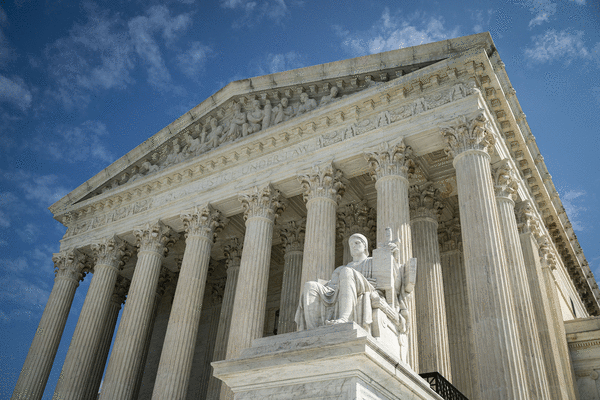
WASHINGTON — The Supreme Court appeared ready to back limited forfeiture powers for federal agencies during oral arguments Tuesday, in a pair of challenges to the ability for the Federal Communications Commission to impose fines on alleged lawbreakers.
Telecommunications giants AT&T and Verizon asked the justices to toss more than $100 million in forfeitures imposed by the FCC, arguing the agency’s process violated the constitutional right to a jury trial under the Seventh Amendment.
The cases come amid a yearslong shakeup by the conservative-controlled court to curtail the power of federal agencies and limit Congress’ ability to give them those powers in the first place.
But on Tuesday, Chief Justice John G. Roberts Jr. and most justices questioned whether the agency adjudication process really denied the companies a jury trial, or if companies were fighting having to pay the forfeitures to avoid “bad PR” associated with FCC proceedings.
“And I’m just wondering, in terms of the substantive legal issue, though, you are not obligated to pay until you get a jury,” Roberts said.
Under current law, the FCC issues determinations about potential violations of law and regulations. Companies can either challenge those findings at a federal appeals court or seek a jury trial by waiting until the Justice Department files a lawsuit to collect the funds.
Jeffrey B. Wall, arguing on behalf of AT&T and Verizon, said many companies, when facing millions of dollars in agency-imposed fines, choose to pay the fines and then challenge the agency decisions in appeals court rather than wait for a potential jury trial months or years down the road.
“When your main regulator tells you you owe hundreds, maybe even billions of dollars, you can’t sit around and do nothing,” Wall said.
Wall and the companies argued that the original FCC order should be subject to a jury trial, rather than leave companies waiting to potentially face a lawsuit down the line.
Roberts responded that FCC proceedings may be similar to a parking ticket, where the ticket imposes a potential fine but the recipient can still fight the claim in court.
Justice Brett M. Kavanaugh also pointed out that the FCC process explicitly allows the companies to receive a jury trial when the DOJ eventually brings a lawsuit.
“When the government seeks a penalty, it would seem that, so long as you get a de novo jury trial, that the Seventh Amendment and Article III would be satisfied, whether the agency process leading up to that was skimpy or thorough, whether it was one step or two steps, so long as you have that de novo jury trial,” Kavanaugh said.
Justice Samuel A. Alito Jr. also pointed out that the FCC process, first created in 1960, seems “quite different” from what the founders, at the time of the ratification of the Constitution, would have thought of as a lawsuit requiring a jury trial.
Tuesday’s case originated in 2024, when the FCC imposed forfeitures on AT&T, Verizon and other companies for alleged data privacy violations. Both companies then chose to pay the fines, $57 million for AT&T and $47 million for Verizon, and then challenge them in federal appeals court.
The U.S. Court of Appeals for the 5th Circuit threw out the FCC forfeiture against AT&T, finding the law violated the company’s Seventh Amendment right to a jury trial. The U.S. Court of Appeals for the 2nd Circuit ruled the other way in Verizon’s challenge, upholding the proceedings against the company.
The case comes two years after the justices ruled that a somewhat different legal structure at the Securities and Exchange Commission violated the Constitution in SEC v. Jarkesy.
During Tuesday’s oral arguments, Vivek Suri, arguing on behalf of the Trump administration, urged the justices to see the FCC structure differently from the SEC.
Suri argued that the FCC can only enforce the orders against AT&T and Verizon through lawsuits, and the companies would have the right to a jury trial when that happens.
“It is not a Seventh Amendment violation that the government might take time to file a lawsuit. The Seventh Amendment simply requires that when the lawsuit is filed, at that point, there is an entitlement to a jury trial if it’s a suit of common law,” Suri said.
Kavanaugh did raise concerns that the FCC “misled” the companies about whether they had to pay the fine to challenge the legality of it.
“I think that’s a problem for you. I think that’s a concern I have about how this is all unfolded, this does not seem regular order to me at all,” Kavanaugh said to Suri.
Suri responded that the justices could decide the broader issue of the FCC’s legal structure in this case and leave the details about how the AT&T and Verizon processes unfolded to later legal decisions.
The cases are Verizon Communications Inc. v. Federal Communications Commission and Federal Communications Commission v. AT&T.
©2026 CQ-Roll Call, Inc., All Rights Reserved. Visit cqrollcall.com. Distributed by Tribune Content Agency, LLC.




Comments