Venezuela sends key terror suspect to Panama 32 years after deadly plane bombing
Published in News & Features
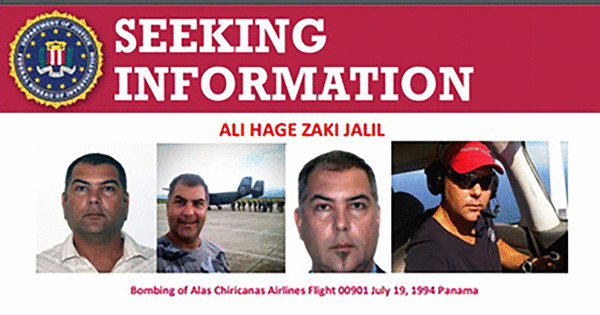
A man long sought in connection with the deadliest terrorist attack in Panama’s history arrived in the country Monday after being extradited from Venezuela, marking a breakthrough in a case that had remained unresolved for more than three decades, U.S. officials in Panama said.
Ali Zaki Hage Jalil, a Colombian-born Venezuelan national accused of involvement in the 1994 bombing of Alas Chiricanas Flight 901, was taken into custody upon landing at Panama City’s Tocumen International Airport under heavy security. Authorities say his transfer represents the most significant development yet in efforts to bring those responsible for the attack to justice.
The bombing, which occurred on July 19, 1994, killed all 21 people on board, most of them members of Panama’s Jewish community as well as at least three U.S. citizens. The aircraft exploded minutes after takeoff from Colón, a Caribbean port city about 50 miles from the capital, before crashing without survivors.
For years, the case languished amid limited evidence and shifting investigative priorities. It was only in recent years, after renewed cooperation between Panama, the United States and Israel, that authorities began to make headway.
U.S. Ambassador to Panama Kevin Cabrera described the extradition as “a very important step toward justice,” noting that the process now moves into the Panamanian judicial system while leaving open the possibility of future legal action in the United States.
“We hope that the legal process and its eventual conclusion will bring peace to the families of the victims who have waited more than 30 years for justice,” Cabrera said after Jalil’s arrival.
Panamanian officials confirmed that Jalil was immediately transferred to the country’s Judicial Investigation Directorate and is expected to face questioning by prosecutors in the coming days. He is accused of participating in the planning and logistical support of the attack, though he has not been convicted of any charges.
The case has long carried international implications. U.S. intelligence agencies have attributed the bombing to the Lebanese militant group Hezbollah, describing it as part of a broader wave of coordinated attacks targeting Jewish and Western interests in Latin America.
The Panama bombing occurred just one day after the 1994 bombing of the Argentine Jewish community center AMIA in Buenos Aires, which killed 85 people and also remains unsolved. Investigators have pointed to similarities in timing and method, suggesting both attacks may have been linked.
Israeli authorities have also supported that assessment. Former Panamanian President Juan Carlos Varela said in 2018 that he had received intelligence from then-Israeli Prime Minister Benjamin Netanyahu indicating that the aircraft explosion was “clearly a terrorist attack” carried out by Hezbollah.
Despite early suspicions, the investigation into the Panama attack struggled to produce results for decades. The case was formally reopened in 2019 after new evidence emerged, and prosecutors later identified Jalil as a key suspect.
According to authorities, he was detained in November 2025 on Venezuela’s Margarita Island following the issuance of an Interpol Red Notice. His extradition was approved by Venezuela’s Supreme Court in March, with conditions that he be tried only for the crimes specified in the request and that his legal rights be respected.
The transfer itself underscores a shift in regional cooperation on security matters. U.S. officials highlighted the role of long-standing collaboration among multiple governments, including the FBI’s decades-long investigation and intelligence-sharing efforts.
The U.S. government had previously offered a reward of up to $5 million for information leading to Jalil’s capture.
Panama’s Foreign Ministry described the extradition as a “significant advance” in a case widely regarded as the country’s worst terrorist attack.
Details of the original bombing remain central to the investigation. Authorities determined that an explosive device had been brought aboard the aircraft, likely concealed in a radio, and detonated shortly after takeoff. One of the victims, whose remains were initially unclaimed, was later identified as the suspected suicide bomber.
Prosecutors allege that Jalil played a role in organizing the operation, including securing materials and coordinating elements of the attack. Those allegations will now be tested in court.
The case has also drawn renewed attention to the presence of transnational militant networks in Latin America. U.S. and regional officials have long warned that groups such as Hezbollah maintain financial and logistical infrastructure in parts of the region, often operating through commercial enterprises and diaspora communities.
The legal proceedings in Panama are expected to take months, if not years, as prosecutors build their case and courts weigh complex evidence gathered across multiple jurisdictions.
©2026 Miami Herald. Visit at miamiherald.com. Distributed by Tribune Content Agency, LLC.





Comments