UCSD marijuana study affirms drug's negative effect on youth
Published in News & Features
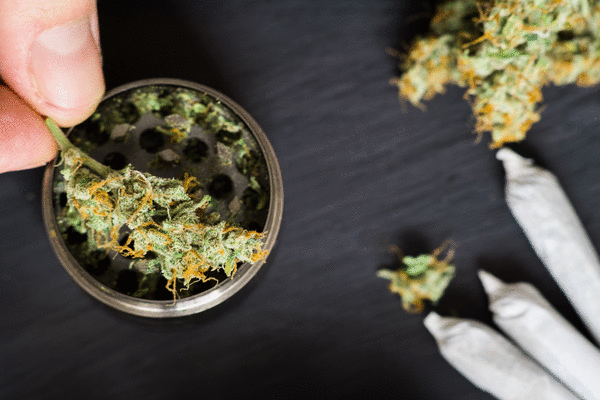
SAN DIEGO — A new UC San Diego study strengthens the growing body of evidence that marijuana use impacts adolescent brain development.
Researchers observed slower gains in cognitive tests that measured memory, focus and thinking speed among middle and high school-age kids who used cannabis when compared to those who abstained.
Scheduled for publication online Monday in the journal Neuropsychopharmacology, the study analyzes how 11,000 kids across the nation enrolled in the Adolescent Brain Cognitive Development (ABCD) Study, a $440 million effort that the National Institutes of Health calls “the largest long-term study of brain development and child health ever conducted in the United States.”
Annual testing started in 2016 when participants were nine or 10 years old, finishing its initial decadelong collection period at 21 sites nationwide this fall. UCSD is the program’s nationwide coordinator and one of its most active hubs, with 740 local enrollees.
A range of cognitive tests, repeated every other year, were chosen for their ability to stimulate the areas of the brain thought to be most affected by marijuana use in adolescence. Picture sequencing, for example, asks kids to sort images in the same order they were originally presented. Pattern comparison measures how quickly subjects can identify whether two pictures are identical. And another designed to measure verbal recall repeats a list of words five times, followed by a “distractor list, the original list, then a long delay.”
Adolescents get better at such tasks as they pass through a period of their lives when brain development accelerates. And that is what happened. Whether or not they used cannabis, all kids showed progress as they moved from childhood toward adulthood.
But, the pace of improvement that researchers observed is somewhat slower for kids known to have used cannabis.
The differences were not massive. Natasha Wade, the study’s lead author and a clinical neuropsychologist at UCSD, said there was enough difference to underline what has become standard advice for parents: Keeping kids away from a drug that is now legal in many states for adults is a wise decision during the teen years and into early adulthood.
“As best you can encourage your kids not to use, to wait until they’re older … that’s likely to serve them a lot better than starting now,” Wade said.
While many other studies have made similar observations about the effects of marijuana on neurological development in adolescents, the new UC San Diego study is believed to be unique for its use of toxicological testing, using samples of urine, saliva and hair, to confirm cannabis use. Studies have traditionally used self-reporting — youth disclosing their drug use to research assistants with the promise that the information won’t be shared with parents — as the method of determining who is using and who is not.
Toxicological testing showed that roughly one in three young study participants did not voluntarily disclose their cannabis use when asked.
Arizona State psychology professor Madeline Meier, whose work focuses on the impacts of cannabis use on cognitive function, called the use of toxicology testing “a valuable addition” for its ability to spot undisclosed cases. But she also noted that there is no ability to include how much of the drug was used.
“It’s important to know that occasional or one-time use would not be expected to drive lasting changes in cognitive development,” Meier said. “Differences are more typically linked to long-term, frequent use.”
Wade said that hair testing, which takes longer to show the presence of cannabis-related chemicals, could eventually allow a deeper assessment of prolonged use.
Researchers analyzed seven years of data, from late 2016 to early 2024, and found that 2,204 used cannabis at least once, while 9,664 did not.
Much effort was put into statistically adjusting results to account for commonly understood factors that can also impact neurological development in adolescence.
“We have controlled for all of the key confounds and the key questions that often come up,” Wade said. “Whether it’s prenatal exposure (to cannabis), whether it’s mental health of the teen when they were young, whether it’s alcohol or nicotine, we’ve controlled for all of those things, and we still see this relationship with cannabis.”
Testing hair samples allows researchers to detect the presence of different compounds known to be present in cannabis, including THC, the chemical most responsible for producing the high that most users seek. But it is also possible to detect cannabidiol, often called CBD, which does not produce a high but which many insist has medicinal properties.
Here, the study results took a turn. Kids whose hair samples showed the presence of CBD did not have the same slower pace of cognitive progress as was observed among the larger group of cannabis users.
Wade cautioned against anyone drawing the conclusion that CBD itself has a protective effect. THC, she noted, is generally less present in marijuana strains with higher levels of CBD.
“I would not be surprised to hear that using a product that has high CBD has better cognitive outcomes, but I don’t know if that’s due to the fact that, when you have higher CBD content, you naturally have lower THC content,” Wade said. “It’s a balance, and we don’t know if CBD is actually protective or beneficial.”
As data collection for ABCD’s decade-long run completes, there will be many more avenues of investigation. In addition to learning more from hair testing, Wade said she is very interested in how cannabis users differ.
“An interesting question to me is, what happens when you stop using?” Wade said. “Some people will develop dependence and some people will not; can we take some of their childhood factors or their genetics or anything else into account to start to identify who’s most at risk?”
The future
Thus far, the list of research papers that have used ABCD Study data has reached nearly 1,900, covering a diverse range of topics far beyond the effects of cannabis. Because annual checkups include a very broad range of questions, it has been possible for researchers to probe everything from the correlation between motor coordination and brain structure to the connection between adolescent smartphone use and sleep quality.
Efforts are already underway to request renewal of the program, initially for an additional five years and, proponents hope, much further into adulthood.
Funding is certainly a hurdle, but the true test of whether ABCD continues will be the participants themselves.
Those who started receiving annual checkups in middle school, excited to receive small stipends for their involvement, are now arriving at the most mobile periods of their lives. Many will head off to other cities for college, military service or work. Convincing 11,000 young adults to keep showing up every year will be more difficult once they leave their parents’ homes.
One participant, whose mother asked that his name not be used due to privacy concerns, was at the UCSD ABCD center last week for his biannual check-in. After taking cognitive tests, but before entering the MRI suite for 90 minutes of now-familiar MRI brain scans, he said he would be willing to continue even though he hopes to attend college out of state.
Seeing real science happen as a result of his involvement, he said, has been rewarding.
“I think it’s a great study, and I think that it should continue,” he said. “I think it’s good to show, like, what happens when you do certain things and the repercussions.”
©2026 The San Diego Union-Tribune. Visit sandiegouniontribune.com. Distributed by Tribune Content Agency, LLC.






Comments