How should students, and schools, use AI? San Diego County districts take a patchwork approach
Published in News & Features
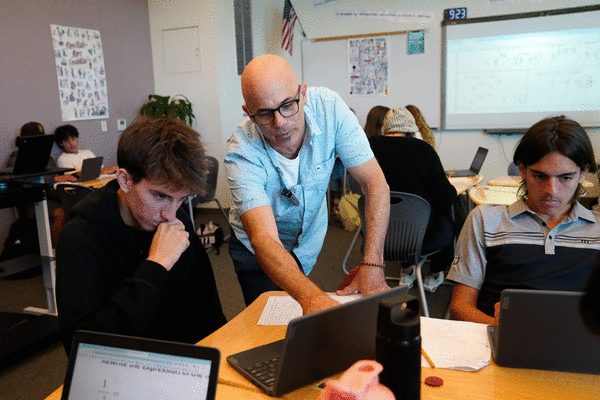



SAN DIEGO — When students are introduced to most new topics, schools can slowly scaffold learning. But that’s not been the case with artificial intelligence, as Poway Unified School District learned.
“We gave students keys to the sports car before we gave them any drivers’ ed,” says Amy Fousek, the district’s director of educational technology, in a November interview.
Across San Diego County, school districts are scrambling to create rules, policies and best practices around generative artificial intelligence — the familiar kinds of AI tools, trained on vast amounts of data, that can generate text, images, code and more.
The approach local schools have taken so far is a patchwork. Some districts are focused on developing rules governing how students can use AI to do their schoolwork. Others, like Poway Unified, are working to develop kids’ AI literacy.
And in Cajon Valley, whose leader is a strong proponent of AI, its capabilities are hailed for what they might mean for labor productivity. “It doesn’t work an eight-hour day. It’s always on,” said Superintendent David Miyashiro in an interview late last year.
One familiar concern about the use of generative AI in schools has long been cheating. But tech specialists like Fousek are also concerned about the impacts of tools like ChatGPT on how students develop their own critical-thinking skills and learning habits.
Fousek added that they are still committed to responsible use, and they are still seeking input from staff.
Poway spokesperson Josue Reyna also provided the district’s AI Playbook, which includes guidance from families.
More than half of American teens say they’ve used such AI chatbots to find information and to help with their schoolwork, according to a Pew Research Center survey released in February. That’s up sharply from fewer than one quarter of them a year ago.
In that survey, 12% of students said they have used AI tools to get emotional support or advice. Across the country, there have been well-publicized deaths by suicides by individuals interacting with AI chatbots.
The San Diego Union-Tribune surveyed all the county’s 42 traditional school districts serving K-12 students about their current policies. Roughly a quarter responded. Even more said they were actively working on developing new plans and rules.
It’s an issue districts are grappling with statewide, and the California School Boards Association has created a list of resources for them. One brief gives examples of how AI can aid in administrative work, such as by scheduling classroom visits. A sample board policy says AI use should be ethical, transparent, secure and regularly evaluated, among other things.
The CSBA’s resources also include recommendations from a task force created to equip districts with the knowledge and tools needed to use AI properly. That task force included both Miyashiro and Jennifer Burks, then Poway Unified’s associate superintendent of technology and now the superintendent of Solana Beach School District.
Getting help
Districts have not taken a cohesive approach to AI. But many of them have enlisted the help from the CSBA.
Escondido Union High gives its employees access to MagicSchool AI, along with optional training, and teachers can choose which of its tools to make available to students. San Ysidro is looking into Google Gemini. San Marcos Unified is working on guidelines, but none have yet been presented to staff.
Lakeside Union is still early in its conversations on the issue and is talking with other districts, too. The district has gotten sample policies from the CSBA, which it will typically review and adopt, possibly with revisions, said Superintendent Scott Goergens.
The policy that Sweetwater Union High School District adopted in August was developed with the help of the CSBA, too, said Dan Winters, the assistant superintendent of leadership development and innovation.
That policy emphasizes student privacy but also says AI use will be monitored. While students can use AI to help with research with appropriate supervision, they can’t use it dishonestly or to plagiarize. The policy also aims to ensure equitable access and to prevent cyberbullying.
South Bay Union also modeled its policy on the CSBA’s but noted that because it’s an elementary district, many generative AI products only apply to their staff. Nearby National School District has also had a first reading of this CSBA policy by the board.
San Dieguito Union High School District has created a dedicated website on AI that includes guidance for parents and the district’s policy on the technology.
That policy, last revised in 2024, says that students should be taught to use technology such as AI in ways that respect human rights and avoid internet dangers, and that any resources the district provides them should align with district goals, objectives and academic standards.
Meanwhile, San Diego County’s largest school district is still working on its AI policy.
The district has been “actively developing” that policy, said San Diego Unified spokesperson James Canning. But its teachers union will weigh in, too.
“Our goal is to ensure that the use of AI tools aligns with our educational values, promotes responsible and ethical digital citizenship and media literacy, and enhances teaching and learning across the district,” he said.
The district struck a deal with its teachers union on a new contract just last month — and AI was a component of it. Teachers have ratified the deal, and the district is set to vote on it this week.
The contract calls for creating a work group on AI that would develop recommendations for an official policy, to be incorporated into the collective bargaining agreement. That work group would report their findings by the end of next January, and the district could not replace or eliminate any union jobs before then.
Canning said the district plans to establish the panel now that a contract with the teachers union deal has been reached.
Kyle Weinberg, the union president, said his members felt it was important to bargain language into the contract that protects teachers from being replaced by AI.
“We have seen that it is on the horizon in other districts, that that is happening,” he said.
The union is just beginning to survey members about how they use AI in instruction, and they’re looking for interested members to join the work group.
‘The machine doesn’t get tired’
Miyashiro thinks a lot of trepidation and pushback for AI comes from a “fear of the unknown.” He is working with stakeholder groups before creating a road map for the rest of the district.
He envisions a future in which AI tutors can personalize questions for students — for instance, using baseball hitters’ percentages to teach fractions. He thinks such tools can provide the right intervention and strategy and be far more precise.
“Those are things it takes teachers hours to do, one at a time, that a machine can do in seconds — and the machine doesn’t get tired, it doesn’t quit,” he said. “It doesn’t work an eight-hour day. It’s always on.”
He said that teachers would have more time for things like behavior management and motivation because those AI questions would be accurate, and machines would do grading and assessments better.
“They’ll be able to do more with more students, because they won’t have to waste the time doing the mundane tasks of curriculum, instruction and assessment,” he said.
Steve Davidson, the president of the district’s teachers union, said any such use would need to be bargained with the union.
“Any district use of AI in areas such as curriculum, instruction or assessment must be negotiated because it impacts working conditions and student learning,” he wrote. “We are advocating for clear guidelines, staff training and strong protections for student data as AI use expands in schools.”
He also said the union supports using AI as a tool to help educators, not replace them.
“Teaching depends on relationships, professional judgment and human connection, elements technology cannot replicate,” he wrote.
Miyashiro rejects the idea that AI will take anyone’s jobs, though he says people who are AI-savvy might take them. He also says that when it comes to students, his district uses AI in age-appropriate ways.
“It’s not about giving students answers but helping them understand what problems they’re trying to solve,” he added.
The district began with a model policy from the school boards association, then sought feedback from its unions and its parent advisory council, says Chris Collins, the district’s data and assessment coordinator.
Day to day, most teachers he’s spoken with use AI tools to improve their planning. The district calls its teacher tool a “thought partner” designed to plan integrated, cross-curricular units.
It’s optional, he stresses, and some teachers are resistant. “It can only influence the human experience so much, and education is a deeply, deeply human process,” he said in December.
Preserving ‘the productive struggle’
It was a few years back, when ChatGPT first came into widespread use, that Poway Unified began developing its understanding of AI, along with its types and challenges, said Fousek — “because it’s really just the large language model portion of AI that is becoming more prevalent.”
The district’s belief in person-centered policy led it to rely heavily on guidance and information on AI put out by the state Department of Education.
The agency encourages schools to educate students in five concepts — “computing systems, networks and the internet, data and analysis, algorithms and programming, and impacts of computing” — and says AI touches on all five.
Such an education helps students “become informed digital citizens who can leverage AI and other technologies to promote social justice and equity,” the agency says.
The agency also offers webinars on AI and an AI resource kit that covers fundamental skills for and provides teachers guiding questions, such as “How might we leverage the capabilities of Al systems?” and “How might we foster a culture that questions the accuracy of Al outputs?”
With the help of those tools, Poway started with professional development, training staff in the understanding and use of AI.
Then, the district also wanted to make sure students had the knowledge and skills to navigate the internet safely and responsible. Staff, then students, also homed in on AI literacy — ensuring they can critically evaluate AI tools’ output for any biases or hallucinations.
The key is preserving “the productive struggle and the learning,” Fousek said.
“If the AI is impeding in any way the productive struggle and the learning, then we are misusing it.”
©2026 The San Diego Union-Tribune. Visit sandiegouniontribune.com. Distributed by Tribune Content Agency, LLC.






Comments