Maryland Gov. Wes Moore's budget boosts utility bill relief, but critics see short-term fix
Published in News & Features
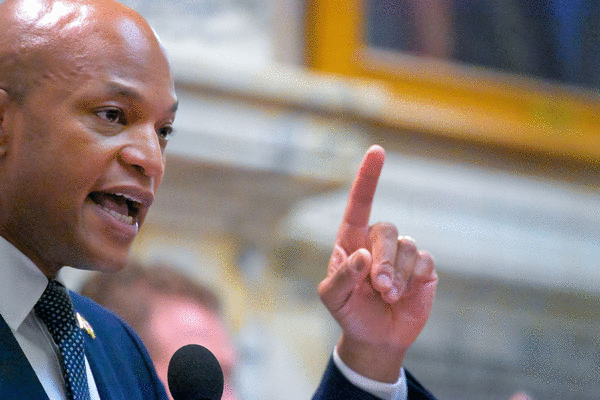
BALTIMORE — Gov. Wes Moore directed hundreds of millions of dollars toward lowering utility bills when he signed Maryland’s fiscal 2027 budget into law, drawing sharp criticism from Maryland Republicans and mixed reactions from environmental advocates.
“This budget puts $100 million back into people’s pockets through utility fee relief,” Moore said at Wednesday’s signing ceremony, later calling the plan part of a broader push to address residents’ affordability concerns.
The energy portion of the budget relies heavily on the Strategic Energy Investment Fund (SEIF), including $100 million to offset costs tied to the state’s EmPOWER energy efficiency program — a move top Democrats say will reduce pressure on ratepayers. “Nothing has been more frustrating for Marylanders than what has happened to their energy bill,” House Speaker Joseline Peña-Melnyk said at Wednesday’s signing ceremony. “This budget delivers significant relief to ratepayers.”
Still, Maryland’s top Republicans sharply criticized the approach, maintaining that it fails to address the root causes of rising energy costs and that the state should permanently part with SEIF and EmPOWER altogether. And environmental advocates praised the new investments in clean energy while still worrying over the budget’s continued troubling pattern of diverting money away from clean energy programs.
“The budget still diverts, it appears, around $400 million from the [SEIF] to the general fund. … That’s a huge loss, considering Maryland is experiencing an energy affordability crisis,” said Josh Tulkin, director of the Sierra Club’s Maryland chapter. “We hope the days of diversion for this fund are done because we know that energy efficiency and clean energy is the solution, and diverting this much money away only hurts Marylanders.”
The spending plan also includes $73 million to help residents transition to energy-efficient heat pumps, which Peña-Melnyk said will “improve energy efficiency and save families money,” and allocates another $37 million to offset costs for low-income households, more than $300 million for the Office of Home Energy Programs, and $82 million for the Maryland Energy Assistance Program.
Together, those investments could translate to at least $150 in relief on utility bills for ratepayers next year — an increase from the roughly $40 in rebates proposed in Moore’s initial budget.
Real relief? Not everyone agrees
Sen. Guy Guzzone, chair of the Senate Budget and Taxation Committee, said lawmakers focused on affordability in a policy area where the state has limited control.
“Affordability is absolutely the keyword for everything we’re trying to do this year in the legislature,” Guzzone told The Baltimore Sun, adding that the General Assembly has very limited power around energy issues. “There’s so many other entities that have control over this at a regional and national level that affect prices … [we wanted] to exercise our control as much as we possibly can to provide some relief.”
But House Minority Leader Jason Buckel said the budget fails to address the root causes of rising energy costs. “Maryland families are not going to get real sustainable energy relief,” Buckel told reporters Wednesday, pointing to a lack of new power generation and transmission solutions. “We’re not going to do anything. We’re just going to tell people that we thought about it real hard, and we talked about it real long, and at the end of the day, we didn’t do very much. Vote for us in November. That’s not fair. That’s not right.”
A mixed assessment
Environmental advocates offered a more mixed assessment, praising new investments in clean energy while warning that broader funding shifts could undermine long-term savings.
Despite concerns, Tulkin called the $73 million for heat pumps “a really exciting investment” that will help thousands of families save energy and money for years.”
Kim Coble, executive director of the Maryland League of Conservation Voters, similarly praised lawmakers for increasing climate-related funding beyond the governor’s initial proposal, including support for heat pumps and clean energy financing programs.
But she said the redirection of hundreds of millions of [SEIF] dollars left her “disappointed.”
Other advocates emphasized that investments in energy efficiency remain one of the most effective ways to lower costs over time. “Using SEIF funds to invest in energy efficiency through EmPOWER is a smart decision because it [reduces] bills short and long term,” Emily Scarr of Maryland PIRG told The Sun in a text message.
While the funds allocated to energy were secured with Moore’s signature, how they will be divided will depend on the Utility RELIEF Act, the General Assembly’s sweeping energy package that, among many other things, seeks to scale back the EmPOWER program until 2036.”
In a joint statement Wednesday afternoon, Peña-Melnyk and Senate President Bill Ferguson said the two chambers have “reached an agreement” between their versions of the bill. But a source familiar with negotiations told reporters shortly after that an identical version is not yet ready for final consideration as lawmakers continue to work through language and await stakeholder input.
-----------
©2026 The Baltimore Sun. Visit at baltimoresun.com. Distributed by Tribune Content Agency, LLC.






Comments