Is Idaho running out of pennies? New law changes how stores are handling cash
Published in News & Features
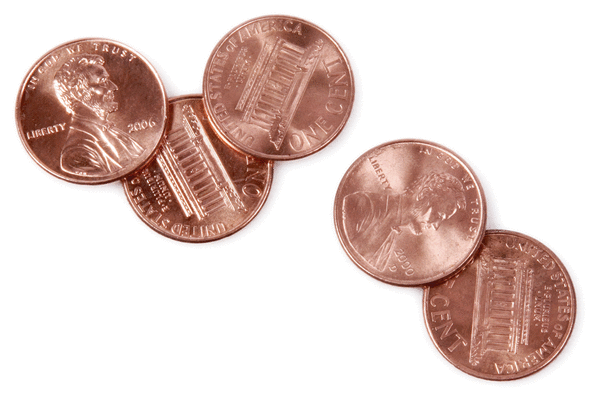
BOISE, Idaho — A new Idaho state law lets stores, restaurants and other sellers round up prices to the nearest nickel to reflect federal guidelines.
Senate Bill 1350 was sponsored by the state Senate State Affairs Committee.
Idaho Gov. Brad Little signed the bill into law on March 31.
Here’s how it works:
Is the US running out of pennies?
Production costs for pennies have risen steadily over the past decade, according to the U.S. Department of the Treasury.
The U.S. Mint officially stopped producing one-cent coins in November.
However, the Federal Reserve will continue to recirculate the roughly 114 billion pennies currently in existence for “as long as possible,” the treasury said.
What is Senate Bill 1350?
SB 1350 will add a new section to Idaho laws on cash handling and conduct.
The bill updates how businesses, government agencies and others conducting cash transactions in Idaho deal with pocket change.
“If a seller is unable to settle a cash transaction to the whole cent” using coins or currency on hand, they can round up the total amount of the purchase — or the amount of change owed to the buyer — to the “nearest multiple of 5 cents,” the law says.
In other words, the new law allows Idaho residents to rely on nickels instead of pennies to sell goods or make purchases.
“This guidance for cash rounding is optional” for businesses but “represents industry best practices,” according to the bill’s statement of purpose.
How does Idaho’s new nickel law work?
SB 1350 not only impacts how much you’ll pay in cash, but also how much change you’re owed if pennies are short.
When your total ends with a 1 or 2 in the hundredths position, such as $10.41 or $2.92, the seller will round the total down to the nearest 10th. You would then pay $10.40 or $2.90.
For totals that end with a 6 or 7, sellers will round down to the nearest 5 cents. A $8.67 item now retails for $8.65.
When your total ends in 8 or 9 cents, the seller rounds up to the nearest 10nth.
For example, $6.59 becomes $6.60 and $42.38 turns into $42.40.
If the final digits of your total are 3 or 4, the amount you owe will default to 5. A total of $12.44 becomes $12.45.
Idaho’s new law only affects cash transactions, so amounts for online purchases and card transactions will stick to exact change.
When does the law take effect?
Idaho’s new nickel law will go into effect on July 1.
However, critics say SB 1350 will allow retailers and restaurants to shortchange customers by charging more for goods and services.
“Businesses that refuse change, force you to round up, and/or say they can’t get coins are ripping people off,” Facebook user Sabra Haney wrote in a comment on a March 25 post by Boise’s KTVB-TV. “I’m a small business owner who banks with a super tiny bank and I’ve had zero issues with coins.”
“There is no penny shortage,” Instagram user joshua_812ferrari wrote in a comment on KTVB’s March 24 post about the new rounding system.
“There are billions of pennies out there in circulation, which is why ceasing production of them shouldn’t affect anyone for literally years,” Haney said.
_____
©2026 The Idaho Statesman. Visit idahostatesman.com. Distributed by Tribune Content Agency, LLC.





Comments