Dispute brews between Poway, San Pasqual tribe after Native American bones found at construction site
Published in News & Features
SAN DIEGO — First they found metates — ancient grinding stones. A human pinky bone, jawbone and ribs were next.
Repeated discoveries of Native American remains and other artifacts on the site of a housing development in Poway has led the San Pasqual Band of Mission Indians to call for construction to be stopped — a move the tribe hopes will give members time to assess the land and repatriate any remains.
Poway and other government agencies say they have no plans to halt construction, even as tribes say they’re running afoul of state and federal law. But the agencies also can’t agree on whose job it is to deal with tribal concerns.
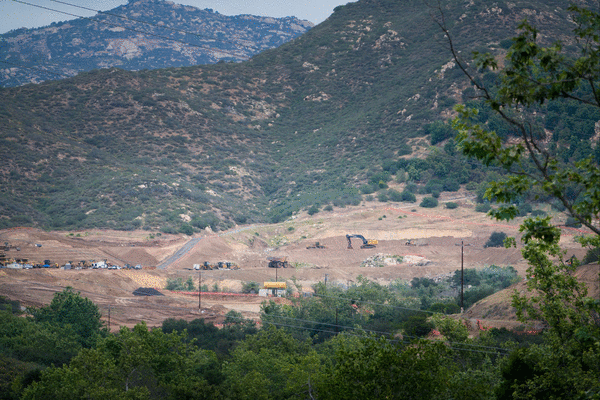
The brewing dispute centers on the 40-home Hidden Valley Ranch development currently being carved into a series of hillsides on Poway’s northern end near the Blue Sky Ecological Reserve.
The project from Shea Homes, a homebuilder with a nationwide presence, has been in the works for more than two decades. But the tribe’s issues with it began in October, when crews first unearthed ancient artifacts there.
Then, tribal members warned Shea Homes and Poway officials that more findings were imminent.
In March, a man’s mandible was found, followed a few days later by the finger bone of a young girl and the ribs of a young adult.
What’s been discovered so far amounts to a “significant find,” said Johnny Bear Contreras, chair of the San Pasqual tribe’s cultural committee.
Because of the extent and nature of the discoveries, the tribe thinks the site — on the eastern side of Old Coach Road just south of the Maderas Golf Club — likely hosted a Kumeyaay village.
“There are ancestors all over that site,” Contreras said. “We need to slow (construction) down. We need to stop it, and we need to assess it.”
After the first discovery, Shea Homes sent the San Pasqual a cease-and-desist letter, alleging the tribe had conducted “unwarranted interference” in the site, said Jan Percival, a spokesperson for the company.
Jason Lavigne, who coordinates historic preservation for the tribe, said the letter came after the tribe had started asking pointed questions about what their role would be in handling the site and how the project first got city approval.
The tribe also contends it’s been denied a federally-mandated consultation process that’s supposed to be undertaken with tribes when Native American remains are found.
Another local tribe, the Viejas Band of Kumeyaay Indians, is currently contracted by Shea Homes to monitor the site and handle potential disturbances to cultural resources.
But the San Pasqual have a key role in deciding what to do with any artifacts and remains, because they’re the most likely descendants of the people who lived on the site, a role outlined in state law.
The Viejas have gathered the artifacts and remains that have been discovered on the site and have been storing them in a shipping container.
Amid the dispute, Poway does not plan to stop work on the site, said city spokesperson Rene Carmichael. The city maintains it’s complied with state requirements for working with tribes and mitigating the presence of Indigenous artifacts and remains, Carmichael said.
The tribe says it’s considering its legal options — including suing.
Already, the recent discoveries have prompted the U.S. Army Corps of Engineers to order work stop in one small part of the site, in the immediate vicinity of where the bones and artifacts were found, said Dena M. O’Dell, a spokesperson for the corps’ Los Angeles District. The Army Corps of Engineers is involved because a less than half-acre portion of the site includes a federal waterway.
This week, construction crews and equipment snaked along a hillside on the southern end of the 420-acre parcel, away from the three sites where the Army Corps had halted work.
But the developer, Poway and the Army Corps can’t agree on whose responsibility it is to deal with the San Pasqual.
Shea’s stance is that it’s the government agencies’ job. The Army Corps says it does not have the authority to do so because its jurisdiction covers such a small portion of the site. And Poway says it’s federal agencies that need to consult with the tribe, since their grievances involve federal law.
Courtney Ann Coyle, a San Diego-based attorney who specializes in Native American law, said finger-pointing among government agencies in a situation like this is typical. But it also doesn’t foster the kind of dialogue with tribes that is necessary to break an impasse, she said.
“The agencies need to be open to what a tribal government says,” Coyle said. “When that happens, you reduce the potential risk for litigation.”
For the tribe, its main objective is to repatriate the remains of their ancestors — a process that often involves gathering the remains and artifacts and burying them together in a spot on the site that cannot be disturbed.
That’s part of a federally-mandated consultation process the tribe says nobody has tried to begin with them.
Contreras called the city’s response “maddening.”
“If they’re going to literally bulldoze through this and bulldoze through us, people are going to know,” he said.
Before Poway first approved the development decades ago, the site was subjected in 2001 to an archaeological survey that found hundreds of Native American artifacts recovered, in addition to about 10 grams of bone — discoveries the review deemed culturally significant.
To mitigate the effect, the city collected subsurface deposits for lab analysis, according to that review. The city also notified a number of government agencies along with the Kumeyaay Cultural Repatriation Committee, a consortium of tribes that includes the San Pasqual, city records show.
The project was approved in 2003.
Since then, multiple state laws have been passed governing how local governments must engage with tribes on land-use decisions.
That includes a 2004 law requiring local governments to consult with tribes on changes to their general plan or specific project plans. And another law that took effect in 2015 folds tribal consultation into the California Environmental Quality Act, or CEQA.
The San Pasqual say that Poway is running afoul of both laws.
Coyle said there’s not much case law on whether old environmental reviews are grandfathered out of the requirements of newer state laws surrounding consulting with tribes.
“There’s risk if agencies and developers rely on these old documents,” she said. “They may feel that they have a legal right to do that, because they feel they might be grandfathered. But the better practice, I think, is to make that effort to consult to make sure that tribal cultural resources are evaluated.”
Michele Fahley, an attorney for the San Pasqual, said Native Americans in general are “realists” when it comes to development on their ancestral lands.
“Property owners have a right to develop their land, but we’re asking them to do it in a way that respects the people who have lived there for thousands of years,” Fahley said.
Often property owners, local governments and tribes meet and compromise, she said. But she says that in the case of Hidden Valley Ranch, the developer and city aren’t even amenable to beginning negotiations to get the tribe involved.
“There’s no part of this conversation that’s easy,” Fahley said. “But there’s the easier way, and there’s the harder way.”
©2026 The San Diego Union-Tribune. Visit sandiegouniontribune.com. Distributed by Tribune Content Agency, LLC.





Comments