After detention in El Salvador megaprison, Venezuelan man sues US for $1.3 million
Published in News & Features
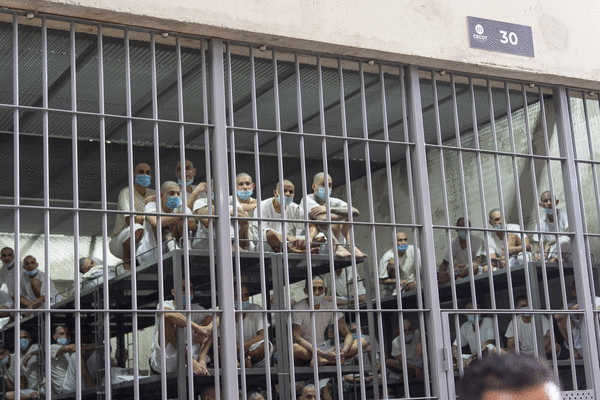
A Venezuelan man who vanished into the U.S. immigration system last year only to reemerge in one of Central America’s most notorious prisons has turned to the courts, accusing the U.S. government of deliberately abusing its power and violating his rights.
On Tuesday, Neiyerver Adrián León Rengel, a 28‑year‑old Venezuelan who spent four months detained at El Salvador’s Terrorism Confinement Center — known as CECOT — filed a sweeping federal complaint against the United States, alleging that Immigration and Customs Enforcement agents, senior officials in the Department of Homeland Security and other government officials systematically denied him due process, misidentified him as a gang member and illegally shipped him to a foreign prison.
León Rengel told the Miami Herald he wants to clear his name. Now back in Caracas, the city he once left behind, he says life after his imprisonment — and the accusations against him — has made it difficult to find work and support his family.
“I don’t want to return to the United States,” he said. “But I do want to clear my name — to show who I am and explain what happened to me. When people point fingers at you, it’s very difficult. What happened to the Venezuelans sent to CECOT could happen to anyone, to any migrant in this country.”
According to the complaint filed in federal court in Washington D.C., León Rengel arrived legally in the United States in June 2023 at the Mexican border with El Paso border after securing a CBP One appointment — a digital system for migrants seeking lawful entry at the time — and complied with immigration protocols. When he was detained in March 2025, he was awaiting an immigration hearing scheduled for 2028 and had an active application for Temporary Protected Status.
But on the morning of his 27th birthday — March 13, 2025 — ICE agents arrested him in the parking lot of his apartment in Irving, Texas. The federal complaint says agents ignored immigration paperwork that confirmed he was in the United States lawfully and instead justified detaining him by claiming tattoos on his body linked him to Tren de Aragua, a Venezuelan gang cited by the Trump administration as justification for its sweeping deportation campaign. León Rengel has consistently denied any such affiliation.
What happened next has become the core of Rengel’s legal fight.
León Rengel’s lawsuit, filed under the Federal Tort Claims Act, says he was “misled into thinking he was being sent to his home country” only to discover mid‑flight that the U.S. government had sent him to El Salvador, a country with which he had no legal ties or connections. Once there, the complaint says, he was thrust into CECOT and subjected to physical beatings, psychological abuse, inhumane conditions and isolation from family and attorneys.
“There was no meaningful opportunity to rebut any allegations,” the complaint says, pointing to repeated denials of access to lawyers and judicial oversight during his confinement. Filed in the U.S. District Court for the District of Columbia, the 40‑plus page complaint lays out claims of negligence, false imprisonment, violation of constitutional due process rights and intentional infliction of emotional distress. Rengel seeks at least $1.3 million in damages for his time removed from the United States, months of incarceration abroad under harsh conditions, and lasting emotional trauma — all while his immigration case remained pending.
On July 2025, the League of United Latin American Citizens, LULAC, a Washington-based civil-rights organization, in partnership with the Democracy Defenders Fund filed an administrative complaint with DHS, which oversees ICE, on his behalf, claiming he was deported without reason or due process.
Juan Proaño, the CEO of LULAC, told the Miami Herald that León Rengel’s case is likely one of many. The organization is helping lead efforts to bring additional claims on behalf of Venezuelans sent to El Salvador’s CECOT prison. Proaño said León Rengel’s case could serve as a model, noting that his family documented key interactions with U.S. authorities — including conversations in which officials allegedly misled them about his whereabouts, saying he had been deported to Venezuela when he was, in fact, in El Salvador.
“At the end of the day, he has had a lot of trouble finding employment in Venezuela,” Proaño said. “He is cutting hair at home for two or three people a day — earning $8 per cut. Previously, working in the U.S. he was earning $6,000 a month. He was supporting his family back in Venezuela, as well as her daughter. He simply can’t do those things anymore.”
León Rengel, one of 252 Venezuelans the U.S. deported to El Salvador and held at the prison incommunicado for four months, was released in July 2025 as part of a prisoner exchange with Venezuela.
For León Rengel, his time in CECOT remains painful, and the memories have not faded.
“While I was in CECOT I never saw a lawyer or a judge. They wouldn’t even let me make a phone call,” he said. “What happened to me — and to other Venezuelans sent to CECOT — could happen to anyone, to any migrant in this country.”
_____
©2026 Miami Herald. Visit miamiherald.com. Distributed by Tribune Content Agency, LLC.






Comments