How unprecedented is Kentucky House's impeachment of Judge Julie Goodman? A look at US trials
Published in News & Features
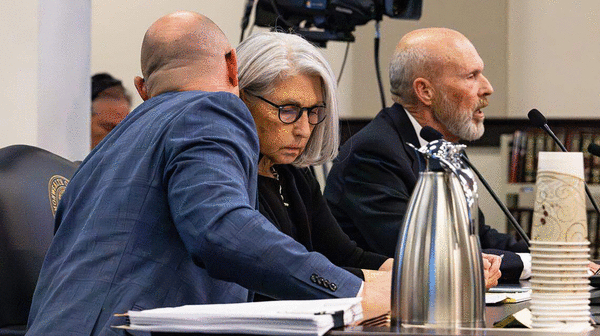
LEXINGTON, Ky. — The Kentucky House of Representatives voted Friday to impeach Fayette Circuit Judge Julie Muth Goodman in a rare move, sending articles of impeachment to the state Senate for trial.
Such proceedings seldom occur in the U.S.
Over a recent 25-year period, only two state judges were impeached, and only one of those was removed, according to a 2018 analysis from the Brennan Center for Justice, a nonpartisan law and policy organization at New York University Law.
“Judicial impeachment is exceedingly rare and has been used only for extrajudicial activity, such as bribery, seeking improper influence in decision making, and the like,” Joshua Douglas, associate dean for research and professor of law at University of Kentucky Rosenberg College of Law, wrote in a Tuesday email to the Herald-Leader.
The basis for Goodman’s impeachment proceedings are not extrajudicial activity but instead her rulings in six cases former lawmaker Killian Timoney highlighted in his January petition to the legislature, all later overturned by the Kentucky Court of Appeals.
Goodman and her attorneys have denied misconduct and attempted to have the courts intervene, claiming the proceedings have violated her rights to due process. Because all but one of the cases are active in higher courts, Goodman has said she cannot defend her rulings without violating professional ethical code.
A number of former judges, lawyers, including Gov. Andy Beshear, and legal experts have spoken out warning of the dangerous precedent the impeachment sets and the potential violation of the constitutional separation of powers.
The March 20 vote to impeach Goodman broke down largely along party lines, with two exceptions and 13 House members not voting.
At the federal level, there have only been 15 judicial impeachments in U.S. history, Douglas said, with eight convictions in the U.S. Senate, although a few of the impeached judges resigned before trial. The last one was in 2010.
In Pennsylvania from 1993 to 1994, the commonwealth’s legislature impeached and removed Supreme Court Justice Rolf Larsen, who was convicted by the state Senate of voting on whether to hear cases based on input from an attorney who was also a political supporter, according to AP News.
Another relatively recent instance was in 2000, when the New Hampshire House impeached state Supreme Court Justice David Brock. The state Senate declined to remove him, however. Brock was accused of lying under oath and of making improper communications in two cases.
“Both involved conduct separate from disagreement with how the judges ruled in particular cases,” Douglas said.
Actual impeachment of state judges is rare, but it’s slightly more common for lawmakers to unsuccessfully attempt to impeach a sitting judge, according to the Brennan Center. The organization reported there were impeachment attempts in at least three states from 2015 to 2018, including in New Hampshire, Pennsylvania and West Virginia.
“While state constitutions vary in their definitions of impeachable offenses, the few recent successful impeachment efforts in states confirm that legislators generally have limited that power to cases of serious ethical and criminal violations,” the Brennan Center says.
In an earlier attempt, the Illinois House of Representatives conducted an impeachment investigation into James Heiple of the state Supreme Court in 1997, but ultimately recommended no articles of impeachment be referred to the state Senate.
In Rhode Island, two chief justices of the state’s Supreme Court resigned amid impeachment proceedings in 1986 and 1993.
How does judicial impeachment work?
The impeachment process has two stages, according to the National Conference of State Legislatures.
The first step is the “impeachment,” or the development of a formal accusation or statement of charges, and is most often the responsibility of the House, or the “lower” legislative chamber. The first stage involves hearing and investigating accusations and developing and voting upon articles of impeachment, if found warranted. If an affirming vote is taken, the articles of impeachment are then typically forwarded to the Senate.
The second stage resembles a trial, according to the NCSL, and involves formally considering the charges laid out in the articles of impeachment and voting on whether to find the individual guilty.
Two primary reasons impeachments are so rare include that it is considered a power only to be used in “extreme cases,” and individuals often resign before the process can begin or be completed, the NCSL reports.
---------
©2026 Lexington Herald-Leader. Visit at kentucky.com. Distributed by Tribune Content Agency, LLC.






Comments