Iran strikes Persian Gulf oil hub as allies resist Trump's Hormuz plan
Published in News & Features
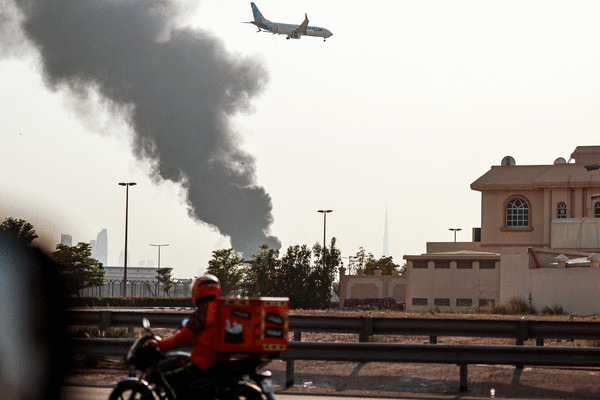
Iran struck new targets across the Persian Gulf, hitting a key United Arab Emirates oil hub as U.S. allies balked at President Donald Trump’s demands to help secure the Strait of Hormuz.
The UAE oil-export terminal of Fujairah suspended loadings temporarily after a drone strike Monday — the second attack in as many days. Dubai also briefly halted flights at its main airport and said some Emirates departures would be canceled because of a fire at a fuel tank that it said was caused by an Iranian drone.
Israel carried out more airstrikes on infrastructure in the Islamic Republic’s capital, Tehran, as Iran continued to launch retaliatory missiles.
The attacks show there’s no letup in the fighting that began with the U.S.-Israeli alliance’s bombing of Iran on Feb. 28. The Strait of Hormuz — a transit point for about a fifth of the world’s oil — remains effectively closed and has forced the likes of Saudi Arabia, the UAE and Kuwait to reduce oil output further. Still, a trickle of vessels is beginning to find a way through the waterway.
Brent crude jumped as much 3.3%, before retracing to trade 1.2% lower at almost $102 per barrel by 5:14 p.m. in Dubai. Stocks in Dubai slid into bear-market territory, having dropped 21% from a February high.
The oil price has surged about 40% since the start of the war, a move that will heap more pressure on Trump as U.S. gasoline prices jump.
The U.S. leader for the first time called on world powers — including France, the United Kingdom, Japan and China — to help the United States reopen the strait by sending warships to provide escorts to commercial vessels.
In Brussels, European Union foreign ministers responded by stressing that they don’t want to escalate the war, treading cautiously about even redirecting an existing Red Sea naval mission to the vital passage for energy shipments.
“We must not do anything that adds even more tension or escalation,” Spanish Foreign Minister Jose Manuel Albares said in Brussels. “What we need is for the bombings and the missile launches against all countries in the Middle East to stop, and for us to return to the negotiating table.”
In Japan, officials said there were no plans to dispatch ships to escort stalled tankers. The U.K. similarly wouldn’t commit to a full naval mission, even as Prime Minister Keir Starmer said he’d explore options with allies.
While China hasn’t made any direct response to Trump’s request, the state-run Global Times dismissed the idea as a U.S. attempt to spread the risk “of a war that Washington started and can’t finish.” Trump raised the prospect of postponing his trip to China later this month to meet President Xi Jinping if Beijing doesn’t help secure the strait, though Treasury Secretary Scott Bessent said any delay would be due to logistics, and not over Trump’s demand.
Trump said over the weekend that Iran is ready to make a deal to end the war, but the U.S. wants better terms, including a commitment by Tehran to abandon nuclear activities.
“Iran wants to make a deal, and I don’t want to make it because the terms aren’t good enough yet,” he said.
Yet Iranian Foreign Minister Abbas Araghchi denied seeking talks or a ceasefire with the United States.
“The reason we say we do not want a ceasefire is not because we are seeking war, but because this time this war must end in such a way that our enemies never again think of repeating these attacks,” Araghchi said at a media briefing Monday. “I think they have already learned a good lesson and understood what kind of nation they are dealing with.”
The Pentagon estimates the war — which U.S. officials said cost the country $11.3 billion in the first six days alone — would take four to six weeks, said Kevin Hassett, head of the White House’s National Economic Council. Underscoring the domestic pressure on Trump, Hassett was among several administration officials Sunday asking Americans for patience as global oil prices rise.
The conflict has left almost 4,000 people dead across the region, according to tolls from governments and nongovernmental organizations. The U.S.-based Human Rights Activists News Agency said more than 3,000 people died in the past two weeks in Iran. Lebanon said 850 people were killed since Israel began attacking the Iran-aligned Hezbollah militia in the country. Dozens have died across the Gulf and in Israel, while the U.S. has lost 13 service members.
The U.S. hit military sites over the weekend on Kharg Island, from which Iran exports almost all its oil. In announcing the strike, Trump said military facilities there had been “obliterated,” adding that he chose not to hit oil infrastructure “for reasons of decency.”
He threatened to do so should Iran “do anything to interfere with the Free and Safe Passage of Ships through the Strait of Hormuz.”
Saudi Arabia has begun pumping oil through a pipeline that runs from its eastern oil fields to a port at Yanbu on its western coast. That’ll allow it to avoid the strait for at least some, but not all, of its crude exports.
Trump said that even though Iran’s military was “already destroyed 100%,” it was “easy” for Tehran to continue threatening ships with drones, mines and short-range missiles. The U.S., he said, “will be bombing the hell out of” Iran’s shoreline to try to counter that.
There have been 16 reported attacks on vessels in and around Hormuz since the war began, according to the U.K. Maritime Trade Operations.
©2026 Bloomberg L.P. Visit bloomberg.com. Distributed by Tribune Content Agency, LLC.






Comments