Murkowski sponsors bill to cut $100,000 H-1B visa fee for public schools
Published in News & Features
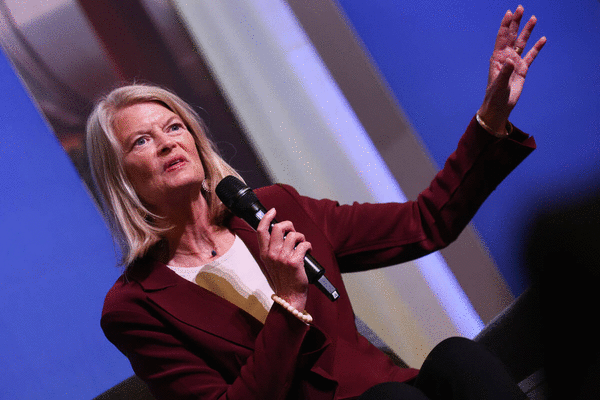
U.S. Sen. Lisa Murkowski has introduced legislation to exempt public schools from a $100,000 annual fee to hire international workers, a fee put in place for some visas by a Trump administration order in September.
Administrators at Alaska school districts, already burdened by high teacher vacancy rates, have pressed federal and state lawmakers for their help on scrapping the fee.
H-1B visas are for specialty or degree-related jobs. Before Trump's order, these visas cost about $5,000.
In its order, the Trump administration asserted the H-1B nonimmigrant visa program "has been deliberately exploited to replace, rather than supplement, American workers with lower-paid, lower-skilled labor."
Murkowski's bill would waive the $100,000 fee for public schools to hire teachers under the visa.
"As soon as this proclamation was released last year, I have been sounding the alarm with the administration about the importance of the H-1B visa program to Alaska's school districts," Murkowski said in a statement about the bill. "Our public school classrooms have been facing a staffing crisis for years, but teachers in Alaska on H-(1)B visas have been instrumental in bridging that shortage and serving our students with talent and care."
Alaska public schools employ more than 500 international teachers, and about 340 of them work under an H-1B visa, according to the Alaska Council of School Administrators. International teachers account for over half of teachers in some rural districts, according to state Rep. Alyse Galvin, an Anchorage independent who is also advocating on the issue.
School administrators say that the fee is an insurmountable burden to an understaffed education system. At the start of last school year, Alaska's public schools had hundreds of vacant positions.
"Districts would be forced into the impossible choice: Pay millions in visa fees and cut student programs, or go without teachers and leave classrooms uncovered," Lisa Parady, director of the Alaska Council of School Administrators, told state lawmakers earlier this month.
The federal legislation comes after Murkowski sent a letter to then-Homeland Security Secretary Kristi Noem in October, urging her to use her discretionary waiver authority to exempt public schools from paying the $100,000 fee. U.S. Sen. Dan Sullivan sent a similar letter to Noem the following month.
Noem responded to Murkowski in December. In a letter shared by Murkowski's office, she stated that exceptions to the fee are possible, but are "extremely rare and are granted only in extraordinarily compelling circumstances."
However, since President Donald Trump fired Noem, Murkowski, along with the rest of Congress, will be working with her replacement, according to Murkowski spokesperson Joseph Plesha.
"The Senator is approaching this through different options to make sure this gets fixed, whether that be through a Legislative fix or working with the Department," said Plesha.
Members of the Alaska Legislature are also speaking out on the additional fee.
Galvin introduced a resolution in February urging the federal government to waive the fee requirement for public schools.
Galvin introduced the resolution after Sullivan's February address to the state Legislature, following the senator's recommendation.
Galvin said that she will continue to try to push the resolution through the state Legislature as Murkowski's bill works its way through Congress. She said she sees the resolution as a tool for the delegation to illustrate the support for the change.
Last week, members of the state Senate also released a resolution broadly supporting J-1 and H-1B visas for their role in the state's "economic security and continuity of critical services."
School districts also hire educators on J-1 visas, but districts have moved away from using them. The U.S. government requires that communities be on a road system and have certain amenities to host a J-1 visa holder — like hospitals and grocery stores — leaving many rural Alaska communities ineligible, according to Jennifer Schmidt, director of the Alaska Educator Retention and Recruitment Center.
Schmidt says she's grateful to state and federal lawmakers for challenging the fee, but she's anxious about the timing.
From start to finish, Schmidt says the hiring process for an international teacher takes around three to four months. That means Murkowski's bill would need to be signed into law by May at the latest for school districts to get new international teachers in by fall, assuming districts pay the $3,000 expedited processing fee per teacher.
"If it's not lifted, we don't exactly know what's gonna happen," Schmidt said.
"I think it's gonna escalate soon, when everybody realizes that there's not enough teachers to go around," she said.
©2026 Anchorage Daily News. Visit at adn.com. Distributed by Tribune Content Agency, LLC.






Comments