Tension lingers between Gov. Wes Moore and Maryland Democrats as session end nears
Published in News & Features
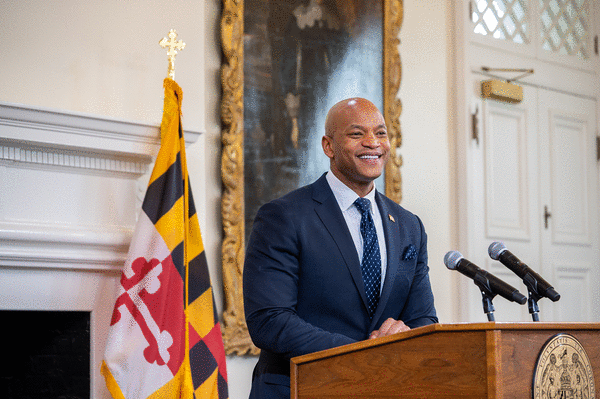
BALTIMORE — With a month left in the 2026 legislative session, the lingering rift between some Democratic members of the General Assembly and Gov. Wes Moore is unlikely to significantly affect this year’s legislative session.
But it might alter the next if Moore wins a second term, political professors told The Sun.
“Your second term is when people get really bold, and [Moore] wants to leave a legacy,” said Niambi Carter, a professor at the University of Maryland’s School of Public Policy. “He is [part of] a handful of Black people that have ever been elected to governor anywhere in the United States … If he’s not more attentive [to the relationship with lawmakers in his party], he’ll just have a second term that won’t do much.”
Matthew Crenson, professor emeritus at Johns Hopkins University, said what Moore “needs to be careful about is appearing to be neglectful of state business and state interests because he’s distracted by the goal of presidential election.”
The Maryland governor’s name has been floated alongside other governors seeking the nation’s highest office in 2028, even though he recently filed for re-election in Maryland.
Strained ties with Senate
Several state senators told The Baltimore Sun that they wouldn’t publicly rebuke Moore to avoid escalation of tensions, but they said privately that they resent the governor’s repeated calls for Senate President Bill Ferguson to force a redistricting vote amid added pressure from U.S. House Minority Leader Hakeem Jeffries and well-funded grassroots ad campaigns. They said they further resent Moore’s labeling the Senate as “undemocratic” for delaying a vote.
“It was more painful than it had to have been,” one senior Senate Democrat said, requesting anonymity to be open about private conversations.
The senator added that, while Moore hasn’t done any permanent damage, “it would be in his interest to change how he’s operating to be more successful in the General Assembly, especially if you have national ambitions and you want to show that you can do the job.”
But Ferguson, who is at the center of Moore’s fight with the Senate, insisted the relationship is functional. After The Sun asked him whether there were residual frustrations as redistricting moved out of focus, he said that, despite an overall “bona fide disagreement” on how to best serve Marylanders, lawmakers and the governor still “have many places where we have to continue working.
Sen. Arthur Ellis, who notably staged a protest in support of redistricting, echoed Ferguson.
“No one’s really frustrated,” Ellis told The Sun.
Sen. Clarence Lam, another pro-redistricting senator, described the redistricting disagreement between the Senate and the governor as “differences in opinion.”
“The governor obviously feels very strongly about his support for redistricting. I still support redistricting. I still think it’s the right thing to do,” Lam told The Sun. “Obviously, some colleagues don’t agree with that. That’s part of the process.”
Moore’s office did not respond to multiple requests for comment.
A person familiar with Senate Democrats’ conversations, who requested anonymity to describe private perceptions of the governor, described the current dynamic with the governor as “interesting.”
“On the outside, we’re calm, we’re going to make it work,” this person said. “But secretly, people don’t like to be talked about in the way [Moore has] talked about us. All the things that the governor said about the Senate Democratic Caucus certainly could be perceived negatively by anybody — whether it’s the anti-democratic thing, race, anything.”
Right before the 2026 legislative session began, Democratic lawmakers said their fallout with Moore peaked when the General Assembly overrode dozens of bills Moore vetoed during the 2025 legislative session.
Moore’s vetoes agitated Maryland House lawmakers during the last session. Today, some House members said they still resent Moore’s veto on a bill to create a commission to study reparations and make recommendations for restitution for descendants of those formerly enslaved in Maryland. The General Assembly overrode that veto during a special session in December.
“There are people walking around going, ‘That was tough,’” a current House Democrat and former member of Democratic leadership, who requested anonymity to speak about private conversations, told The Sun.
The source added that House members now choose to focus on their new leadership instead.
“There will be a time and place where — and it will probably happen the week before crossover — where people go, ‘Oh s**t, we have not been paying attention to them over there,’ and ‘What’s happening and what bills are moving and what’s going on,’” this Democrat said. “We’re just like in our own bubble trying to figure out how our chamber is working and dealing with this new dynamic.”
Republicans’ perspective
Republicans say the intra-party fighting among Democrats is noticeable.
“Honestly, [Moore’s] the one keeping it alive. He’s the one who keeps talking about alternative paths to redistricting and all that,” Senate Minority Whip Justin Ready told The Sun, referring to Moore’s recent comments that deadlines are artificial and that Democrats in Maryland can still pursue redistricting even though the candidate filing deadline has passed and election day nears
Still, Senate Majority Leader Steve Hershey told The Sun that the General Assembly should still be able to collaborate with Moore despite the odds.
“I don’t think just because of one position he’s taken on redistricting necessarily affects the way that we can work together,” Hershey said.
----------
©2026 The Baltimore Sun. Visit at baltimoresun.com. Distributed by Tribune Content Agency, LLC.






Comments