Iran picks new leader as escalating war deepens oil shock
Published in News & Features
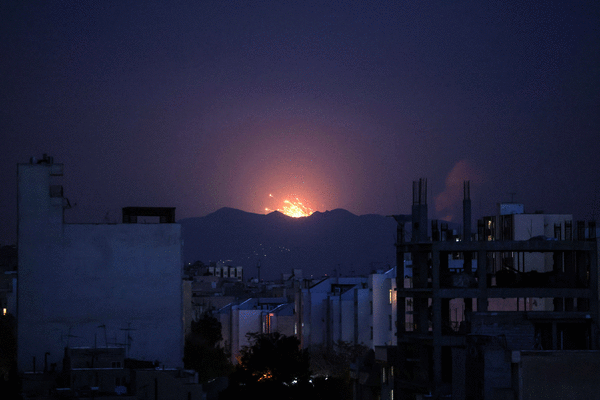
Iran picked a new supreme leader and kept up attacks on the ninth day of the war in the Middle East, hitting a water plant in Bahrain, while Israel struck fuel depots in Tehran and threatened the Islamic Republic’s power grid.
The attacks overnight into Sunday came as Arab states across the Persian Gulf continued to face incoming missiles and drones from Iran, which said it had the capacity to sustain the war for months. The Red Crescent warned of toxic acid rain following the Israeli strikes. Tehran didn’t disclose the identity of the new leader.
President Donald Trump said the U.S. will consider widening its strikes on the Islamic Republic in a conflict that’s upended energy markets and caused mass flight disruptions.
The United Arab Emirates, Kuwait, Saudi Arabia and Bahrain said they intercepted Iranian attacks overnight. The UAE and Kuwait began reducing oil production amid the near-closure of the crucial Strait of Hormuz, through which about a fifth of the world’s energy exports transit.
The Iranian strike on Bahrain came after Tehran accused the U.S. of hitting one of its water desalination plants. Persian Gulf countries rely on the facilities for most of their fresh drinking water and sustained attacks could compound the impact of a war that’s already rattled the financial hubs in the region.
President Masoud Pezeshkian said he had instructed the military not to attack any nation that isn’t striking the Islamic Republic and apologized to neighboring countries. Trump said the remarks amounted to a surrender, but Tehran pressed ahead with strikes.
“When the enemy attacks us from bases in the region, we respond and will continue to respond,” Ali Larijani, secretary of Iran’s Supreme National Security Council, said on state television on Saturday. “Countries in the region must either prevent the U.S. from using their territory against Iran themselves, or we will.”
On Sunday, Pezeshkian said Iran’s adversaries had drawn “naive conclusions” from his earlier remarks, adding Tehran is “compelled” to respond to aggression carried out from other countries.
Iran’s armed forces have the capacity to sustain at least six months of high-intensity war at the current pace and will start using more advanced, rarely used long-range missiles in coming days, state news agency IRIB said Sunday, citing the Islamic Revolutionary Guards Corps.
Israeli jets targeted Iranian oil depots in the Kuhak and Shahran areas of Tehran as well as the nearby city of Karaj, Iran’s semi-official Fars news agency reported. Explosions were heard in parts of the capital, where authorities urged residents to wear face masks and stay indoors, citing the air pollution risks from the debris clouds.
The Red Crescent warned the explosion of fuel-storage tanks had released massive amounts of hazardous particles into the atmosphere, the semi-official ISNA news agency reported.
On Sunday, Israel’s military said it had struck some 400 targets in western and central Iran over the past day. Eli Cohen, Israel’s energy minister, said targets including oil refineries and power stations were on the table.
The Israeli military said the Home Front Command search-and-rescue forces, together with emergency teams, were operating at impact sites in center of the country following an Iranian missile attack. Five people were evacuated to hospitals.
The UAE, which pumped more than 3.5 million barrels a day as OPEC’s third-biggest producer in January, started cutting oil production at its offshore fields. Kuwait, OPEC’s fifth-biggest producer, reduced crude oil and refinery production, citing the “ongoing aggression” by Iran.
U.S. gasoline prices have risen to the highest since September 2024 and American crude futures ended the week above $90 a barrel — more than $20 higher than last Friday — and notched the biggest weekly percentage gain on record in data going back to the 1980s.
The financial markets are being complacent about the war, with energy outages possibly ranking among the largest in recent history, according to Bloomberg Economics economist Ziad Daoud and geo-economic analyst Dina Estandiary.
“If attacks on regional energy infrastructure continue and the Strait of Hormuz remains shut, oil could surge toward $108 per barrel, posing serious risks to the global economy,” they said in a report.
Shares of Saudi Aramco climbed as much as 4.9% on Sunday, the most in nearly three years. Junaid Ansari, head of research and strategy at Kamco Investment Co., said the gain in oil prices would likely offset a decline in exports by the state-backed oil giant, and it should be able to re-route the bulk of its shipments to the Red Sea.
Bahrain on Sunday said three people were injured after shrapnel from intercepted missiles fell on the country.
Saudi Arabia intercepted a drone heading toward its Shaybah oil field and thwarted an attempt on the Diplomatic Quarter, where the U.S. embassy is located. At least one person was killed in Dubai due to “debris from an aerial interception,” the emirate said.
Meanwhile, there was an explosion at the U.S. embassy in Oslo early Sunday that caused minor damage and Norwegian police were exploring links to the conflict.
Trump told reporters on Air Force One on Saturday there would have to be a “very good reason” for the U.S. to deploy ground troops to Iran. He added that he expects the war would continue “for a little while” and oil prices would come back down.
China, a significant buyer of Iranian oil, has called for a ceasefire. But Foreign Minister Wang Yi on Sunday signaled that Beijing won’t allow the conflict to affect its relationship with Washington ahead of a planned meeting between Trump and Chinese leader Xi Jinping in Beijing.
French leader Emmanuel Macron is due to travel to Cyprus Monday to meet President Nikos Christodoulides and Greek Prime Minister Kyriakos Mitsotakis. The visit will demonstrate France’s solidarity with Cyprus following Iranian strikes and underscore the importance of maritime security, the Elysee palace said in a statement.
U.K. Prime Minister Keir Starmer’s government is defending its refusal to join in the initial strikes on Iran, following repeated criticism from Trump. Foreign Secretary Yvette Cooper told Sky News that Starmer was acting in the U.K.’s national interest and its security partnership with the U.S. remains incredibly strong.
The war began after the U.S. and Israel struck Iran on Feb. 28, and more than a dozen countries have been sucked into the fray. Iran has so far reported 1,332 deaths, alongside widespread destruction. Scores of others were killed elsewhere in the region, most of them in Lebanon where Israel has been fighting Iran-backed Hezbollah militia. Six U.S. service members have lost their lives.
Iran’s Assembly of Experts elected the country’s next supreme leader, the semi‑official Mehr news agency said citing council member Ahmad Alamolhoda, without providing a name. He replaces Ayatollah Ali Khamenei who was killed on the first day of the conflict. Mojtaba Khamenei, the slain leader’s second-oldest son, was viewed as being a possible pick.
_____
(With assistance from Leen Al-Rashdan, Shamim Adam, Dan Williams, Neil Munshi, Patrick Sykes, Christine Burke, Dana Khraiche, Samy Adghirni, Golnar Motevalli, Chris Miller and Galit Altstein.)
_____
©2026 Bloomberg L.P. Visit bloomberg.com. Distributed by Tribune Content Agency, LLC.



Comments