Clocks spring forward Sunday, but the sun may be setting on year-round daylight saving time
Published in News & Features
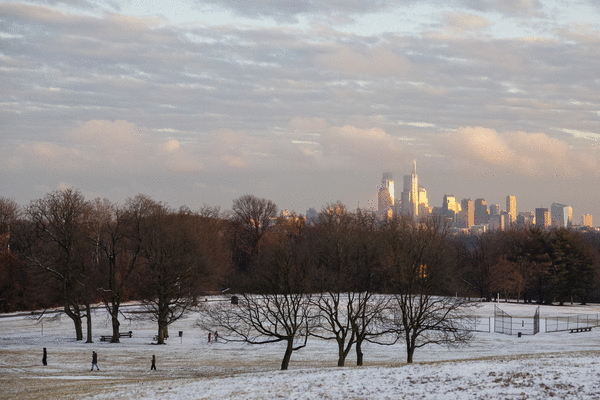
Clocks are taking a major leap into spring this weekend, this time around as early as it ever happens.
On Sunday the clocks will skip right over 2 a.m. and proceed to 3 a.m. as daylight saving time begins and will continue through Nov. 1.
The sun won’t set before 7 p.m. until Sept. 22.
Congratulations to those who prefer eating dinner before dark or savoring an extra dose of daylight after work. If you dread being shorted an hour on a precious weekend and hold that DST actually stands for “delayed sunrise time,” we offer a modest consolation prize.
The sun appears to be setting on the all-DST-all-the-time movement.
Recall that the U.S. Senate unanimously (at least technically) passed the 2022 iteration of the Sunshine Protection Act that would have ditched the switch and installed daylight saving time as the year-round system. U.S. Rep. Brendan Boyle, D-Pa., said at the time “the idea definitely has legs”
It’s as if the campaign has gone back to bed.
The 2022 bill’s sponsor, Marco Rubio, at the time a senator representing the Sunshine State, is now the secretary of state and appears to have bigger fish to fry. His immediate supervisor, President Donald Trump, who at different times advocated for year-round standard and year-round DST, has lost interest.
So, evidently, have legions of state lawmakers around the country.
The number of bills calling for year-round daylight saving time has dropped dramatically, and this year they are far outnumbered by bills advocating year-round standard time, based on a survey of data compiled by the National Conference of State Legislatures.
That said, the discussion may never die. The Sunshine Protection Act was reintroduced in the Senate last year. Sen. Rick Scott, R-Fla., says he’s giving it another shot. But expect 100% chance that clocks go back in the fall; the bill remains in committee.
Daylight saving time advocates have pointed to the recreational and other benefits of later sunsets, and those will become ever more evident during the next several weeks. Conversely, any number of health organizations warn of the dangers caused by sleep disruption, exacerbated by a certain longitudinal inequity.
To honor a day that so many look forward to, and so many others dread, we offer a few numbers for consideration, starting with a visit to Marquette, Michigan.
Sunrise Monday in Marquette doesn’t occur until 8:11 a.m., compared with 6:52 a.m. in Lubec, Maine. That is a 79-minute difference — in the same time zone. Lubec is on the shores of the Atlantic. Marquette is on the shores of Lake Superior in Michigan’s Upper Peninsula.
In Marquette, the sun’s reluctance to get out of bed may be understandable. The city already has had close to 210 inches of snow this season. “Even by our standards, this has been a pretty remarkable winter,” said Chris Burling, a meteorologist with the National Weather Service in Marquette.
As with the snow, the locals appear to accept the late sunrises with a measure of equanimity. “I think there’s some grumbling for a couple days,” said Burling, “but otherwise, it’s just ... that’s how it is.”
Sleep experts advise that people in the westerly longitudes of time zones stand to suffer more than their counterparts to the east. In Marquette, twilight won’t end until close to 10:30 p.m. around the summer solstice. That can be disruptive to bodily sleep rhythms, experts say, by depriving bodies of melatonin, the sleep hormone that the body produces in the dark.
The Michigan legislature is among those that have considered a bill for year-round standard time. Federal law permits states to go all-standard, but all-daylight saving time would require Congress to pass a law to allow it.
—Eight hundred bills have been introduced in state legislatures since 2005 to enact year-round daylight saving time, according to Tom Klein, policy associate with the legislatures conference.
—There were 93 bills introduced in 2025 in favor of either year-round Daylight Saving Time or standard time.
—Thirty-five states considered such bills in 2025, about evenly split between all-DST and all-standard, by the conference’s count.
—In 2026, 21 bills are under consideration, with 16 calling for year-round standard time and five favoring all-Daylight Saving Time.
—It’s been 1,454 days since the U.S. Senate approved the Sunshine Protection Act.
—The nation’s last experiment with year-round daylight saving time, in 1974, survived only 294 days,
—Just 238 days until we fall backward again. Incidentally, since Daylight Saving Time begins on the second Sunday in March, this is the earliest it could happen. Nov. 1 is the earliest possible starting date for standard time.
—Innumerable: Projected number of days before the clock-switch debate ends.
_____
©2026 The Philadelphia Inquirer. Visit inquirer.com. Distributed by Tribune Content Agency, LLC.






Comments