Trump's 'Shield of the Americas' summit in Miami will reinforce US leadership in region
Published in News & Features
MIAMI — President Donald Trump will host leaders from across Latin America and the Caribbean in Doral on Saturday for what the White House describes as a landmark summit aimed at reshaping regional alliances and reinforcing U.S. influence in the Western Hemisphere.
The gathering, which the Trump administration is calling the “Shield of the Americas Summit,” will bring together the heads of state or government from 12 countries aligned with Washington on issues including migration, drug trafficking and regional security.
The summit, to be held at Trump’s Doral resort, is a central piece of the administration’s hemispheric strategy, dubbed the “Donroe Doctrine,” a play on the 19th Century Monroe Doctrine, which officials say seeks to deepen cooperation among U.S. partners while limiting the influence of geopolitical rivals such as China, Russia and Iran in Latin America.
Among the leaders expected to attend are Argentine President Javier Milei; Salvadoran President Nayib Bukele; Dominican President Luis Abinader; Ecuadorian President Daniel Noboa; Costa Rican President Rodrigo Chaves; Paraguayan President Santiago Peña; Panamanian President José Raúl Mulino; Guyanese President Irfaan Ali; Honduran President Nasry “Tito” Asfura; Bolivian President Rodrigo Paz Pereira, and Trinidad and Tobago Prime Minister Kamla Persad-Bissessar. Chile’s president-elect, José Antonio Kast, is also expected to participate.
Conspicuously absent from the gathering will be the leftist leaders Luiz Inacio “Lula” da Silva of Brazil, Gustavo Petro of Colombia and Claudia Sheinbaum of Mexico, who were not invited, a fact that has led critics to dub the meeting as the Right-Wing Summit of the Americas.
A White House official said that the participating governments are expected to sign the Doral Charter, a declaration affirming what officials describe as the “right of the peoples of our Hemisphere to chart their own destiny free from interference,” while emphasizing democratic governance and free-market principles.
The document is also expected to commit participating countries to closer cooperation against drug cartels, criminal gangs and illegal migration, as well as expanded coordination on trade and economic policy.
White House Deputy Press Secretary Anna Kelly said the summit reflects Trump’s effort to reassert U.S. leadership in the region.
“After years of neglect, President Trump established the ‘Donroe Doctrine’ to restore American preeminence in the Western Hemisphere,” Kelly said in a statement. “This weekend’s ‘Shield of the Americas’ Summit will encapsulate his work to strengthen partnerships that make the region safer and more stable.”
Trump will be joined by several senior administration officials, including Secretary of State Marco Rubio, Defense Secretary Pete Hegseth, Commerce Secretary Howard Lutnick and U.S. Trade Representative Jamieson Greer, according to the White House.
Roger Noriega, a former U.S. assistant secretary of state for Western Hemisphere affairs under President George W. Bush, said the summit reflects a deliberate effort to bring together governments with similar strategic priorities.
“It’s significant that they’ve chosen like-minded countries to participate,” Noriega told the Miami Herald. “There’s obviously a lot of interest in issues like Venezuela and the counter-narcotics struggle.”
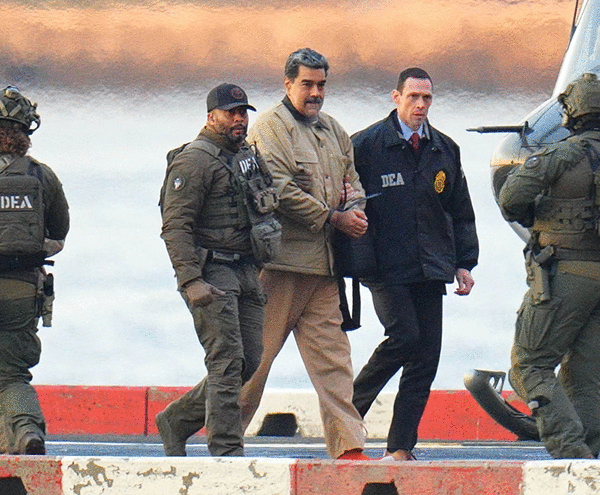
Noriega said many governments in the region broadly support the direction of Trump’s policy but want more details about Washington’s strategy — particularly efforts to restore democratic governance in Venezuela following the capture earlier this year of Nicolás Maduro and his wife, Cilia Flores.
“The folks in the region that are going to be in attendance aren’t going to want to second-guess the president, but they do want to support the effort,” he said. “It’s easier for countries to make tangible contributions if they know more about the strategy for getting a democratic government in power.”
He added that the arrests of Maduro and his wife should send a strong message to criminal organizations across the region.
“The United States is prepared to do whatever is necessary to address this threat,” Noriega said. “Venezuela has been a curse under this regime of the last 20 years.”
Still, Noriega said regional cooperation will be essential. Governments across Latin America already maintain lists of actions needed to combat drug trafficking, some requiring domestic enforcement and others involving international coordination.
Recalling conversations with Dominican President Luis Abinader, Noriega said the spirit of the summit reflects a willingness among allies to assist Washington’s efforts.
“His view was simple,” Noriega said. “If you’re an ally and a friend, you behave like an ally and a friend.”
Kevin Sullivan, vice president of Americas Society/Council of the Americas and head of the organization’s Washington office, said the meeting underscores the importance of sustained engagement between the United States and regional leaders.
“It’s always important when the president of the United States takes time to meet with leaders from the Americas,” Sullivan said. “Given the global demands on the presidency — from conflicts in places like Ukraine and tensions involving Iran — it’s not easy to dedicate time to the region.”
Sullivan said the gathering comes at a moment when many governments across the hemisphere face shared challenges, particularly violent crime and transnational criminal organizations.
“There appears to be a real possibility of reaching important agreements on how to confront those priorities,” he said. At the same time, Sullivan noted that the invitation list suggests the administration sought to bring together governments that broadly share its political outlook.
“You can sometimes move further and faster with like-minded partners,” he said.
The gathering comes as the United States intensifies pressure on drug-trafficking networks across the hemisphere and urges regional governments to confront what officials describe as “narco-terrorist organizations.”
On Thursday, Hegseth led an “Americas Against the Cartels” conference in Miami, where representatives from nearly 20 countries discussed expanded security cooperation and counter-narcotics operations.
Saturday’s summit also carries broader geopolitical implications. Trump administration officials have repeatedly warned about expanding Chinese economic influence in Latin America and Iran’s growing diplomatic presence in parts of the region.
Holding the summit in Miami also carries symbolism. The city — home to large Cuban, Venezuelan and Nicaraguan exile communities — has long served as a political hub for Latin American opposition movements and conservative diaspora groups.
It was also the site of the first Summit of the Americas in 1994, launched by President Bill Clinton as a forum intended to bring together leaders from across the hemisphere.
Three decades later, Trump’s gathering appears designed to reshape that model — bringing together a smaller group of like-minded governments to pursue closer cooperation on security, migration control and economic partnerships.
_____
©2026 Miami Herald. Visit miamiherald.com. Distributed by Tribune Content Agency, LLC.



Comments