US calls on allies in hemisphere to intensify fight against drug cartels
Published in News & Features
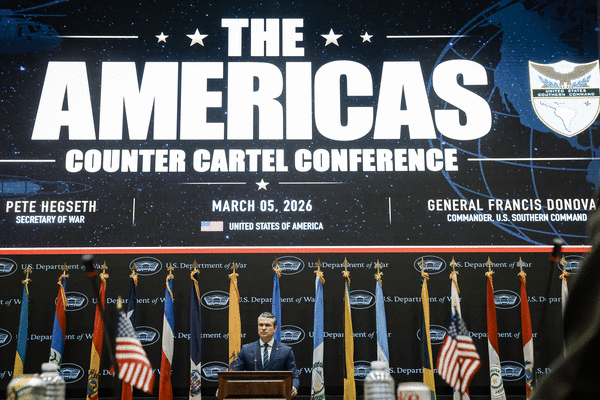
DORAL, Fla. — Senior Trump administration officials on Thursday called on allied nations across the hemisphere to intensify their fight against drug cartels and narco-traffickers, with White House deputy chief of staff Stephen Miller comparing the groups to the ISIS and al-Qaeda of the Western Hemisphere.
“The cartels that operate in this hemisphere are the ISIS and the al-Qaeda of the Western Hemisphere, and should be treated just as brutally and just as ruthlessly as we treat those organizations,” Miller said, telling the representatives of more than a dozen allied governments gathered at U.S. Southern Command headquarters in Doral they will have “the unwavering support” of President Donald Trump, the Defense Department and others in the administration to eradicate criminal groups.
“The human rights that we are going to protect are not of the savages that torture and rape and murder,” he said. “The human rights that we are going to protect are the peaceable citizens who have an absolute human right to live in physical safety and security every day of their lives.”
Miller brought the administration’s aggressive stance against drug traffickers and designated “foreign terrorists organizations” to Miami alongside Defense Secretary Pete Hegseth and other senior officials.
Hegseth hosted the inaugural The Americas Counter Cartel Conference alongside SouthCom commander Gen. Francis L. Donovan. Invitees included military officials and defense ministers from 17 allied governments from South and Central America and the Caribbean. Among those in attendance were the prime minister of Guyana, the defense minister of Chile and officials from Jamaica, Costa Rica, Argentina and Paraguay.
“America is prepared to take on these threats and go on the offense alone if necessary,” Hegseth told defense ministers and military officials during a 20-minute speech where he evoked the Monroe Doctrine and President Trump’s corollary, which is being called the Donroe Doctrine.
“However, it is our preference, and it is the goal of this conference, in the interest of this neighborhood, we all do it together with you, with our neighbors and with our allies who are eager and willing and capable,” he added.
Most of the countries represented are engaged in their own battles, and while voicing their continued cooperation with Washington, they stressed the need to ensure their efforts uphold the rule of law. Others also cited the need for support to continue to carry out operations.
“What weakens Nassau ultimately weakens Miami,” Bahamas National Security Minister Wayne Munroe said. “Instability in Port-au-Prince reaches Nassau long before it reaches Washington.”
Chilean Defense Minister Fernando Barros said to a roomful of applause that it was great seeing “the administration leading the war” against so many social diseases their nations are suffering from today.
“We are joining because there is a great threat,” he said. “They hurt our societies. They create poverty, they create pain, they create weakness. They act against the law.”
Noticeably absent from the conference were Brazil, Colombia and Mexico. The left-leaning governments have clashed with Trump over a number of issues; Mexico in particular has pushed back on possible U.S. military actions inside Mexican territory.
Hegseth described the gathering as a coalition of nations “united by our heritage, our history and geography.”
“In this new world, we share the same interests, and because of this, we face an essential test, whether our nations will be and remain Western nations with distinct characteristics, Christian nations under God, proud of our shared heritage with strong borders and prosperous people ruled not by violence and chaos,” he said
The event comes ahead of Trump’s Shield of the Americas Summit at the president’s nearby golf club in Doral. The leaders of several of the countries represented at Thursday’s conference have been invited to the summit and will meet personally with Trump.
Aggressive campaign
Since taking office, Trump has announced both an aggressive stance on protecting U.S. borders against illegal immigration and targeting drug traffickers. The Pentagon has carried out about 45 boat strikes in the southern Caribbean and Pacific that have left 150 people dead, and in January launched an operation to capture Venezuelan leader Nicolás Maduro and his wife, Cilia Flores. Following that operation, Trump did not rule out using military force in other countries and this week, U.S. forces launched a joint military operation with Ecuador against what they described as “designated terrorist organizations.”
“The Western Hemisphere is our neighborhood and the narcoterrorists who seek to export drugs and death to our shores and your shores will be dismantled and defeated,” Donovan said. “As allies and partners, we must take aggressive action together, sharing the burden through cooperation.”
As evidence of the administration’s commitment, both he and Hegseth mentioned the Maduro operation.
“U.S. forces raided and arrested the most dangerous house in the most dangerous compound inside the most fortified fort in the capital city of Caracas,” Hegseth said. “Nobody can do what the United States can do.”
Before breaking into sessions on topics including Monitoring the Caribbean, Counternarcotics, Migration and Legal Authorities, officials introduced a signed joint security declaration. Written in English and Spanish, the declaration endorses efforts to strengthen regional cooperation in combating transnational criminal organizations and narcotics trafficking in the Western Hemisphere.
Miller, widely seen as the architect of Trump’s immigration crackdown but increasingly involved in Western Hemisphere policy, said there has been a shift under the president in the last 14 months. No government in the room, he emphasized, should tolerate the existence of a single square mile of territory being under control of cartels.
“We are not going to cede an inch of territory in this hemisphere to our enemies,” he said.
After decades of effort, he said, nations have learned “that there’s not a criminal justice solution to the cartel problem.
“The reason why this is a conference with military leadership and not a conference of lawyers is because these organizations can only be defeated with military power,” Miller added
For too long countries in the region had been caught in what he described as “a vicious cycle” and it’s time, he said, for a more aggressive posture.
“Countries from Mexico down to the tip of South America do not provide their citizens with basic physical security,” Miller said. “So those citizens, in search of economic opportunity, illegally immigrate to the United States. They pay the smugglers. They pay the cartels, who then grow richer, who then grow more powerful, and then your countries, in turn, become poor, because you’ve lost your citizens, you’ve lost your human capital, you’ve lost your opportunities to develop and to grow.”
Countries must dismantle these organizations, Miller said, arguing that “illegal immigration facilitated by criminal networks is a form of terrorism.”
Comparing the Western Hemisphere to Europe, Miller said governments have been getting “very, very bad advice” for a long time from non-governmental organizations that encourage them to be softer on their approach to crime and migration.
“They told people, you, in short, that you needed to be softer and gentler and nicer than criminals, and that you had to demilitarize your approach and extend more rights and more opportunities to the people who are sabotaging and destroying your society,” he said, adding that such policies have weakened Western nations.
©2026 Miami Herald. Visit at miamiherald.com. Distributed by Tribune Content Agency, LLC.



Comments