Justifications for war multiply at White House
Published in News & Features
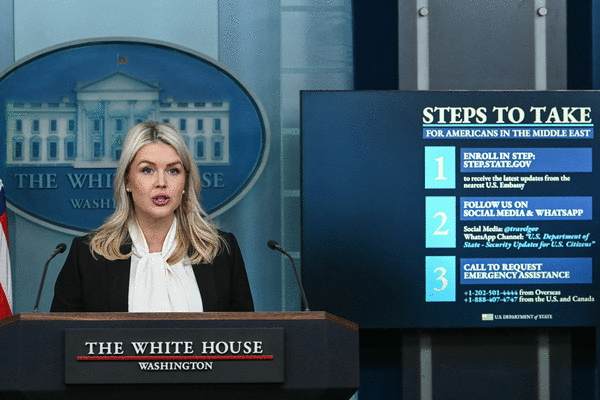
WASHINGTON — The White House tried for a fifth day Wednesday to explain why the United States is waging war in Iran — this time it was press secretary Karoline Leavitt’s turn — as Democrats said the president has not made a clear case.
Leavitt led her Wednesday press briefing by dubbing the Iranian government led by Ayatollah Ali Khamenei, killed in Saturday strikes, the “rogue Iranian terrorist regime.” Trump and other top administration officials had pointed to Tehran’s nuclear and missile programs as the main reasons for President Donald Trump’s surprise and ongoing war.
She again listed the nuclear and missile programs as part of the administration’s war justification, but added a desire to sink the Islamic Republic’s navy. Leavitt also added a fourth reason to the ever-growing list of reasons why Trump defied his decades-old anti-war views.
“Operation Epic Fury will ensure the regime’s terrorist proxies in the region can no longer destabilize the region or the free world and attack our armed forces,” she contended. “And, thus far, Iran’s proxies are hardly putting up a fight.”
Leavitt became the second senior Trump administration official in as many days to argue that the U.S. businessman-turned-president wanted — as he has with a long list of countries, individuals and entities since returning to office last January — to cut a few lucrative deals with Iranian leadership.
“Additionally, (Iran) had the opportunity to accept our support as an investor in potential projects to develop peaceful nuclear energy together,” she said. “Yet, in response, Iran would have to forfeit their enrichment capacity once and for all. But Iran … accepted none of these generous and unprecedented offers by the United States.”
Nearly half (45 percent) of U.S. adults opposed using U.S. military force to overthrow the Iranian government, with 32% in support, according to a YouGov-Economist survey conducted Feb. 27-March 2.
Asked Wednesday in the White House briefing room if Trump believes most Americans support the decision to go to war, Leavitt replied: “I think he does, and I think the president knows the country is smart enough to (ignore) many of the fake news headlines produced by people in this room.”
“This is a rogue terrorist regime that has been threatening the United States and our allies and our people for 47 years,” she added. “And the American people are smart enough to know that, and they’ve also been smart enough to listen to the president himself.”
She described the list of reasons used so far by multiple officials as “a cumulative effect of various direct threats that Iran posed to the United States of America.”
Leavitt’s comments came a day after Trump contradicted Secretary of State Marco Rubio’s account of what drew the United States into the conflict that Israeli and American forces began on Saturday.
Seated alongside German Chancellor Friedrich Merz, Trump said he likely forced Israeli Prime Minister Benjamin Netanyahu into the conflict.
“No, I might have forced their hand. You see, we were having negotiations with these lunatics, and it was my opinion that they were going to attack first. They were going to attack,” Trump told reporters in the Oval Office. “I felt strongly about that.
“And based on the way the negotiation was going, I think they were going to attack first. And I didn’t want that to happen,” he added. “So, if anything, I might have forced Israel’s hand. But Israel was ready, and we were ready, and we’ve had a very, very powerful impact, because virtually everything they have has been knocked out.”
But on Monday afternoon, before briefing lawmakers on Capitol Hill, Rubio said an imminent threat to Israel led to U.S. involvement.
“We knew that there was going to be an Israeli action. We knew that that would precipitate an (Iranian) attack against American forces, and we knew that if we didn’t preemptively go after them before they launched those attacks, we would suffer higher casualties,” said Rubio, also Trump’s national security adviser.
Back on Capitol Hill later Tuesday, Rubio told reporters “there’s nothing to clarify.” But then he offered an account more in line with Trump’s Oval Office comments.
“The bottom line is this: The president determined we were not going to get hit first. It’s that simple, guys. We are not going to put American troops in harm’s way,” the former GOP senator and Trump 2016 campaign rival said. “(Iranian leaders) wanted to reach a point where you couldn’t touch them, and then they could do whatever the hell they wanted with their nuclear program.”
Trump administration officials appear to be trying to settle on the Iranian government’s missile and drone programs as a safeguard for its masked nuclear ambitions as the chief justification for going to war.
But each time, a senior official has offered another reason, further clouding the Trump team’s thinking.
It was Defense Secretary Pete Hegseth’s turn on Wednesday morning.
“Yesterday, the leader of the unit who attempted to assassinate President Trump has been hunted down and killed,” Hegseth said during a briefing at the Pentagon. “Iran tried to kill President Trump and President Trump got the last laugh.”
What’s more, White House officials this week have been unable to square why a new attack was necessary after Trump had said in June that U.S. strikes had “totally obliterated” Iran’s nuclear program.
Two senior administration officials who briefed reporters under condition of anonymity to be candid described a robust and mature nuclear program, contending Iranian negotiators wanted to ramp up enrichment to weapons-grade levels.
The varying explanations led House Minority Leader Hakeem Jeffries, D-N.Y., on Tuesday to declare of administration officials: “They’re all over the place in terms of their justification,” adding of Trump’s June assessment: “So, was he lying to the American people then — or is he lying now?”
Senate Minority Leader Charles E. Schumer, D-N.Y., wrote in a Wednesday X post that he “sat yesterday with my Senate colleagues for an all-senators briefing, and here’s how much clarity we got out of that briefing: Zero.”
Some Democrats have warned about a prolonged American military mission in Iran.
Leavitt on Wednesday would not rule out Trump eventually deploying ground forces, though she said “they’re not part of the plan for this operation at this time.”
“I know there (have been) many leaders in the past who liked to take options off the table without having a full understanding of how things are developing,” she said. “So, again, it’s not part of the current plan, but I’m not going to remove an option for the president.”
_____
©2026 CQ-Roll Call, Inc., All Rights Reserved. Visit cqrollcall.com. Distributed by Tribune Content Agency, LLC.





Comments