Mich. Gov. Whitmer spotlights literacy, housing, medical debt in final State of the State
Published in News & Features
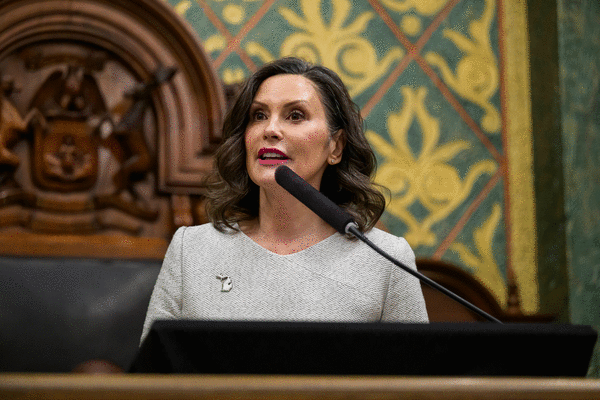
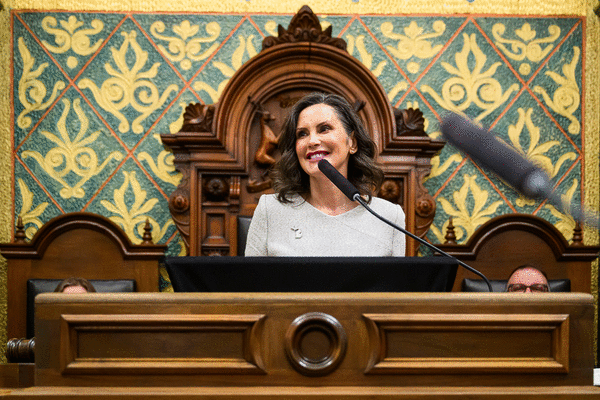
LANSING, Mich. — Gov. Gretchen Whitmer focused her final State of the State speech Wednesday on ways to improve education and make housing and health care more affordable in an address to a joint session of the Michigan Legislature.
The governor, at the start of her address, called Michigan's ranking as 44th in the nation for 4th grade reading proficiency "a serious problem" that so far has not been abated by record education funding.
"Literacy is a national challenge," Whitmer said. "No matter who becomes governor after me, they’ll have to continue this work."
Whitmer, who is in her fourth year of her second term, can’t run for reelection this fall. Her speech Wednesday marks her eighth and final State of the State address as governor, and Republicans were quick to criticize her work over the past several years.
Ahead of her remarks, Republican House Speaker Matt Hall argued any credit for accomplishments over the past year belonged to the House GOP, including the passage of a road funding package in the fall.
"If there are wins to celebrate tonight, they happened because Michigan House Republicans led and delivered," the Kalamazoo County Republican said in a social media post.
In her speech, Whitmer described last year's deal to direct another $1.1 billion annually towards roads as the "biggest bipartisan roads deal in state history."
Michigan Senate Republicans, including Senate Minority Leader Aric Nesbitt, R-Porter Township, held a press conference Wednesday morning inside the Capitol, where they displayed their report card for Whitmer’s time in the state’s top office, giving her a failing grade.
The card noted that Michigan had one of the highest unemployment rates in the country and ranked 44th among the 50 states in the average reading score of fourth-graders, according to the most recent National Assessment of Educational Progress results.
“The only fortunate thing about today is that this is her last State of the State, and we have a real opportunity to turn the state around,” said Nesbitt, who’s currently running for the GOP gubernatorial nomination.
Nesbitt and Sen. Lana Theis, R-Brighton, strongly criticized Whitmer’s handling of education policy, as the governor has vowed to focus on literacy in her last year in office. They cited her past decisions to toss out the Republican-backed A-F letter grade system for evaluating Michigan schools and to repeal a standard that required students be held back if they were unable to prove they could read by the third grade.
“I commend her for deciding that she needed to start working on reading,” Theis said. “We’ve been asking her to do this for seven years.”
Prioritizing literacy
The governor's spotlight on literacy focused on the state's efforts to improve literacy after years of abysmal reading scores among Michigan students.
The governor signed legislation that would improve literacy teaching methods, buy "evidence-based classroom resources" and invest in literacy coaches.
But more is needed, Whitmer said, before outlining a plan contained in her executive budget recommendation earlier this month that would start reading efforts earlier, adopt proven methods and bring in extra help.
"Literacy is an ordinary superpower that every child deserves," Whitmer said. "We’ve already seen remarkable progress in states doing the same things I’ve covered tonight."
The governor's $88.1 billion executive budget recommendation proposed earlier this month includes roughly $24.5 billion for education, about $21.4 billion of which is dedicated to K-12 students.
The $21.4 billion K-12 budget would increase current per-pupil funding from $10,050 to $10,300 as well as hike weighted foundation payments for some learners by 6%.
Whitmer's budget proposal also includes additional funding for early literacy interventions, including a $100 million tutoring program, $150 million in continuing funding for better literacy curricula and training and $10.5 million for more literacy coaches.
A focus on housing
The governor named housing affordability and accessibility as a focus for her final months in office, noting the pressures of inflation and tariffs have increased the cost of the goods needed to building housing.
"We can’t change national tariffs — believe me, I’ve tried — but we can build more quality, affordable housing in Michigan," Whitmer said.
Whitmer voiced support for an affordable housing development tax credit at the state level, one similar to the credit available at the federal level.
The proposal comes as the Legislature earlier this month introduced a bipartisan package of housing bills meant to remove regulatory red tape slowing down the development of housing.
The legislation led by state Rep. Joe Aragona, R-Clinton Township, has been roundly rejected by local government leaders who argue it impedes on locals' ability to control their own building and zoning regulations related to multifamily housing, parking availability, setbacks, lot sizes, minimum dwelling sizes and timelines for government review of development requests.
Whitmer seemed to voice some support for the legislation, advocating for an end to "nonsensical construction requirements" and the streamlining of zoning.
"There’s still a lot of red tape that gets in the way of shovels hitting dirt," the governor said.
Addressing medical debt
The outgoing governor called for stricter parameters around medical debt as two bipartisan legislative packages seeking to do so move through the House and Senate.
The legislation would cap medical debt interest, prohibit medical debt from showing up on credit reports, ban medical debt from leading to home liens or foreclosures and require hospitals to establish financial assistance programs for patients.
It's unclear how the state would implement the ban on the listing of medical debt in consumer reports in the face of federal rule interpretations overriding state law.
Last fall, the Trump administration ruled that the federal Fair Credit Report Act preempts state laws on credit reporting, making such state laws largely moot or subject to litigation.
The governor also called on Congress to renew Affordable Care Act subsidies to spare Michigan residents from heightened insurance costs.
"The domino effect of higher premiums, hospital closures, reduced services, workforce reduction will impact us all, even if you have good insurance," Whitmer said. "No state can pick up the massive tab the federal government has dropped on us."
_____
©2026 The Detroit News. Visit detroitnews.com. Distributed by Tribune Content Agency, LLC.






Comments