Push for a 'talking filibuster' stalls in Senate GOP conference
Published in News & Features
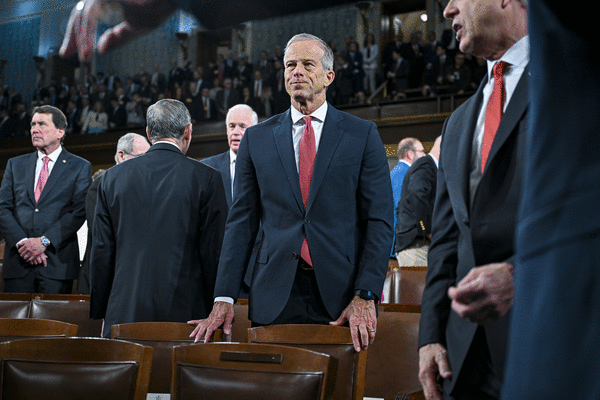
WASHINGTON — A handful of House Republicans have flooded social media and brought a MAGA influencer to Capitol Hill in a pressure campaign for Senate Majority Leader John Thune to move forward on passing their voter ID bill with a simple majority.
President Donald Trump even pressed Thune specifically to get the bill passed during the State of the Union address. “I’m asking you to approve the SAVE America Act,” he said during his Tuesday night address. “The cheating is rampant in our elections. ... We have to stop it, John. We have to stop it.”
Without the 60 votes needed to pass the measure in the Senate, one option the bill’s advocates believe they can use to move forward would be to force Democrats to engage in a so-called talking filibuster — essentially, forcing Democrats to occupy the floor and talk nonstop, until one side or the other backs down. Their bet is that Democrats would eventually give in.
The plan is a nonstarter for most GOP senators, who have warned of a monthslong suck of precious floor time and rippling implications from changing the fabric of the chamber’s procedure.
“The talking filibuster issue is one on which there is not a ... unified Republican Conference, and there would have to be,” Thune, R-S.D., said Wednesday. “It is still an open question, one that we are having conversations about, but clearly not a unified position.”
Known as the SAVE America Act, the bill, which passed the House earlier this month, would require Americans to prove their citizenship when registering to vote and present photo identification when casting a ballot.
Cutting off debate and shutting down a filibuster by invoking cloture requires 60 votes, and with a slim GOP majority and little-to-no Democratic support, that’s not an option for Thune.
If Senate Republicans want to bypass the 60-vote threshold and try to pass the bill and get it to Trump’s desk with just a simple majority instead, the talking filibuster is one option. A talking filibuster, unlike current filibuster practice, however, would require a constant presence on the floor. And opening the door to that option would hamper, for instance, the GOP’s ability to delay floor proceedings if they are in the minority in the near future. The majority party has changed in the Senate twice in the last 10 years.
Although some Senate Republicans are in support of deploying the talking filibuster to pass the bill, most of the pressure on Thune is coming from a handful of House GOP members and “Make America Great Again” advocates outside Capitol Hill.
“It was designed to force debate, so when an unelected Senate staffer can shut down bills because they don’t want to do work, kiss my ass. Write that down,” said Rep. Derrick Van Orden, R-Wis.
Rep. Anna Paulina Luna, R-Fla., who helped lead an ongoing social media pressure campaign on Thune, said the Senate GOP leader wouldn’t make eye contact with her during the State of the Union address Tuesday night. She said of the talking filibuster: “They need to embrace it, and if they don’t, don’t vote them back in office.”
A few weeks ago, MAGA social media creator Scott Presler spent days on Capitol Hill meeting with Republicans and pushing support for the voter ID bill. He posted videos with Speaker Mike Johnson, R-La., and Republican Study Committee Chairman August Pfluger, R-Texas, about the bill.
The social media campaign even got a hold of rapper Nicki Minaj, a newfound friend of the Trump administration, who urged people on social media to call their senators about the bill. Billionaire Elon Musk has chimed in to support, too.
In the Senate, Mike Lee, R-Utah, has been leading a small group of Republicans publicly pushing a talking filibuster. “We won’t pass the SAVE America Act unless we start by making filibustering senators speak. This will take time and effort, but we’d be crazy not to give it the effort it deserves,” he posted to X on Wednesday.
Still, Presler continues to return to the Capitol — he posted pictures in front of Thune’s office door just a few days ago. Most recently, Presley announced his organization, Early Vote Action, is launching a SAVE America Tour starting in Thune’s home state.
Measured in months
As senators left their weekly policy lunches on Wednesday, it became clear the GOP conference doesn’t have an appetite to gamble on a talking filibuster.
Sen. Thom Tillis, R-N.C., told reporters he would support the talking filibuster “under no circumstances,” despite being an original co-sponsor of a previous iteration of the bill and liking “the policy.”
“We either care about the integrity of this institution or we don’t,” Tillis said.
“Anybody that is supporting a talking filibuster is just using different words to get to the ultimate nuking of the filibuster,” Tillis said, pointing to when his conference pushed back against Democrats’ attempts to employ a talking filibuster on their voting rights legislation in 2022.
Thune’s fellow South Dakotan GOP Sen. Mike Rounds said, “It’ll be up to leadership to determine how we approach this thing. I think the best thing we could do would be to push our Democrat colleagues to the point where they understand just how much the American people want.”
Sen. Roger Marshall, R-Kan., added the situation is “much more complex than what’s being advertised” by House members. “We wouldn’t vote on anything else for probably two to three months with no guaranteed outcome.”
It’s also not clear what a talking filibuster would look like in the 21st century, said Michael Thorning, director of the Bipartisan Policy Center’s Structural Democracy Project.
“The majority leader can use his discretion to allow debate to go on until it’s exhausted. … That doesn’t require any kind of nuclear option, that’s sort of just letting the rules play out as they’re written,” he said. But “the reason it’s rare is because there is a very high burden and demand on the majority for it to actually be successful.”
“Essentially, the majority has to keep a majority of their members around the floor, basically for at a moment’s notice,” Thorning explained. And that could last for months. One of the longest talking filibusters, for example, lasted for 60 days and resulted in the passage of the landmark 1964 Civil Rights Act.
Thorning added senators could use procedural loopholes to lower the approval threshold from 60 votes to a simple majority, but doing so would “really undermine Senate rules.”
“(It) is precisely what people are talking about when they say the nuclear option,” he said.
Even Sen. Ron Johnson, R-Wis., who is still pushing for the talking filibuster among his colleagues, said he is “very cognizant of how difficult that’s going to be” unless Senate leadership decides to change the rules to make it easier on the majority.
“I understand this is a math problem, passing the SAVE America Act through the Senate right now,” he said. “It is a challenge, no doubt about it. But we can at least make Democrats defend their indefensible position.”
House Republicans, for their part, don’t intend to let up.
“The Senate’s like, ‘No, we’re just not going to do it,’” Van Orden said. “No, do your damn job!”
_____
©2026 CQ-Roll Call, Inc. Visit at rollcall.com. Distributed by Tribune Content Agency, LLC.






Comments