Deadly bird flu found in California elephant seals for the first time
Published in News & Features
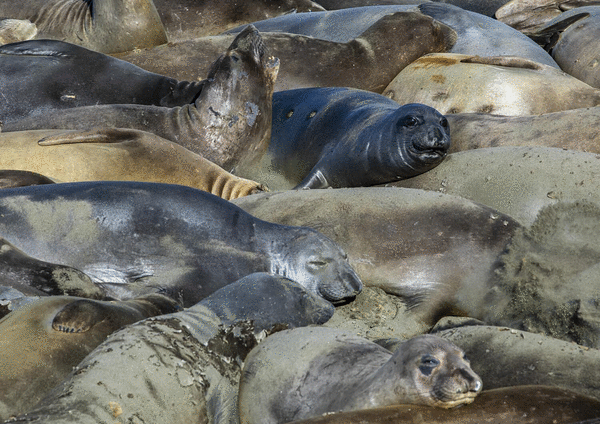
The H5N1 bird flu virus that devastated South American elephant seal populations has been confirmed in seals at California's Año Nuevo State Park, researchers from the University of California, Davis and the University of California, Santa Cruz announced Wednesday.
The virus has ravaged wild, commercial and domestic animals across the globe and was found last week in seven weaned pups. The confirmation came from the U.S. Department of Agriculture's National Veterinary Services Laboratory in Ames, Iowa.
"This is exceptionally rapid detection of an outbreak in free-ranging marine mammals," said Professor Christine Johnson, director of the Institute for Pandemic Insights at UC Davis' Weill School of Veterinary Medicine. "We have most likely identified the very first cases here because of coordinated teams that have been on high alert with active surveillance for this disease for some time."
Since last week, when researchers began noticing neurological signs of the disease in some animals, 30 seals have died, said Roxanne Beltran, a professor of ecology and evolutionary biology at UC Santa Cruz. Twenty-nine were weaned pups and the other was an adult male. The team has confirmed the virus in only seven pups.
Infected animals often have tremor, convulsions, seizures and muscle weakness, Johnson said.
Beltran said teams from UC Santa Cruz, UC Davis and California State Parks monitor the animals 260 days of the year, "including every day from December 15 to March 1," when the animals typically come ashore to breed, pup and nurse.
The concerning behavior and deaths were first noticed Feb. 19.
"This is one of the most well-studied elephant seal colonies on the planet," she said. "We know the seals so well that it's very obvious to us when something is abnormal. And so my team was out that morning and we observed abnormal behaviors and seals and increased mortality that we had not seen the day before in those exact same locations. So we were very confident that we caught the beginning of this outbreak."
In late 2022, the virus decimated southern elephant seal populations in South America and several sub-Antarctic Islands. At some colonies in Argentina, 97% of pups died, while on South Georgia Island, researchers reported a 47% decline in breeding females between 2022 and 2024. Researchers believe tens of thousands of animals died.
More than 30,000 sea lions in Peru and Chile died between 2022 and 2024. In Argentina, roughly 1,300 sea lions and fur seals perished.
At the time, researchers were not sure why northern Pacific populations were not infected, but hoped previous or milder strains of the virus had conferred some immunity.
The virus is better known in the U.S. for sweeping through the nation's dairy herds, where it infected dozens of dairy workers, millions of cows and thousands of wild, feral and domestic mammals. It's also been found in wild birds and killed millions of commercial chickens, geese and ducks.
Two Americans have died from the virus since 2024, and 71 have been infected. The vast majority were dairy or commercial poultry workers. One death was that of a Louisiana man who had underlying conditions and was believed to have been exposed via backyard poultry or wild birds.
Scientists at UC Santa Cruz and UC Davis increased their surveillance of the elephant seals in Año Nuevo in recent years. The catastrophic effect of the disease prompted worry that it would spread to California elephant seals, said Beltran, whose lab leads UC Santa Cruz's northern elephant seal research program at Año Nuevo.
Johnson, the UC Davis researcher, said the team has been working with stranding networks across the Pacific region for several years — sampling the tissue of birds, elephant seals and other marine mammals. They have not seen the virus in other California marine mammals. Two previous outbreaks of bird flu in U.S. marine mammals occurred in Maine in 2022 and Washington in 2023, hitting harbor and gray seals.
The virus in the animals has not yet been fully sequenced, so it's unclear how the animals were exposed.
"We think the transmission is actually from dead and dying sea birds" living among the sea lions, Johnson said. "But we'll certainly be investigating if there's any mammal-to-mammal transmission."
Genetic sequencing from southern elephant seal populations in Argentina suggested that version of the virus had acquired mutations that allowed it to pass between mammals.
The H5N1 virus was first detected in geese in China in 1996. Since then it has spread across the globe, reaching North America in 2021. The only continent where it has not been detected is Oceania.
Año Nuevo State Park, just north of Santa Cruz, is home to a colony of some 5,000 elephant seals during the winter breeding season. About 1,350 seals were on the beach when the outbreak began. Other large California colonies are located at Piedras Blancas and Point Reyes National Sea Shore.
Public access to the park has been closed and guided elephant seal tours canceled.
_____
©2026 Los Angeles Times. Visit latimes.com. Distributed by Tribune Content Agency, LLC.






Comments