NASA begins Artemis II roll back to the garage to try and hit April launch window
Published in News & Features
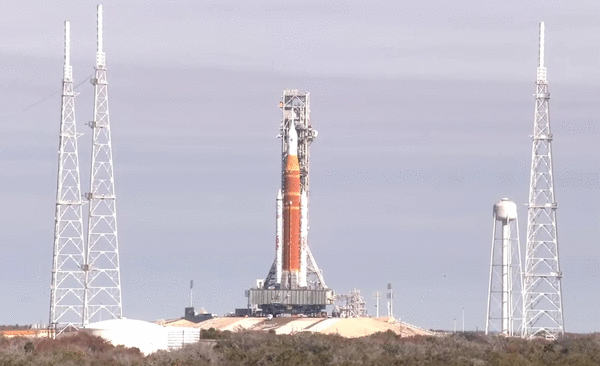
NASA has at least another 8 miles of terrestrial travel to accomplish before it can take on a 600,000-mile trip to space.
With a problem in the Artemis II rocket’s upper stage that cannot be fixed at the launch pad, NASA began to roll back the 11 million pounds of hardware from Kennedy Space Center’s Launch Pad 39-B to the Vehicle Assembly Building on Wednesday morning.
First movement came at 9:38 a.m. for the slow, 4-mile trek that will take roughly 12 hours at a top speed of 1 mph. Along for the ride are the Space Launch System rocket, Orion spacecraft and mobile launcher 1 platform and tower, all piled atop NASA’s massive workhorse, crawler-transporter 2. The tracked vehicle the size of a baseball infield has been used for more than 50 years to haul the likes of space shuttles and Saturn V rockets as well as the SLS that flew on Artemis I.
NASA plans to address a helium gas flow issue into the SLS’s interim cryogenic propulsion stage (ICPS) that was discovered last weekend.
It’s a headache that gave some NASA officials whiplash including the four astronauts set to ride in Orion for what would be the first human spaceflight beyond low-Earth orbit since 1972.
NASA astronauts Reid Wiseman, Victor Glover and Christina Koch as well as Canadian Space Agency astronaut Jeremy Hansen had entered into quarantine last Friday after NASA had signaled a wet dress rehearsal of launch operations had gone well last week.
NASA was pushing for a potential launch as early as March 6, but with the helium leak revelation, NASA Administrator Jared Isaacman on Saturday said a roll back to the VAB would be required before launch, and the astronauts were back out of quarantine by Sunday.
With some free time on their hands, Isaacman and the four astronauts were in attendance Tuesday night in Washington for President Trump’s State of the Union address, although the president didn’t mention Artemis specifically in his speech.
Now the earliest Artemis II can launch would be April 1. The mission will be the first crewed flight of Orion, which will take its passengers on a 10-day trip highlighted by a lunar fly-by that will bring them farther from the Earth than any human has ever traveled before, surpassing the farthest distance flown by Apollo 13 in 1970.
The mission is designed to ensure Orion is safe enough to fly humans for future lunar missions. The follow-on mission, Artemis III, which the Trump administration is pushing to fly before the end of 2028, looks to return humans to the lunar surface for the first time in more than half a century. To date, only 12 men have walked on the moon during six successful landings from 1969-1972.
NASA had originally lined up for a potential launch in early February having first rolled the rocket to the pad on Jan. 17, but a first attempt at a wet dress rehearsal on Feb. 2 begat liquid hydrogen leaks to the SLS core stage that required repairs to the propellant line connecting ground systems to the rocket.
Those fixes held strong for the second wet dress rehearsal and teams were able to complete all the tasks during the simulated countdown that looked to set up a retry for launch in early March.
Then the helium leak in the ICPS upper stage occurred.
“The ICPS helium system performed as expected during both (wet dress rehearsals). This was an unexpected development during routine helium flow operations last evening. The teams were up all night assessing the situation,” Isaacman had posted on X after the issue was revealed.
In a lengthy followup post, he detailed that there was no flow detected from the bottles of helium that are meant to purge the engines of the liquid oxygen and liquid hydrogen propellants that were put into the stage during the wet dress rehearsal and repressurize the hardware.
“This occurred during a routine operation to repressurize the system,” he said. “We observed a similar failure signature on Artemis I.”
Teams used a backup ground systems to complete the LOX and LH2 purge instead so the vehicle was able to achieve a safe configuration.
Isaacman noted that the problem could be a filter between the round systems and the flight vehicle located in an umbilical line, a failed quick disconnect umbilical interface or a failed check valve on the vehicle.
This latter potential issue was seen during the 2022 uncrewed launch of Artemis I, but Isaacman said corrective actions had been taken to minimize it from happening again for Artemis II.
Yet just like on Artemis I, which didn’t launch until after its fourth trip to the pad, Artemis II will have to make at least one more trip back to the garage before what could be its final 4-mile crawl back to the pad.
“Regardless of the potential fault, accessing and remediating any of these issues can only be performed in the VAB,” he said. “I understand people are disappointed by this development. That disappointment is felt most by the team at NASA, who have been working tirelessly to prepare for this great endeavor.”
While at the VAB, NASA will also replace batteries in the flight termination system and retest it, as well as replace additional batteries in the upper stage.
Isaacman promised a more extensive briefing about Artemis II as well as future missions later this week.
-----------
©2026 Orlando Sentinel. Visit at orlandosentinel.com. Distributed by Tribune Content Agency, LLC.






Comments