Screws tightening for immigrant detainees swept up in Operation Midway Blitz as arrests continue
Published in News & Features


CHICAGO — Many of the most in-your-face signs of Operation Midway Blitz have evaporated from public life in Chicago.
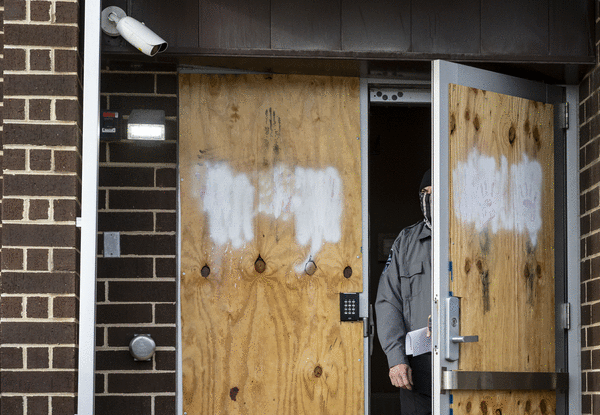
There’s no more tear gas or pepper balls in the streets. The Broadview processing center that saw so much chaos still draws protests and demonstrations, but last week, a religious group reported that just four people were being held there. U.S. Border Patrol Cmdr. Gregory Bovino, who oversaw the height of the operation, hasn’t been seen in Chicago in months.
Yet immigration enforcement continues in and around the city. And the battles that started on residential streets during the fall are still wearing on in courtrooms and detention centers from Wisconsin to Indiana to Texas.
The U.S. Department of Homeland Security said last week it had arrested a total of 5,000 people from the area since the start of the so-called blitz. Those who have chosen to fight their cases face a rapidly shifting legal and administrative landscape that experts say is narrowing paths to legal status and continuing their lives in the U.S.
A slew of decisions by the Board of Immigration Appeals, an administrative body that reviews the choices of immigration judges around the country, stand to have serious consequences for immigrants who are seeking to remain in the U.S. Those decisions are already shaping outcomes for those arrested during the fall, and will likely limit options even further for people who are arrested in the coming months.
Samuel Cole, the chief immigration litigation counsel with ACLU of Illinois and a former Chicago immigration judge, said those decisions are a direct result of Trump-era efforts to reshape the immigration board and the court system it supervises into an enforcement tool.
“These rulings are designed to deport people, detain people and make the lives of non-citizens as uncomfortable as possible,” he said. “It makes it much more difficult for anyone who is seeking to stay in the U.S. to win their case.”
An enforcement decrease
If Midway Blitz hiked Shelby Vcelka’s stress level to a 10, these days it’s about half that.
Vcelka, an immigration defense attorney, noticed her firm started to get more calls about detainees in the earliest months of the second Trump administration, but that it only amounted to one new client in detention each month. Then came Midway Blitz, which she described as an “onslaught.”
“It went from one detainee a month to multiple detainees a day,” she said. “Our phones would blow up, we would get calls all the time.”
By the height of Midway Blitz, Vcelka estimated she had about 30 clients in detention. But by mid-February, she said that number had dwindled to about 10. Other attorneys said they’d seen a similar lull.
Data from the Illinois Coalition for Immigrant and Refugee Rights shows that calls reporting enforcement activity and arrests have dropped from a peak of around 14,000 in October 2025. Last month, the organization got about 5,000 such calls, a spokesperson said, reflecting continued arrests even without concentrated neighborhood “sweeps.”
For Vcelka, whose clients were some of the most visible faces of Chicago’s “blitz,” the last few months have been a rush of hearings and deadlines as she and her colleagues work to resolve cases that started in the fall and new cases have continued to pile up.
“It’s a lot of picking up (pieces),” Vcelka said. “Just because they’re not here in the streets does not mean the work is over.”
Far from being over, the work to secure someone’s legal status or even get them released from detention while they await trial is now taking place in a rapidly evolving legal landscape rife with confusion and unpredictability.
Nicole Hallett, who runs the Immigrants’ Rights Clinic at the University of Chicago, said unpredictability is the most serious problem facing legal aid offices right now. Hallett’s still hearing from people every day who have been arrested or whose family members are detained, she said.
But “the normal way that things are supposed to happen, (where) you file your applications and then you wait for your court date and most people aren’t detained” is no longer guaranteed, she said.
“Even if I had capacity at this moment, taking on new cases is a huge risk because any of my other cases could blow up at any moment,” Hallett said.
Much of that risk is due to a decision by the Board of Immigration Appeals known as the Matter of Jonathan Javier Yajure Hurtado. That ruling, which was issued just days before Midway Blitz began in Chicago, found that an immigrant without legal status is not eligible for bond and instead must be detained.
That leaves a petition for a writ of habeas corpus — in other words, a challenge to detention filed in federal court — as the only option for an attorney looking to get a client out of detention.
Hallett said the Hurtado decision worked in concert with Midway Blitz in a way that was “really, really harmful to people.”
“At the very moment when ICE (and CBP were) arresting more people, they also limited the options for people to get released,” she said. “And the result of that is that lots of people ended up taking deportation orders rather than fighting their case, because the conditions were deplorable and they had no money to file a habeas petition.”
Adding to the volatility is the fact that there is serious disagreement about the validity of the Hurtado decision. After a California district court judge declared it wrong late last year, Chief Immigration Judge Teresa L. Riley instructed all other immigration judges to continue following the decision, which the Texas-based 5th Circuit Court of Appeals, upheld earlier this month. But on Thursday, a California district judge vacated the Hurtado decision.
It is not yet clear how DHS and the Executive Office for Immigration Review will respond to the opinion. For now, Cole said, whether someone is given the opportunity to bond out of detention will likely come down to whether that person’s case plays out in a jurisdiction that is amenable to the Trump administration’s priorities.
“It’s going to matter where you are,” Cole said. “If you’re in an immigration court in the 5th Circuit, I guarantee you they’re going to follow it.”
Hallett noted that as the disagreement continues, the decision has already impacted many immigrants and will continue to shape outcomes for people who find themselves arrested in the coming months.
“The courts work really slowly, and ICE works very quickly,” she said. “So even if a court strikes this down, there’s going to be thousands of people who lose their right to apply for asylum.”
Legal obstacles
Should a person reach the trial stage with their immigration case, they’re increasingly likely to encounter a move known as pretermission, where the government moves to dismiss a case without a hearing.
That could mean DHS lawyers argue for dismissing an asylum case because an application is missing something as small as an “N/A” in a form, Hallett said.
Or, following an Oct. 31 decision by the Board of Immigration Appeals, DHS attorneys may cite an asylum cooperative agreement, where an asylum-seeker is transferred to a third county to have his or her case heard there. Mario Godoy, an Oak Brook-based immigration attorney, said he’s seeing that move on the “vast majority” of asylum cases that reach a final trial.
Pretermission often prompts an immigration lawyer to file an appeal with the Board of Immigration Appeals, but people who are seeking to appeal their cases are soon nearly certain to find that route a dead end.
A new set of regulations for the board set to go into effect early next month rules that cases will be automatically dismissed with only a few exceptions. The new rules also cut way down on the time allowed for an appeal, citing the current backlog of more than 200,000 pending cases, and make it dramatically more expensive to do so.
Immigrants used to have a month to get an appeal to the board; now, most will only have 10 days. On top of that, last year’s “One Big Beautiful Bill” hiked the cost of filing an appeal to $900 from the previous $110. The cost has now climbed even further, to $1,030, although people can ask for their fees to be waived.
Godoy, the Oak Brook immigration lawyer, said his clients who had pending appeals to the board had more of a chance to sort out a different solution to their legal status or even get their affairs in order to leave the country on their own terms. In some cases, he said, the appeals did correct something that had gone wrong in the previous legal process.
But under the new rules, the board is nearly certain to dismiss every appeal it receives. That will force applicants into federal court if they want to get a review of the immigration judge’s decision, which costs hundreds of dollars more. If they can’t make that happen, he said, “then the removal order will become final. … And that’s when an ICE agent can come get you.”
Continuing enforcement
Early Friday morning in Elgin, three trucks with flashing lights pulled up to a home near Melrose and Lawrence avenues.
Video footage shared with the Tribune shows the three trucks converge on a dark street. Men exit the car and can be heard screaming, “Show me your hands! Hands!”
Local “rapid response” volunteers, who track immigration enforcement and help families who have had loved ones arrested, said they’d confirmed the trucks and men were immigration agents but had no news of a detention. Instances like this are less common than they had been in the fall in the northwest suburb, a major locus of enforcement activity (and activism against it) since the beginning of Midway Blitz.
Vcelka, the immigration attorney, said the arrests “seem to be less crazy” than they were in the months when Bovino and Border Patrol were roaming the area. But they are still happening.
Elsewhere in Chicago, other volunteers and attorneys have reported people getting arrested at appointments related to their immigration status. Some enforcement has made news, like a crash and arrest in west suburban Bolingbrook. But much of it has gone under the radar, and sometimes people are reported as having been arrested some time after the fact.
“Things are happening quietly because they’re being taken when no one is looking,” one Elgin-area volunteer said. “A lot of these folks don’t have a lot of family or extended family and so we, the neighbors, are the only ones coming looking for them.”
Gabe Gonzalez, a volunteer with the North Side group Protect Rogers Park, said he hears evidence of arrests “every couple of days.”
“The volume has tapered off considerably but it has not stopped,” he said. “Currently we have not seen the neighborhood sweeps that we saw previously.”
They’ve used the relative quiet to keep recruiting possible neighborhood and school patrollers, and to add onto existing volunteers’ knowledge base using lessons from Operation Metro Surge in the Twin Cities. In the wake of the killings of Renee Good and Alex Pretti at the hands of federal agents, they’ve placed a particular emphasis on de-escalation and prevention techniques while interacting with federal personnel.
The group has scaled back its patrols but still has volunteers stationed on high-traffic corners around schools for drop-off and dismissals, and has continued to track news of arrests around the city and suburbs. Gonzalez and others said they fully expect agents to return in force to the Chicago area, despite the fact that Bovino has been sent back to his normal duties and the “drawdown” in Minneapolis.
“People know this isn’t over,” Gonzalez said.
Hallett, of the Immigrants’ Rights Clinic, said the winter has felt more like a reprieve than anything else. Her phone isn’t overloaded anymore, but the steady drip of new policies have her wary of what the spring could bring.
“It does not feel like a return to normal at all,” she said. “I do not feel any sense of relief whatsoever.”
____
©2026 Chicago Tribune. Visit at chicagotribune.com. Distributed by Tribune Content Agency, LLC.






Comments