Venezuelan military commander accused of torturing Maduro's opponents is at Krome
Published in News & Features
MIAMI — They would never forget his face after being stripped and beaten at a Venezuelan national guard barracks for protesting Nicolás Maduro’s narrow presidential win in 2013.
Five years later, they discovered that the commanding officer who allegedly gave the brutal orders was living in the Miami area and the FBI was investigating him. It turned out that the Venezuelan lieutenant colonel, Rafael Quero Silva, was hiding in plain sight — spotted playing an extra as a police officer on a Spanish-language soap opera, “My Perfect Family,” that aired in the United States on Telemundo in 2018.
Five of the Venezuelan protestors who were held at the national guard headquarters in Barquisimeto have sued Quero Silva in Miami federal court. Their civil case accuses him of directing a campaign of torture against the protestors after they were arrested for decrying Maduro’s 1.5% margin over a candidate who opposed the heir of the late socialist president Hugo Chavez.
They filed the Torture Victim Protection Act case in late December — just days before U.S. military forces seized Maduro in Caracas and brought him to the United States on drug-trafficking charges.
Their lawsuit alleges Quero Silva was the national guard commander who instructed his officers to strip both male and female protestors and then kick and strike them with boots and helmets inside the barracks in Barquisimeto, west of Caracas.
“He used his authority to orchestrate a violent crackdown on political dissent, targeting Venezuelan civilians who protested the contentious election of Nicolás Maduro in 2013 or who opposed the Venezuelan government,” the suit says.
The five plaintiffs, who live in Florida, other parts of the United States and Spain, are seeking compensatory and punitive damages from Quero Silva, but their lawsuit may end up being more symbolic than financially rewarding.
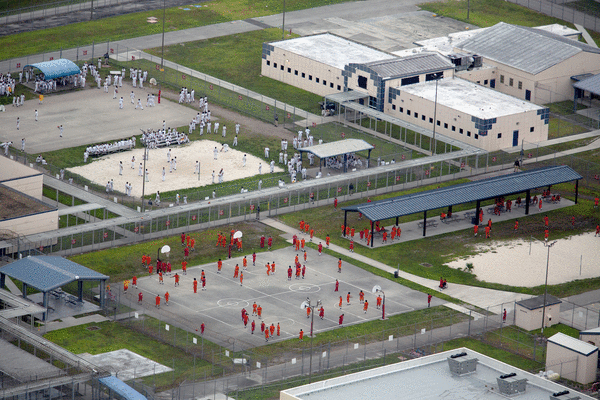
Quero Silva, 55, who came to South Florida with his family on a visa in 2016 and settled in Miramar, has been held at the Krome detention center in West Miami-Dade since he was picked up by Immigration and Customs Enforcement agents a year ago. He had overstayed his visa.
Judge orders his deportation
An immigration judge ordered his removal in November, refusing to hear his asylum bid because he was found to be a human rights violator, according to an ICE spokesman and his lawyer. He has appealed his removal, but the chances of a reversal are slim, meaning Quero Silva could be deported to Venezuelan before the plaintiffs ever confront him in federal court.
An attorney who represented him in the immigration court fired back at the lawsuit and its Venezuelan plaintiffs.
“After living lawfully in the United States for nearly eight years while awaiting his asylum interview ... he was arrested without grounds the day before his interview and placed into removal proceedings without any criminal charge or conviction,” his immigration lawyer, Eduardo Pereira, told the Miami Herald.
“The civil plaintiffs did not file suit during those eight years,” he said in a statement. “They did not file when he was detained. They filed only after an unsupported administrative ruling declared him ineligible for asylum ... because he had been a member of the Venezuelan National Guard.”
The attorney said Quero Silva has “consistently maintained that he never persecuted anyone and never authorized abuse. To the contrary, when he learned of misconduct, he castigated those responsible and sought to stop it,” leading to “death threats against him and his family.”
According to court records, Quero Silva is defending himself against the new federal lawsuit accusing him of torturing the protestors in Barquisimeto. Last month, he filed a motion to dismiss the case, saying he was not personally served at Krome, the allegations are “stale” and he’s “indigent.”
“Allowing this action to proceed would be fundamentally unfair and contrary to due process,” he wrote in the motion, claiming that he’s “not able to participate in his defense or appear in court” because of his detention at Krome.
‘They beat everyone who was captured’
In their suit, the five Venezuelans said they’ve been struggling for years to redress the notorious beatings that they and many others suffered at the Bolivarian National Guard headquarters in Barquisimeto in 2013 and 2014, turning to the federal court in Miami only after discovering that Quero Silva was living in South Florida.
Andres Colmenarez Farias, who was working as a sales manager at an auto parts store in Barquisimeto, had not been much of a political activist. But he recalled how terrible he felt after Maduro was declared the winner of the presidential election, believing his victory over opposition leader Henrique Capriles was rigged.
On April 15, 2013, Colmenarez marched with other protestors to the local office of the National Electoral Council, which oversees voting in Venezuela, and demanded a recount. At noon, the Bolivarian National Guard forces confronted them in the streets with armored trucks and tear gas. He returned home that evening with blood stains on his clothes.
The next day, Colmenarez joined the protestors again in the streets around the government’s election office, but were pushed back by national guard officers firing tear gas canisters. As he and about 50 others scattered, the national guard officers surrounded them. After a fight broke out, the officers arrested Colmenarez and many of the other protestors and held them at the national guard barracks called “Detachment 47.”
“That’s when I saw Quero Silva for the first time,” Colmenarez, who lives in Spain, told the Miami Herald in a recent interview. “He was the commander giving orders to the mid-level officers who gave instructions to the low-level guards to beat the protestors.
“They beat everyone who was captured — anyone who resisted,” he said, saying he witnessed male protestors being forced to take their clothes off and that female protestors were also being stripped before their hair was chopped off. He said the national guard officers also used electric shock on some of the protestors.
Colmenarez said during his detention on April 16, 2013, he was forced to kneel down and place his head between his legs while the officers hit his back and neck, kicking and stepping on him with their military boots. He was denied water, food, phone calls or other contact with family members.
After eight hours in detention, he was released after an exchange with a military doctor, who told him not to say anything. Colmenarez, 50, the father of two daughters, said he endured severe physical pain from the beatings but realized it would be futile to seek justice in Venezuela because of the repressive climate under Maduro. In 2018, he fled to Spain and founded a human rights advocacy group.
Colmenarez told the Herald that he was contacted that fall by the FBI, which wanted to talk with him about Quero Silva and the beatings at the national guard headquarters in Barquisimeto.
FBI probe
He immediately checked with another Venezuelan protestor, who had also been beaten, to inquire if he had heard about the FBI’s probe of Quero Silva. The colleague confirmed it, saying Quero Silva was in the Miami area. He also told Colmenarez that another victim of the beatings had seen the former military commander on the Spanish-language soap opera TV show.
“I’m not certain about when and how the FBI investigation began, but in November 2018 I gave them testimony at the U.S. Embassy in Madrid,” Colmenarez said, adding that he was never told about the outcome.
The FBI’s office in Miami did not respond to an inquiry about its investigation of Quero Silva. But he has not been charged with a crime in connection with the beatings of protestors at the national guard headquarters in Venezuela.
According to Immigration and Customs Enforcement, Quero Silva was arrested as an “illegal criminal alien from Venezuela” on Feb. 27, 2025 — after entering the United States on June 20, 2016, at Miami International Airport with “a temporary B-2 visa for pleasure.” But, ICE said, he “failed to depart and is in violation of the terms of his visa.”
After an immigration judge found in November that he “participated in human rights violations in Venezuela,” Quero Silva was ordered to be removed from the United States. While he has appealed that decision, he remains in custody at the Krome detention center, according to ICE.
A team of lawyers working pro bono on the Venezuelan plaintiffs’ torture case said the victims “have been subjected to unfathomable cruelties at the direction of Mr. Silva,” for voicing opposition to the “sham election results” in Venezuela and “overall repressive conduct by Maduro and his military.”
“This lawsuit is an effort by our clients to seek some semblance of balance, holding Mr. Silva accountable and ensuring that the memory of his actions don’t now evaporate as he amazingly attempts to set up shop in the U.S.,” according to a statement provided by attorneys Ben Curtis and Kelly Shami with the Miami law firm McDermott Will & Schulte and attorney Madelaine G. Altman with The Guernica37 Centre for International Justice in San Francisco.
“We just hope that the U.S. government will not deport him before our clients first have had an in-person opportunity to confront him and obtain justice,” they said.
A seasoned immigration lawyer who is not involved in the case said Quero Silva cannot be deported by U.S. authorities while he challenges his removal order to the Bureau of Immigration Appeals. And if he fails there, the former Venezuelan military commander could appeal the final order to the federal courts.
“In simple terms, Silva should not be going anywhere until his appeal is resolved,” said Miami-based immigration attorney Regina de Moraes. “But ICE can send him to different detention facilities, anywhere in the United States. He does not have to remain at Krome.” De Moraes said that in the meantime, the attorneys for the Venezuelan plaintiffs could file a stay of deportation with ICE, putting a hold on his removal until the civil torture case is over: “If Quero Silva’s appeal is dismissed, ICE would keep Silva in the U.S. during the period of the stay provided the agency grants it.”
©2026 Miami Herald. Visit at miamiherald.com. Distributed by Tribune Content Agency, LLC.





Comments