Opposition leader Guanipa back in custody hours after release in Venezuela crackdown
Published in News & Features
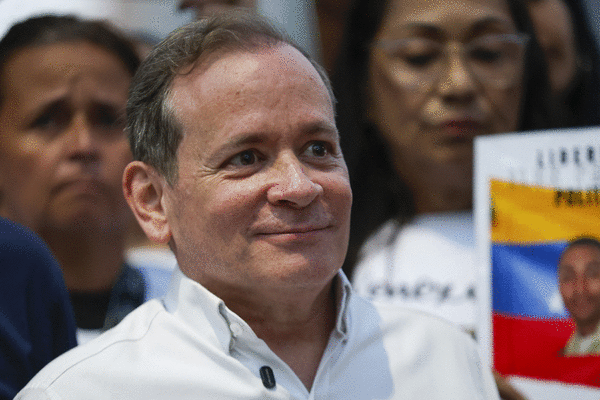
Juan Pablo Guanipa, one of the highest-ranking Venezuelan opposition leaders still behind bars, spent less than 12 hours free before being taken back into custody on Monday, casting fresh doubt on the interim government’s pledge to free political prisoners under a forthcoming amnesty law.
Guanipa’s re-arrest came after he spent part of his brief release traveling through Caracas in a motorcycle caravan alongside fellow activists, visiting detention centers and meeting with relatives of political prisoners. The public display of defiance, which included calls for the release of those still jailed, was later cited by authorities as a violation of the conditions imposed on his release.
The re-arrest came just hours after his release on Sunday, which had been widely interpreted as a key signal ahead of a proposed general amnesty law expected to be debated this week by Venezuela’s National Assembly. The legislation, promoted by interim President Delcy Rodríguez, is supposed to lead to the release of all political prisoners.
The opposition leader’s new detention was initially denounced as a “kidnapping” by María Corina Machado, Venezuela’s main opposition figure and the 2025 Nobel Peace Prize laureate. Machado said heavily armed men in civilian clothing seized Guanipa overnight and took him away in four unmarked vehicles. “We demand his immediate release,” Machado wrote on X.
Hours later, Venezuela’s Public Prosecutor’s Office confirmed that it had requested a court to revoke Guanipa’s release, alleging that he had violated the conditions imposed by the judiciary. Authorities said Guanipa will be transferred to a regime of house arrest.
“The precautionary measures ordered by the courts are conditioned on strict compliance with the obligations imposed,” the prosecutor’s office said in a statement.
A fleeting release
Guanipa had been released Sunday afternoon after being detained since May 2025, accused by authorities of participating in an alleged conspiracy linked to elections for governors and members of parliament.
During his brief time outside prison, Guanipa toured Caracas on a motorcycle and led a caravan of activists to several detention centers, where they met with relatives of political prisoners and demanded their release. Images of the caravan spread rapidly on social media and were seen by opposition supporters as a sign that political space might be reopening.
The human-rights organization Foro Penal, which tracks political detentions in Venezuela, verified at least 35 new releases on Sunday. According to the group, nearly 400 political prisoners have been freed since Jan. 8, when Rodríguez announced the first phase of releases shortly after assuming power following the U.S. military operation that led to the capture of Nicolás Maduro.
Guanipa’s release had been particularly significant because he was one of the most prominent opposition figures still incarcerated and a close ally of Machado. Guanipa’s son, Ramón Guanipa, said a group of about 10 unidentified individuals intercepted his father. The family demanded proof that he was still alive.
“I hold the regime responsible for anything that happens to my father. Enough with the repression,” he wrote on X. Machado had earlier celebrated the releases announced over the weekend. “Very soon we will meet again and embrace in a free Venezuela, and we will thank these heroes for everything they have given to make Venezuela the country we deserve,” she said in an audio message posted online.
Machado left Venezuela in December to receive the Nobel Peace Prize in Oslo after spending more than a year in hiding. She has repeatedly denounced fraud in the 2024 presidential election, which gave Maduro a third term — a result the opposition says does not reflect the will of voters.
A key opposition figure
In Miami, members of the Venezuelan community warned that Guanipa’s re-arrest is a clear indication of how shallow the regime’s reconciliation efforts really are.
“This is not an isolated incident or a ‘mistake’: it is clear proof that political repression in Venezuela has not ceased, but has instead intensified under new forms of intimidation and control. The regime continues to use arbitrary detention, violations of due process, and the simulation of gestures of openness to mislead the international community, while keeping its repressive apparatus fully intact,” José Antonio Colina, president of the Miami-based Venezuelan exile organization Veppex, said in a press release.
Guanipa served as vice president of Venezuela’s National Assembly and was elected governor of Zulia state, the country’s main oil-producing region. He was removed from office in 2017 after refusing to swear allegiance to a pro-Maduro Constituent Assembly that assumed legislative powers from the opposition-controlled parliament.
His last public appearance before his arrest was on Jan. 9, 2025, when he accompanied Machado at a rally opposing Maduro’s inauguration.
Speaking to Agence France-Presse shortly after his release, Guanipa said Venezuela’s political crisis must be resolved by respecting the popular vote. “On July 28, 2024, the people made a decision. Are we going to respect it? Then let’s respect it. If not, then we need an electoral process,” he said.
Amnesty under scrutiny
The opposition party Alianza Bravo Pueblo, founded by former Caracas mayor Antonio Ledezma, condemned what it described as Guanipa’s “repeated kidnapping” and sharply criticized the amnesty law being promoted by the interim government.
In a statement titled “The amnesty dies before it is born: the chaos of a dying tyranny,” the party accused authorities of using repressive laws to give a “veneer of legality” to political persecution.
“There is no normality in kidnapping. There is no peace in injustice,” the statement said, arguing that the detention reflects desperation within the government.
Other Machado allies were also released on Sunday under strict conditions, including her legal adviser Perkins Rocha and opposition activist Freddy Superlano. Local media reported a constant police presence outside their homes in Caracas.
Guanipa’s renewed detention has deepened skepticism over the credibility of the amnesty process and reinforced opposition claims that legal guarantees remain fragile in Venezuela, even as the interim government seeks international support for a political transition after years of repression, economic collapse and diplomatic isolation.
©2026 Miami Herald. Visit at miamiherald.com. Distributed by Tribune Content Agency, LLC.




Comments